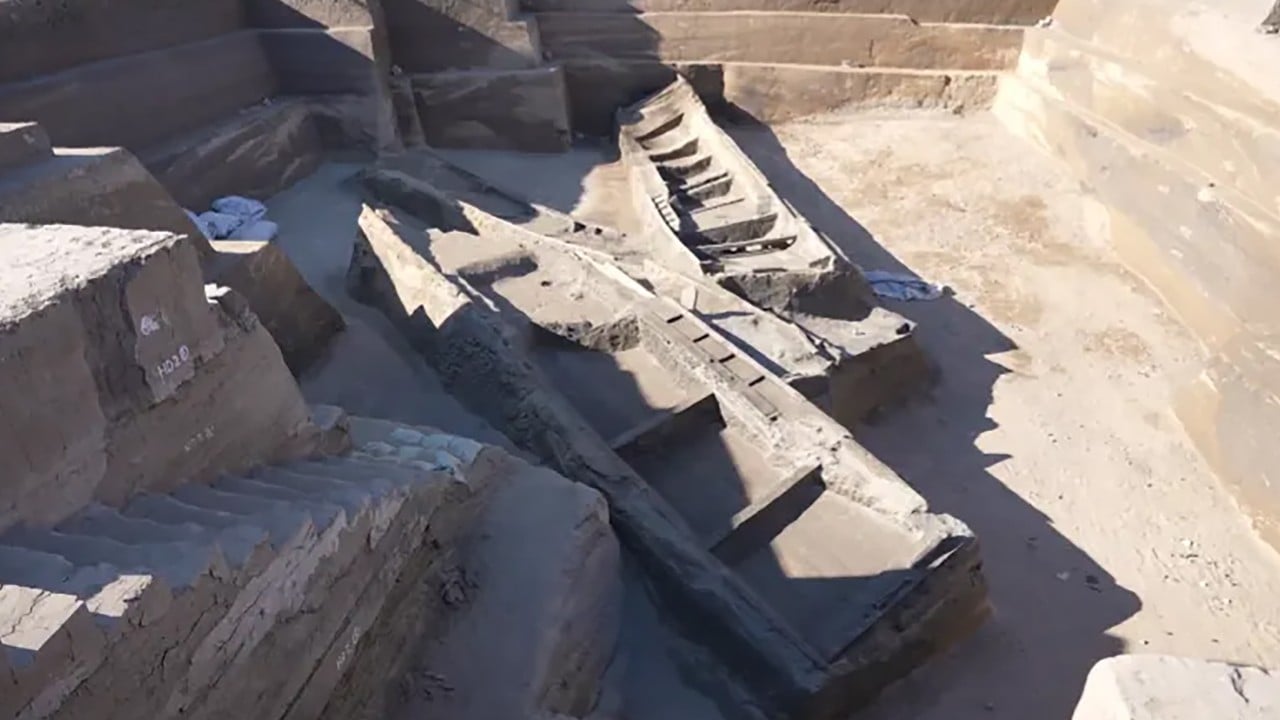
Buried seven meters beneath the concrete and glass of modern Beijing lies a quiet contradiction. Most people think of ancient northern capitals as landlocked hubs of cavalry patrols, dusty imperial courts, and massive brick walls. You picture horses galloping across arid plains, not grand commercial fleets navigating busy rivers.
That mental picture just took a massive hit.
Archaeologists digging in Beijing's Fengtai district pulled up three remarkably preserved wooden boats dating back roughly 1,800 years. Unearthed from an ancient channel of the Yongding River, these vessels represent the largest and most structurally intact inland water transport ships ever discovered in northern China. They date back to the Han-Jin period, spanning the late Han Dynasty, the Three Kingdoms era, and the early Jin Dynasty.
If you want to understand how early states handled logistics, state-run grain transport, and long-distance trade, you have to look right at these muddy planks.
The Logistics Blueprint of Antiquity
Let's talk about why these ships matter beyond just being old wood. Finding a sunken boat is cool, but finding a state-sanctioned fleet is entirely different.
Researchers spotted a stamped Chinese character, "guan", meaning "official," pressed directly onto the hollow beams of the bulkheads. This stamp changes everything. It proves these weren't random fishing skiffs or private merchant canoes. They were part of an official government logistics and grain transport network operating in the heart of what is now China's capital.
The ships are massive by regional standards, utilizing complex mortise-and-tenon joinery reinforced with wooden pegs. This composite structure allowed the hulls to withstand heavy cargo loads against strong river currents. Archaeologists also unearthed two human skulls and quantities of animal bones around the wrecks, suggesting the vessels likely gathered in a river bend for repairs before a sudden flood buried them beneath meters of silt.
The Mediterranean Connection You Did Not Expect
Here is where the archaeology gets genuinely fascinating. When experts analyzed the construction methods of these 1,800-year-old Beijing vessels, they noticed specific joinery patterns that look remarkably similar to ancient Mediterranean shipbuilding techniques of the Roman era.
East and West often get treated as isolated bubbles in ancient history textbooks. We learn about the Silk Road as a land route, picturing camel caravans crossing deserts. We forget that maritime trade and regional watercraft innovations often shared surprising technological DNA. While direct direct-line contact between Roman shipwrights and northern Chinese inland builders is still debated, the structural parallels in joining heavy timbers point to parallel engineering solutions—or broader technological diffusion across Eurasia than traditional histories admit.
When you dig into the data, ancient empires solved similar structural problems with striking ingenuity. Both Roman Mediterranean shipbuilders and Han Dynasty engineers pushed the limits of timber engineering to move heavy bulk goods across vast distances.
What Most People Get Wrong About Ancient Beijing
People assume Beijing only became important later, during the Yuan, Ming, and Qing dynasties, when grand canal systems and imperial palaces defined the landscape.
The Fengtai discoveries prove that the geography of northern China supported major navigable waterways much earlier than popular history suggests. The ancient Yongding River was a vital artery connecting the region to the Central Plains. Long before modern skyscrapers dominated the skyline, goods, grain, and government orders moved by water right through the modern metropolitan footprint.
You're looking at physical evidence of an active, highly organized shipping industry in a landscape that modern urban planners spent decades paving over.
Moving Forward With Ancient Discoveries
Protecting fragile relics buried seven meters underground requires extreme care. Archaeologists didn't just pull these boats out with cranes. They deployed internal steel frame supports and monolithic lifting techniques to extract the massive wooden hulls in one piece without destroying the ancient joinery.
These vessels are now headed to specialized laboratories for deep conservation, cleaning, and material analysis. Every inch of surviving timber will undergo scrutiny to unlock more secrets about ancient forestry, timber sourcing, and regional climate conditions 1,800 years ago.
History isn't just written in old books. Sometimes it's preserved in the mud, waiting for a construction crew or an archaeologist to rewrite what we thought we knew.