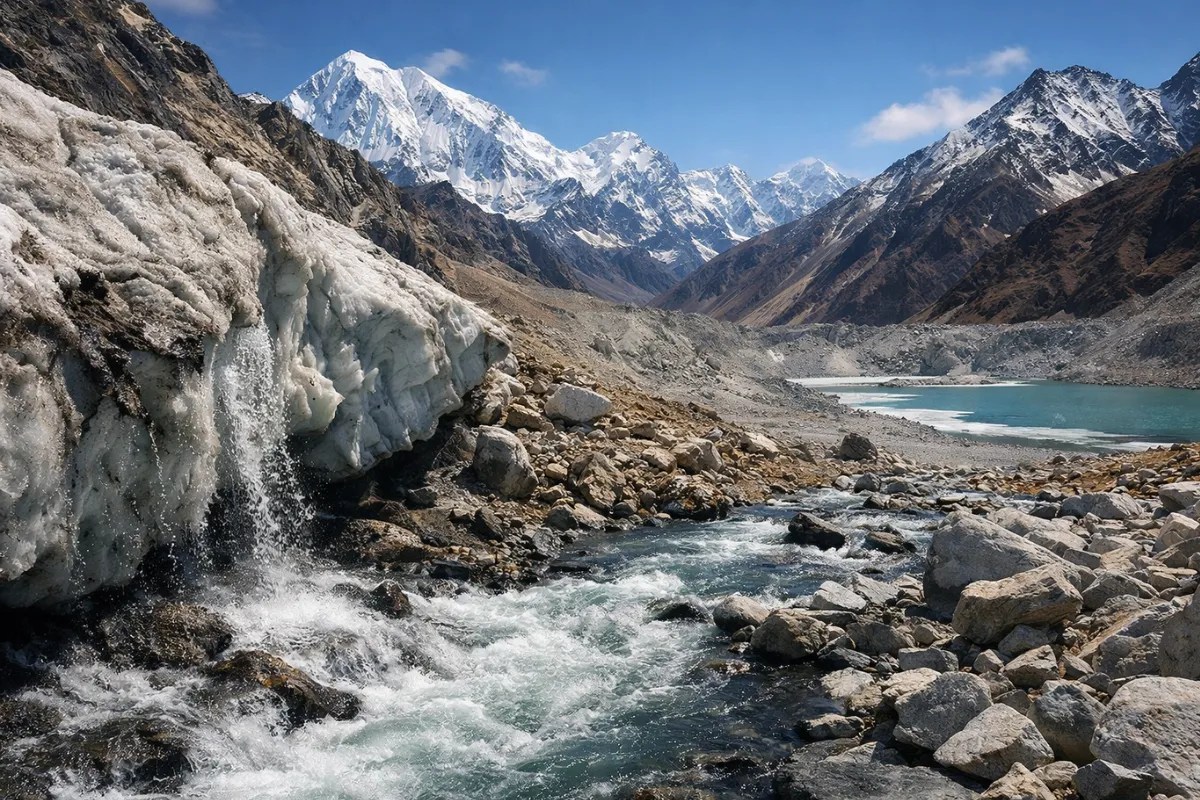
Mountains look permanent. They aren't. When a massive wall of ice and rock lets go, it doesn't just slide—it liquefies into a deadly avalanche that races down valleys at highway speeds. We tend to focus on earthquakes and hurricanes, but high-altitude glacial collapses carry a silent, hyper-destructive force that erases entire towns in minutes.
Look back at May 31, 1970. A magnitude 7.9 earthquake struck off the coast of Peru, shaking the majestic Mount Huascarán in the Cordillera Blanca. That violent jolt sheared off a colossal chunk of glacial ice and granite from the mountain's northern wall. Within seconds, millions of tons of debris plummeted downward.
The mass picked up speed, melting ice, mud, and boulders as it rushed down the slopes. It reached an astonishing velocity of over 300 kilometers per hour. In less than four minutes, it covered roughly fifteen kilometers. Its targets were the towns of Yungay and Ranrahirca.
Yungay didn't just experience damage; it was completely buried. An estimated 25,000 people lost their lives in Yungay alone, with thousands more casualties across the wider disaster zone. Only a handful of people survived because they happened to be standing on elevated ground in the local cemetery or inside a stadium. The rest of the town vanished under meters of gray mud and stone.
This wasn't an isolated anomaly. Just a few decades earlier, in 1941, a glacial lake outburst flood smashed into the Peruvian city of Huaraz. A massive block of ice crashed into Lake Palcacocha, triggering a catastrophic wave that overtopped the natural moraine dam. Water, ice, and mud tore through the heart of Huaraz, wiping out roughly a third of the city and killing around 5,000 residents.
Then came 1962, when Huascarán struck again. Another massive ice avalanche roared down, destroying the village of Ranrahirca and several neighboring hamlets in under seven minutes. Nearly 4,000 people died in that event. These repeated tragedies in the Peruvian Andes exposed a terrifying reality: glaciers hold immense destructive potential long before modern climate change accelerated their retreat.
Fast forward to today, and these historical warnings feel intensely relevant. Recent catastrophic floods along the Tibet-Nepal border and the devastating 2021 Chamoli disaster in India's Uttarakhand region prove that high-mountain hazards are only escalating. In Chamoli, a rock and ice avalanche triggered a flash flood that destroyed two major hydroelectric projects and killed over 200 people.
When you combine accelerating glacial melt with unbridled infrastructure development in fragile mountain gorges, disaster becomes a matter of when, not if. Early warning systems, continuous monitoring of glacial lakes, and stricter zoning laws aren't optional bureaucratic checks—they're the only things standing between mountain settlements and total annihilation.