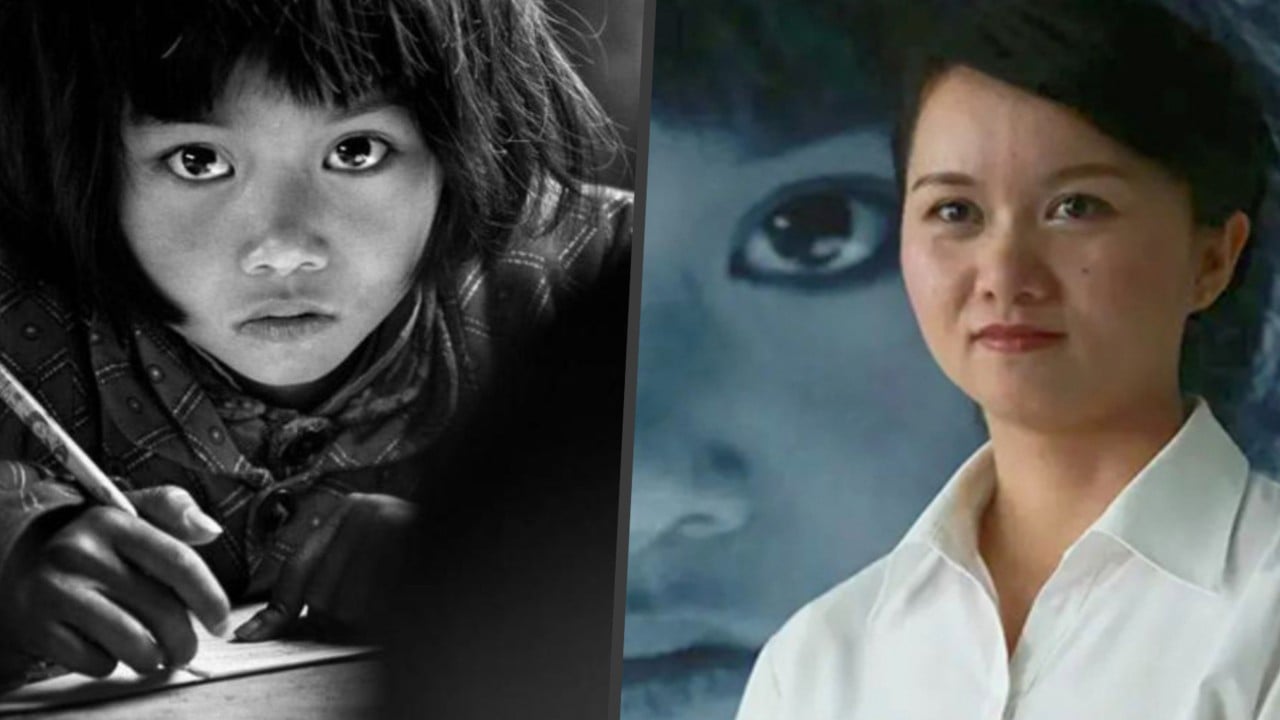
A single frame of film captured in an Anhui province classroom back in 1991 changed millions of lives. You have probably seen it. An eight-year-old girl holding a pencil, her massive, wide-open eyes staring directly into the camera lens with a mixture of raw innocence and absolute desperation to learn.
That picture, officially titled "I Want to Go to School" but universally known as "Big Eyes", didn't just document poverty. It weaponized empathy. It became the visual anchor for Project Hope, an initiative that transformed rural education across China. But the real story isn't just about a famous black-and-white portrait. It is about what happens when an accidental symbol grows up and spends the rest of her life paying it forward.
The Man Behind the Lens and the Reality of Rural Classrooms
Photojournalist Xie Hailong didn't stumble into that classroom by accident. He spent years traveling across dozens of provinces and hundreds of counties, documenting the staggering drop-out rates in China's impoverished mountainous regions. Schools back then frequently meant crumbling ancestral temples with plastic sheets or holes instead of glass windows.
When Xie snapped Su Mingjuan's picture inside her primary school in Jinzhai County, he caught a universal truth. Her family was struggling to scrape together tuition fees that cost roughly 60 to 70 yuan per term—around nine to ten US dollars. To most city dwellers, that amount was pocket change. To a farming family in rural Anhui, it was the difference between sending a child to class and keeping them home to work the fields.
If that photo hadn't been taken, Su admits she likely would have dropped out within months. Instead, the image went viral in the truest pre-internet sense. It landed on billboards, magazine covers, and national newspapers.
How One Image Built an Empire of Schools
The timing of the photo coincided with the rollout of Project Hope, launched in 1989 by the China Youth Development Foundation. The initiative needed a face, and those intense, yearning eyes provided the exact emotional resonance required to move a nation.
The numbers tell an astonishing story of collective impact:
- Donations soared past 25 billion yuan, translating to roughly 3.7 billion US dollars.
- More than 21,000 rural schools were constructed or heavily renovated.
- Over 7.8 million underprivileged students received direct financial support to stay in the classroom.
Critics sometimes dismiss charity campaigns as fleeting emotional spectacles. Yet, Project Hope built lasting physical infrastructure. The drafty ancestral temples gave way to multi-story concrete buildings equipped with modern learning tools. Su's own school underwent a radical upgrade, replacing dirt floors and broken windows with functional classrooms.
Living in the Shadow of the Lens
Becoming a national icon overnight isn't easy for an eight-year-old. Su suddenly found her mailbox stuffed with letters from strangers across the country. Well-wishers showed up in her village, sending donations that completely covered her educational expenses through university.
She felt overwhelmed at first. The pressure to represent every struggling student in the country weighed heavily on her shoulders. She could have faded into the background once she graduated, enjoying the quiet life afforded by a stable banking career. She didn't.
Instead, Su chose a life of continuous reciprocity. She began donating a portion of her own money to younger students back when she was still in junior high. In 2006, she teamed up with photographer Xie Hailong to auction the copyright for the "Big Eyes" image, netting 300,000 yuan (about 45,000 US dollars) to fund a brand new school in a remote Tibetan area.
Her philanthropic footprint expanded further in 2018 when she established her own educational foundation. Over a six-year span, that fund pulled in roughly 10 million yuan, financing five more rural schools.
Moving From Poster Girl to Policy Maker
Charity is one thing, but systemic change requires institutional muscle. Su climbed the ranks professionally, taking a full-time role as a secretary for the Youth League Committee at a major bank in Anhui. Her journey came full circle when she was selected as a delegate to the 20th National Congress of the Communist Party of China.
Standing on a national political stage, she wasn't just the girl with the big eyes anymore. She was an active policymaker shaping the future of youth development.
People often ask why this specific photo still matters over three decades later. The answer is simple. Educational equity remains a moving target globally. Even as modern classrooms swap chalkboards for artificial intelligence tablets, the core divide between rural access and urban privilege persists in developing economies everywhere.
Su's story proves that a single snapshot can mobilize billions of dollars, but human dedication keeps those schools running long after the camera crew leaves. Stop looking at historical photos as mere relics of the past. Look at them as blueprints for what ordinary people can achieve when they refuse to let talent go to waste.


