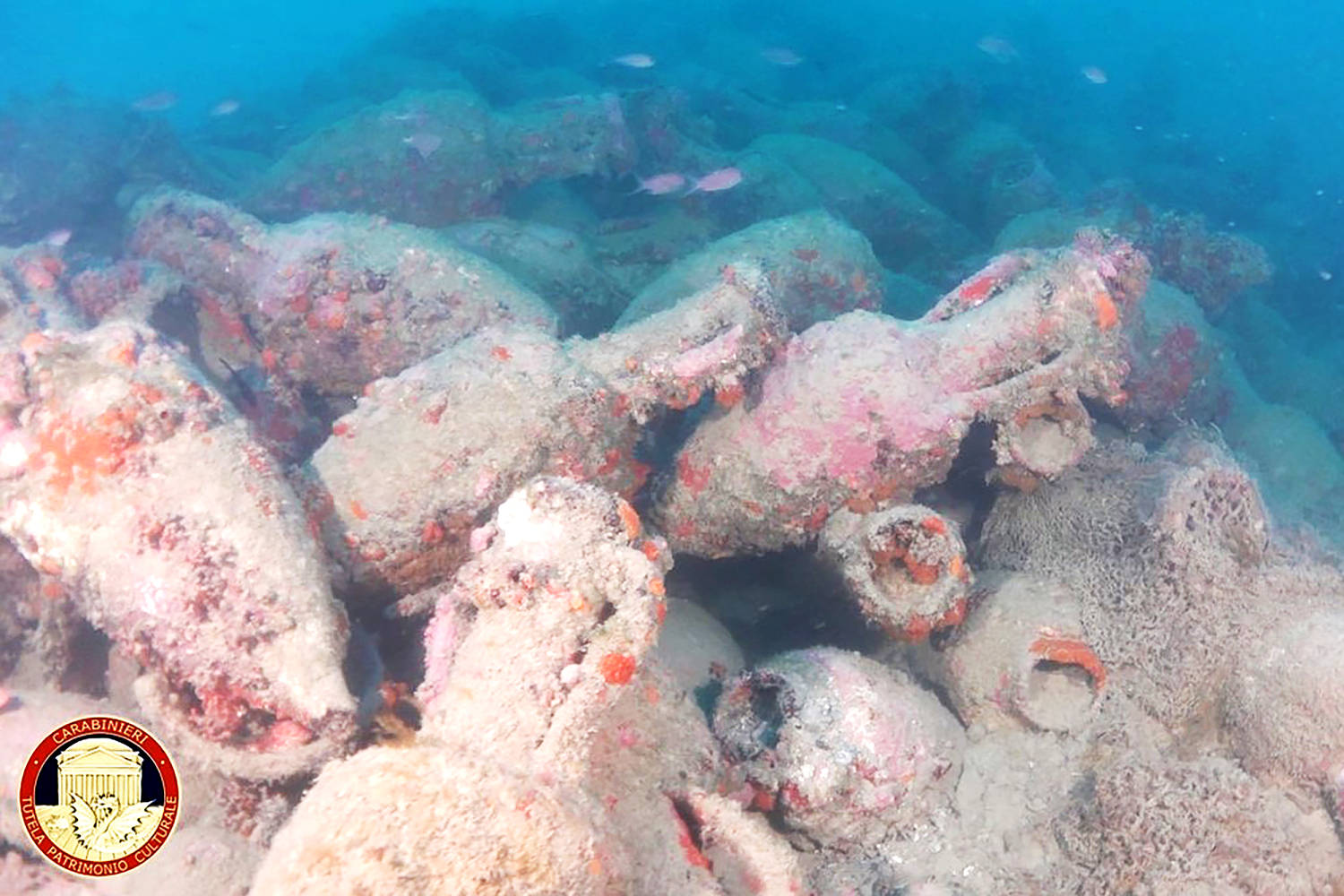
You won't find this kind of history in a standard textbook. Divers off the coast of Sicily recently stumbled upon a 2,100-year-old ancient Roman shipwreck that completely redefines what we know about Mediterranean trade routes.
Sitting 46 meters down near Mazara del Vallo, this vessel isn't just a pile of rotting wood. It is an intact time capsule.
What Actually Happened at the Site
Free divers Giacomo De Mola and Igor Bisulli were out on the water when their sonar picked up an irregular shape. Most people would have kept driving. They didn't.
De Mola dove down expecting a boring sea boulder. Instead, he found an ocean floor blanketed by hundreds of clay containers.
Italy's culture ministry, led by Alessandro Giuli, quickly classified the find as one of the most vital underwater archaeology breakthroughs of recent decades. The ship measures roughly 21 meters long by 6 meters wide. It dates back to the second or first century BC.
The Cargo That Tells the Real Story
Cargo matters. This ship was packed to the brim with roughly 500 amphorae.
These aren't random pots. They are primarily Dressel 1A type amphorae. Ancient merchants used these specific heavy clay jugs to haul massive quantities of regional wine across the sea.
Finding them stacked nearly two meters high gives researchers a clear look into the logistics of the ancient Roman economy:
- The specific pottery style maps out exact trade corridors between mainland Italy and external Mediterranean ports.
- Lead anchor stocks found alongside the hull show precise manufacturing and ship-stabilization techniques of the era.
- The sheer volume confirms that commercial wine shipping wasn't a localized cottage industry—it was a high-capacity industrial machine.
Why This Discovery Matters Right Now
Underwater archaeology is changing. We aren't relying purely on blind luck or multi-million-dollar institutional expeditions anymore. Local divers, fishermen, and citizen scientists are doing the heavy lifting.
When a fisherman drops a tip to the Carabinieri Art Squad—Italy's specialized cultural heritage police—history gets saved from looters. The Mediterranean seabed is basically a massive museum floor. Unfortunately, it's also a target for illegal artifact traffickers.
If you plan on diving off the coast of Sicily or anywhere else in the Mediterranean, know the local laws. Reporting unusual seafloor structures to groups like the Sicilian Regional Superintendency of the Sea preserves heritage instead of destroying it.
Support marine conservation efforts. Respect restricted archaeological zones. Let the professionals handle the excavation so history stays intact for the next generation.