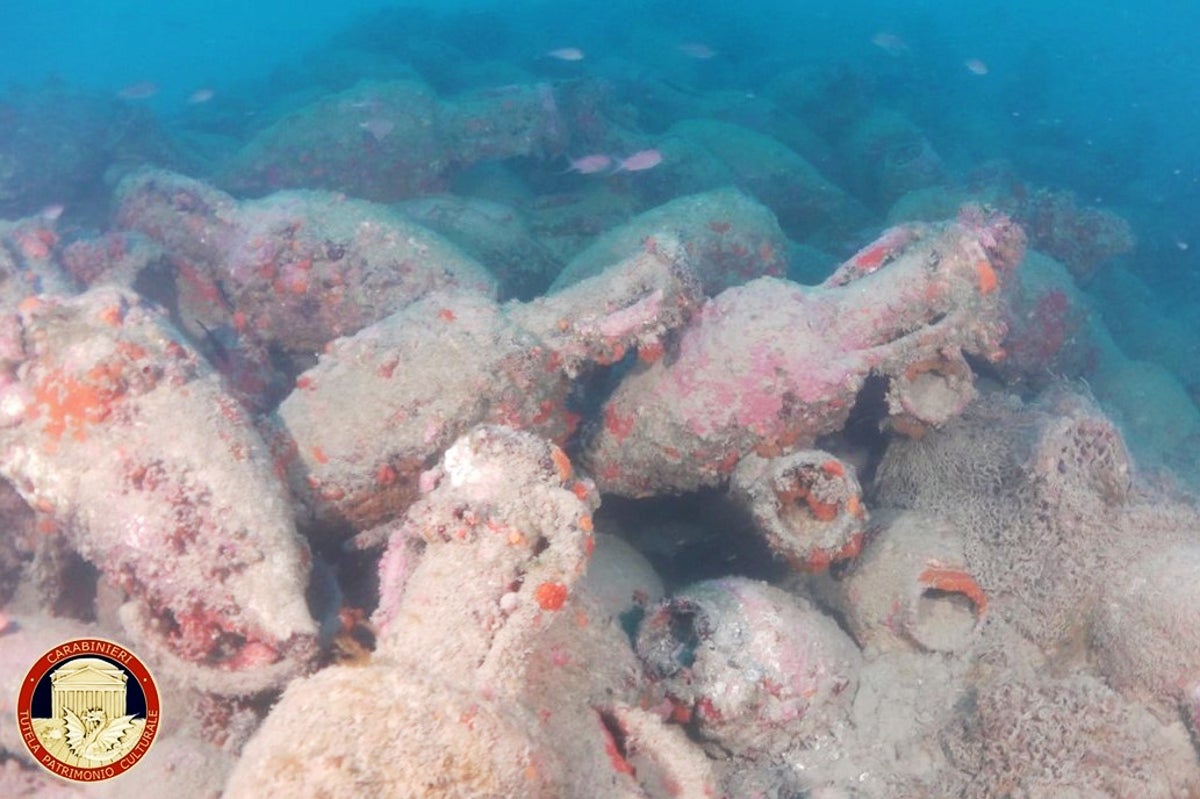
You won't believe what's resting 46 meters down off the Sicilian coast. Divers just stumbled upon a 2,100-year-old Roman merchant vessel packed with hundreds of perfectly preserved wine containers.
Italy's Culture Minister Alessandro Giuli calls it one of the most important underwater archaeological finds of recent years. But what does it actually mean for history? Let's break it down.
What Hunters Found on the Seabed
The ship rests roughly three nautical miles off Mazara del Vallo. It measures about 21 meters long and 6 meters wide.
Local divers, acting on a tip-off from fishermen, investigated an unusual reading on their sonar scanners. What they found blew their minds.
- Hundreds of Dressel 1A amphorae scattered across the ocean floor.
- Rare lead anchor stocks preserved in the silt.
- A remarkably intact hull structure dating back to the late Roman Republic.
Giacomo De Mola, one of the divers who first spotted the site, described looking down through murky water only to find a vast expanse of ancient clay jars stretching into the dark.
The Mystery of the Dressel 1A Amphorae
Why do archaeologists care so much about these jars? Because they're time capsules.
Dressel 1A containers were the heavy-duty shipping crates of the ancient Mediterranean. Producers manufactured them mainly along the Tyrrhenian coast of Italy, specifically between Etruria and Campania.
Merchants used these thick-walled ceramic vessels to haul massive amounts of wine across treacherous sea lanes. Finding them grouped together gives researchers a direct blueprint of late Republican trade routes, economics, and shipping logistics.
Why Sicily Keeps Rewriting History
Sicily is basically a giant museum waiting at the bottom of the sea. As the first major province conquered by Rome, it served as the core transit hub for goods moving across the Mediterranean.
Ships constantly sank here due to sudden storms, rocky shoals, and heavy traffic. Every time authorities pull artifacts from sites like this, we learn more about how ancient supply chains operated under extreme conditions.
You're looking at a physical snapshot of a ship that went down sometime between the 2nd and 1st centuries BC. It didn't reach its port. It stayed right where it hit the sand.
What Happens Next to the Wreck
The Carabinieri Command for the Protection of Cultural Heritage has locked down the site. Joint teams from Palermo, the Soprintendenza del Mare of the Sicilian Region, and marine units are mapping the debris field.
Recovery operations take time. Divers must document every single artifact in place before hauling anything to the surface. Otherwise, crucial context disappears forever.
If you want to track the science, keep an eye on upcoming bulletins from Italy's Ministry of Culture. They're planning detailed recovery phases and scientific analysis of the remaining organic matter inside those ancient jars.