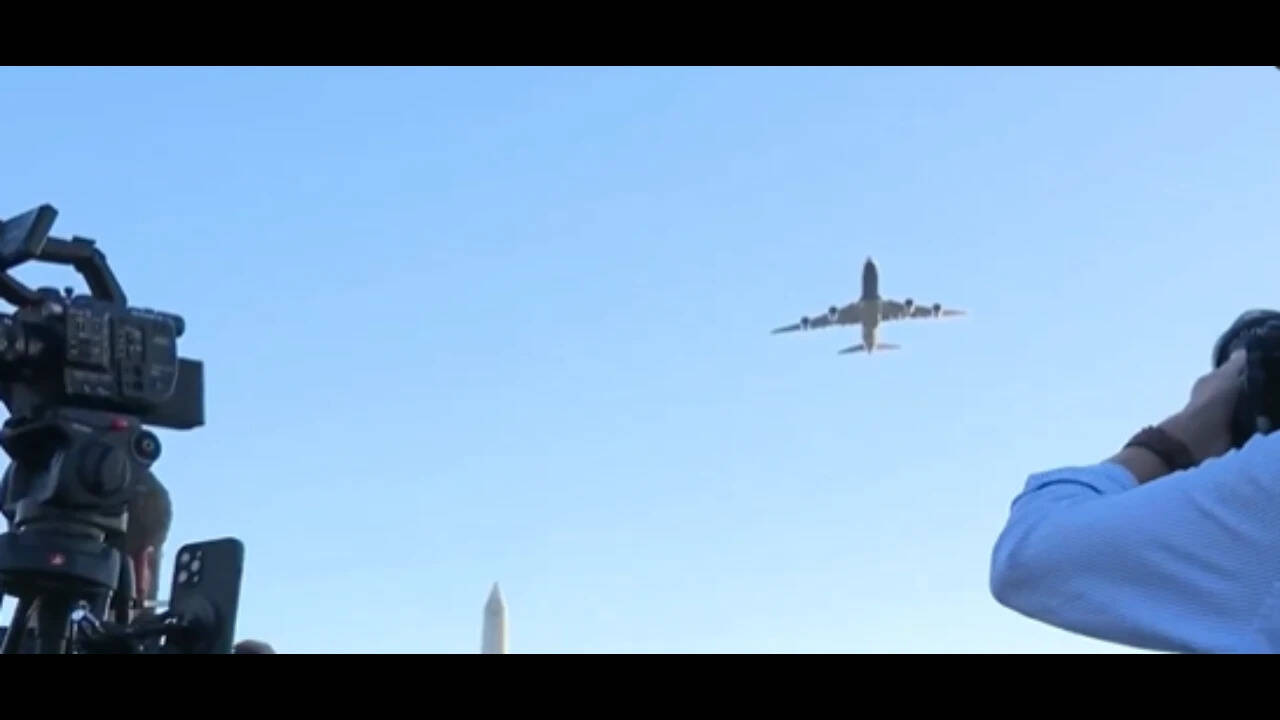
Imagine standing on a downtown Washington street on a Thursday evening, minding your own business, when a massive Boeing 747 roars overhead at dangerously low altitudes. That is exactly what happened to residents, tourists, and local workers when an unannounced presidential stunt turned a festive evening into a scene of genuine panic.
President Donald Trump decided to give trick-or-treaters and guests at a White House Halloween celebration an aerial surprise. While the administration posted upbeat videos boasting about an "epic" flyover, the reality on the ground looked completely different. People dialed 911, commuters froze, and air traffic control audio caught frustrated workers dealing with the fallout.
Why a Low-Altitude Boeing 747 Triggered Real Fear
The primary reason this stunt caused widespread anxiety comes down to geography and history. Washington, D.C. airspace is among the most heavily restricted and closely monitored zones on the planet. When a giant aircraft dips low over the city with very little public warning, instinct takes over.
Many residents and office workers immediately recalled the trauma of September 11, 2001, when American Airlines Flight 77 struck the nearby Pentagon. Giving people roughly fifteen minutes of notice via local alert channels simply wasn't enough to prevent sheer shock. Social media quickly filled with panicked reactions from people who genuinely thought an emergency or an attack was underway.
Local leaders didn't hold back their frustration either. The D.C. Council issued a public statement pointing out that the abrupt maneuver startled locals, public safety officials, and visitors alike. When you drop a low-flying commercial-sized jet into a populated urban center without robust advance communication, panic is an entirely predictable outcome.
The Ripple Effect on National Airspace and Flight Delays
The disruption extended far beyond frightened pedestrians looking up at the sky. Commercial aviation took an immediate hit. National Airport and surrounding airspace faced temporary holds and tight restrictions to accommodate the presidential passes.
Flight-tracking data showed that the disruption triggered cascading delays across regional arrivals and departures. Pilots flying into the capital region expressed disbelief over the short window they had to manage the altered traffic patterns. Air traffic control logs captured a tired exchange where a pilot asked how many more passes were planned, only to hear a controller respond with a weary hope that it was the final one.
Airlines reported having less than an hour of formal notice before the maneuver disrupted standard routing. Passengers sat trapped on tarmac planes forced to circle or wait out the ground stops, turning a simple holiday evening into a logistical headache for thousands of travelers.
Protocol Versus Optics
The Federal Aviation Administration defended the event by noting that the flight had gone through standard coordination channels and followed established safety protocols. From a technical standpoint, the flight was authorized.
Yet, public relations and public safety are two entirely different beasts. Trump has always loved theatrical displays involving Air Force One, frequently utilizing dramatic flybys during major public rallies and sporting events. Transporting that exact brand of political theater directly into the dense, anxiety-sensitive urban core of the nation's capital crossed a line for many local officials.
When official protocols prioritize spectacle over clear, widespread community communication, the public bears the emotional cost. Residents shouldn't have to guess whether a roaring jet engine overhead is a presidential photo-op or a national security crisis.
Clearer communication channels and longer lead times are absolute necessities if the executive branch wants to pull off aerial stunts in crowded metropolitan skies without terrifying the very people living underneath them.