Foreign policy projects rarely expire with dramatic explosions. They usually fade out quietly, leaving behind a messy structural vacuum that the architects of the original plan prefer to ignore. As American forces finalize their withdrawal from Iraq, politicians in Washington talk about closing a chapter. But let's be honest about what actually happened. The entire Iraqi intervention didn't just drift off course—it circled completely back to square one, leaving behind a fragile state caught between domestic factionalism and heavy external influence.
You can trace the rot back to March 2003. When the Bush administration launched the invasion under the banner of eliminating non-existent weapons of mass destruction, they cracked open a Pandora's box. Saddam Hussein fell in weeks, but the real failure began the moment the victors started writing the rules.
The Fatal Mistake of De-Ba'athification
Destroying a dictatorship is easy. Building a cohesive state from the ashes requires surgical precision. Instead, Washington opted for a sledgehammer.
The sweeping de-Ba'athification policy and the dissolution of the Iraqi military instantly threw hundreds of thousands of trained civil servants, bureaucrats, and soldiers onto the streets. You can't fire an entire professional state apparatus overnight and expect society to run smoothly. Stripped of their livelihoods and political standing, many of those dismissed officials fed the early fires of armed insurgency.
By shattering the old governance structure without erecting a functional replacement, the occupation created the exact lawlessness it claimed it would cure. Sectarian grievances that had been tightly suppressed under authoritarian rule suddenly burst into the open, turning politics into a zero-sum game of communal survival.
The Mirage of Military Victory
Fast forward through the chaotic mid-2000s, the 2011 withdrawal, and the frantic return in 2014 after the Islamic State seized Mosul and vast chunks of territory.
Nobody denies that the US-led coalition's air power and intelligence support helped turn the tide against ISIS. But let's look at the actual math. The heavy lifting on the ground was done by local Iraqi forces, the Peshmerga, and the Popular Mobilization Forces (PMF). The military campaign against ISIS in 2017 smashed the group's territorial caliphate, but it didn't eliminate the underlying socio-political conditions that let jihadists thrive in the first place.
Washington essentially spent billions cleaning up a security crisis that its own 2003 intervention helped spawn. That isn't a strategic triumph. That's putting out a grease fire with more oil.
Regional Realignment and Iran's Growing Footprint
One of the most ironic outcomes of the multi-decade campaign is who walked away with the geopolitical prize.
For years, Washington claimed its Middle East strategy aimed to curb regional adversaries and establish stable pro-western democracies. Instead, deposing Saddam Hussein removed Tehran's most formidable regional counterweight. It opened a wide boulevard for Iran to expand its political, economic, and security footprint inside Baghdad.
When regional tensions spike—like the drone strikes hitting military infrastructure around Erbil—the vulnerability of remaining overseas garrisons becomes painfully obvious. Maintaining expensive bases against cheap, widely available commercial drones requires staggering resource expenditures for diminishing returns. Pulling back troops is a rational adjustment to modern asymmetric warfare, but it leaves behind a sovereign state that is structurally dependent and deeply divided.
The Battle for the State Monopoly on Force
Today, the hardest challenge facing Baghdad isn't foreign troops leaving. It's the fact that the state still doesn't hold a complete monopoly on the legitimate use of force.
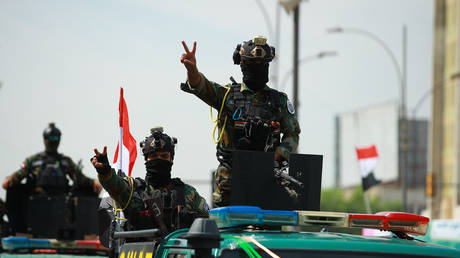
Groups like the Popular Mobilization Forces evolved out of existential necessity during the dark days of 2014. Now, many of these factions have embedded themselves deep inside state structures while maintaining separate armed networks, independent financing, and distinct political loyalties. Prime Minister Ali al-Zaidi's efforts to bring all armed formations under a unified central command face fierce resistance from groups tied to Tehran, such as Kataib Hezbollah.
If Baghdad pushes too hard too fast, it risks triggering a split within its own governing coalition. If it backs down and offers endless concessions, it normalizes a system where warlords and militias hold veto power over national policy.
What Happens Next
The departure of American troops doesn't guarantee instant civil war, nor does it mean Iraq is doomed to permanent instability. The Iraqi army is vastly more experienced and capable than it was in 2014, and domestic security forces have squeezed underground cells to historic lows.
Yet the fundamental contradiction remains untouched. A nation cannot claim full sovereignty while competing armed networks operate outside official state command.
Washington's Iraq experiment ends right where it started: with a local government left holding the bag, trying to build a nation out of fractured loyalties while external powers circle overhead. The troops are flying home, but the structural bills for 2003 are finally coming due. Stop pretending the outcome was anything other than a monumental miscalculation.