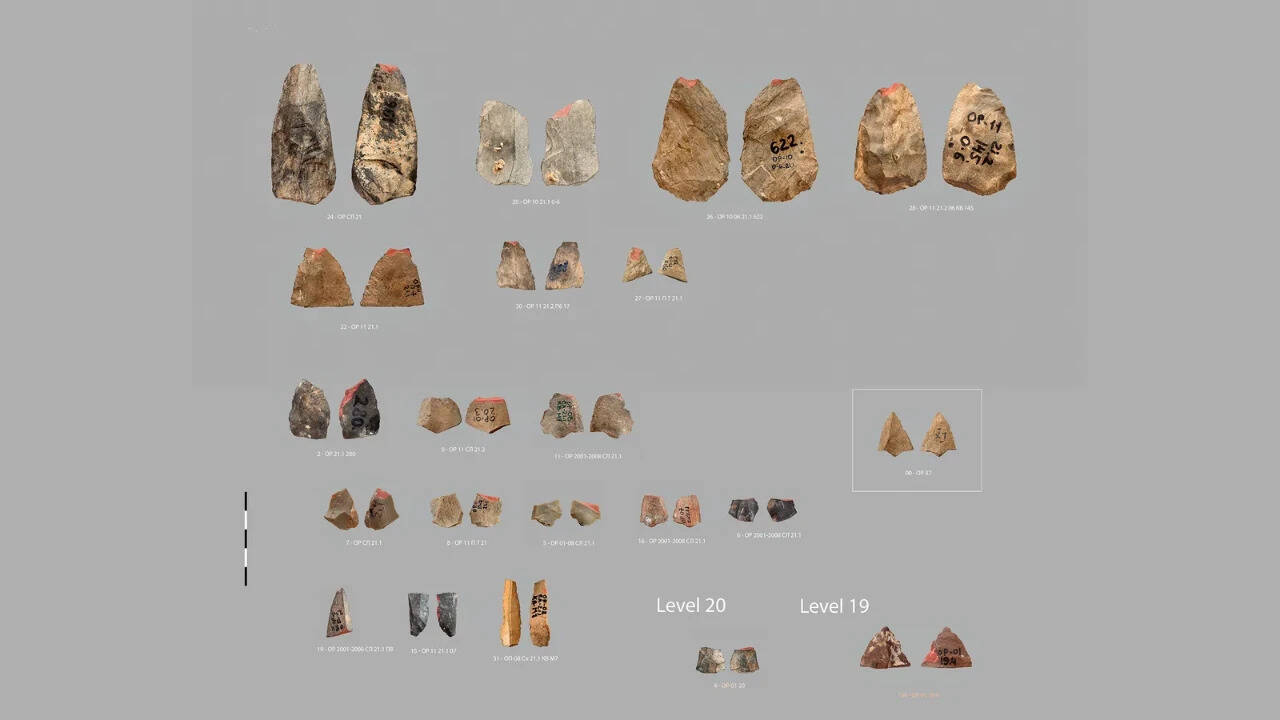
History loves throwing curveballs, and a dusty rock shelter in Uzbekistan just delivered a massive one. Archaeologists digging at Obi-Rakhmat, perched in the western foothills of the Tian Shan Mountains, found tiny stone points dating back roughly 80,000 years. Here is the kicker: they look almost identical to weapons unearthed in France's Rhône Valley at Mandrin Cave, which showed up a staggering 25,000 years later.
We are talking about a 6,000-kilometer gap across Eurasia and a massive temporal chasm. Traditional views of ancient human migration are suddenly looking way too neat.
The Mystery of the Obi-Rakhmat Micropoints
If you expect giant prehistoric spears, you're looking at the wrong artifacts. The pieces making noise right now are minuscule. Researchers analyzed unretouched triangular micropoints averaging less than two centimeters in width and weighing about 1.4 grams.
Let's be honest, finding tiny flakes of stone doesn't automatically mean someone built an advanced weapon. Archaeologists know this trap well. To avoid wishful thinking, the excavation team ran detailed traceological investigations. They separated everyday manufacturing debris from actual impact damage. Out of the assemblage, 20 specific pieces displayed microscopic linear impact traces and fracture patterns confirming they served as active projectile armatures.
Geometric calculations indicate these bits sat on shafts roughly 7.5 to 8 millimeters wide. That dimension screams arrow technology. It points to early hunters designing miniaturized projectile systems long before standard timelines suggested such complex engineering was common in the region.
The French Connection That Doesn't Make Sense
Move forward in time and space, and you hit Mandrin Cave in France. Layer E at Mandrin dates to roughly 54,000 years ago. Inside, researchers found tiny projectile points that match the Central Asian artifacts down to the microscopic fracture signatures.
The French layer also contained a deciduous tooth belonging to early Homo sapiens, while Neanderthal remains showed up in surrounding strata. This juxtaposition placed Mandrin Cave on the map as evidence of early modern human pioneers pushing into western Europe.
Now, scientists look at Obi-Rakhmat and scratch their heads. You have identical tiny weapons separated by 25 millennia and thousands of miles.
Are we looking at a direct technological lineage passed down through generations? Most researchers say slow down. No one is claiming the Obi-Rakhmat hunters packed up and marched straight to France. Instead, the data points to a broader Eurasian toolkit. Similar bladelet and micropoint setups are cropping up at Middle Palaeolithic sites like Cueva Millán in Spain and Riparo l'Oscurusciuto in Italy.
Why Chronology Matters More Than Ever
Human migration models used to rely on clean, linear arrows drawn across global maps. People moved out of Africa, crossed specific choke points, and replaced existing populations in an orderly fashion.
Discoveries like the Obi-Rakhmat stones blow that framework apart. Technology doesn't always move in a straight line. Similar environmental pressures or shared baseline traditions can spark identical mechanical solutions across entirely different populations and epochs.
Did ancient humans independently invent lightweight projectile systems because hunting fast, wary prey demanded it? Or did knowledge filter across vast distances through trade and sporadic contact between groups we assume were isolated?
Right now, we simply don't have all the answers. The excavation at Obi-Rakhmat covers a modest 20 square metres of a much larger deposit. Future digs across Central Asia will either confirm a widespread regional network or prove that ancient toolmakers arrived at the same brilliant design completely on their own.
Keep an eye on Central Asian archaeology. The next major breakthrough in human prehistory won't come from Western Europe; it's waiting in the high mountain valleys of the East.