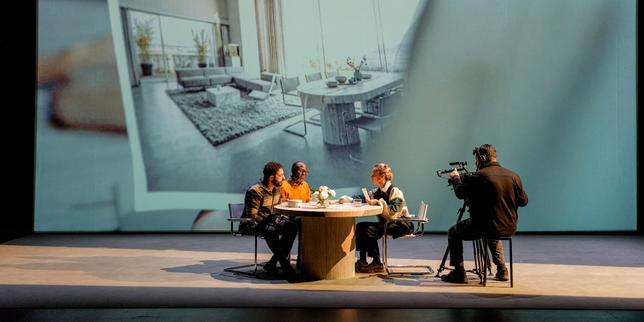
When power protects its own, public memory tends to fracture. That uncomfortable truth sits squarely at the center of La Fête, a striking theatrical creation by Anne-Cécile Vandalem and co-writer Joëlle Sambi, premiered at the Théâtre National Wallonie-Bruxelles. Rather than offering comfortable resolutions, this nearly three-hour production drags audiences straight into the murky waters of systemic privilege, societal denial, and the quiet mechanisms that shield elites from genuine accountability.
If you are wondering why this specific staging has dominated cultural conversations across Belgium and beyond, you have to look at its roots. The play draws direct inspiration from the tragic 2018 death of Sanda Dia during a university hazing ritual in Belgium, an event where the subsequent legal and social fallout laid bare deep structural inequities. Instead of staging a strict documentary drama, Vandalem and Sambi project us forward. Two years after a similar tragedy, families and individuals are brought together in an engineered encounter to speak, collide, and attempt the impossible: confront what society prefers to sweep under the rug.
The Anatomy of Denial on Stage
Theater rarely functions well when it tries to lecture. Fortunately, La Fête avoids moralizing traps by turning the stage into an unstable friction chamber. The narrative unfolds through a bilingual framework—using both French and Dutch with precise surtitling—mirroring the linguistic and cultural fractures of the country itself.
On stage, characters shift fluidly between roles. One moment a participant appears as an objective witness, and the next they slip into the position of an accomplice, a victim, or an accidental judge. This constant shifting of perspective forces you, sitting in the audience, to constantly reevaluate your own footing. Who gets to define what actually happened? Whose pain gets prioritized, and whose suffering is minimized through bureaucratic language and class solidarity?
The co-writing synergy between Vandalem and Sambi brings a sharp political edge that cuts through polite liberal consensus. They don't just point fingers at overt racists; they interrogate the much harder target: the liberal institutions, elite networks, and polite bystanders who maintain systems of dominance while claiming neutrality.
Beyond the Tragedy: The Power of Unresolved Frictions
Most cultural works dealing with systemic violence lean heavily on catharsis. They wrap up the trauma with a neat emotional bow, leaving viewers feeling like justice has somehow been served in the span of an evening. La Fête refuses this cheap comfort.
Instead, it exposes the zones of shadow that remain long after the headlines fade. By examining how institutional protection works, the production asks an urgent question: how does a society manage to forgive its dominant class while punishing the marginalized with ruthless efficiency? The actors—including a powerhouse ensemble featuring Habib Ben Tanfous, Anne-Pascale Clairembourg, Arne De Tremerie, François Ebouele, and Oscar Van Rompay—deliver performances that vibrate with raw urgency.
The staging choices match this intensity. With stark, immersive set designs by Ruimtevaarders and a haunting musical composition by Alex Tambu and Pierre Kissling, the production pulls you into an atmosphere where breathing room feels scarce. Every element works to dismantle the wall of denial that protects powerful networks from facing their own moral failures.
What We Can Learn From the Reception of La Fête
When art touches a raw nerve, the reactions tell you everything you need to know about the society watching it. Critics across Europe have noted how the production acts as a mirror for contemporary European anxieties regarding race, class privilege, and impunity.
You cannot watch this play and walk out thinking racism is merely an individual moral failing. It is structural. It is protected. And most importantly, it is systematically denied by those who benefit from it most.
If you get the chance to catch its tour across European venues like the Théâtre de Liège, Nanterre-Amandiers, or NTGent, don't expect an easy night out. Expect to feel unsettled. Expect to question the narratives you consume daily. And above all, expect theater to do what journalism and politics often fail to accomplish: make the invisible mechanisms of power impossible to ignore.