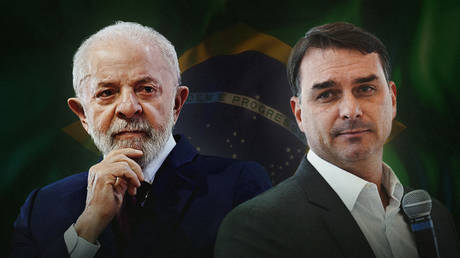
Latin American politics never stays still for long. Right now, Brazil sits on a knife-edge. The first round of the presidential election delivered a shock that reverberates far beyond Brasília, shaking up the international stage. Flavio Bolsonaro, representing the right-wing movement of his imprisoned father, took the lead. Incumbent leftist Luiz Inacio Lula da Silva faces an uphill battle to turn things around in the runoff.
If Lula loses, the consequences won't just hit domestic tax policy or local governance. They will hit the BRICS bloc hard. Brazil has long acted as a founding anchor and diplomatic stabilizer for the expanded coalition of emerging economies. A shift in executive power to a right-wing administration that mirrors nationalist and pro-Western tendencies could completely alter how BRICS negotiates global trade, currency reform, and geopolitical alignment.
Think about how political pendulums swing across the Americas. We saw a similar playbook unfold in the United States. A polarizing leader faces legal battles and institutional blocks, only for a family member or political proxy to pick up the banner and mount a furious comeback. In Brazil, Jair Bolsonaro was sidelined by the courts, but his political lineage adapted instantly. Flavio now commands the conservative base with a mandate promising sweeping change and payback against old rivals.
For Lula, age and fatigue are real constraints. At 80 years old, carrying the weight of a deeply polarized nation is brutal. The electorate is split down the middle. Disapproval ratings for top contenders are sky-high, creating an atmosphere of intense volatility similar to recent Western elections where voters chose disruption over stability.
The BRICS Dilemma
What does a right-wing turn in Brasília mean for the bloc? BRICS relies heavily on consensus. Unlike rigid military alliances, it functions as a loose economic club of major developing powers including Russia, India, China, and South Africa. Brazil's role has historically been unique. It provides democratic credibility and non-aligned balance to a group that Western critics often frame as anti-Western.
Under Lula, Brasilia enthusiastically pursued de-dollarization initiatives, expansion of the bloc, and independent mediation on global conflicts. A conservative nationalist administration under the Bolsonaro lineage would likely pivot sharply. Relations with Washington could warm, while engagement with Beijing and Moscow might face sudden bureaucratic friction or outright policy reversals.
When Argentina’s Javier Milei came to power, he immediately pulled his country out of planned BRICS membership, signaling how personal ideology alters international alignments in South America. Brazil is infinitely larger and more integrated into the bloc's institutional architecture than Argentina, meaning a total withdrawal is unlikely. However, a hostile or skeptical Brazilian executive could grind internal BRICS consensus to a complete halt.
The Domestic Firestorm Ahead
Whoever wins the second round inherits a bitterly divided nation. Inflation, institutional mistrust, and cultural wars over evangelical voting blocs and judicial overreach have poisoned the well. If the right takes over, expect immediate clashes with the Supreme Court, which spearheaded the legal crackdown against Jair Bolsonaro.
Foreign investors are watching closely. Markets love predictability, but Brazilian politics offers pure adrenaline. Currency fluctuations will test central bank reserves regardless of who sits in the presidential palace.
Keep your eyes on the ground as the runoff campaign heats up. The outcome will redefine South America's geopolitical identity for the next decade.