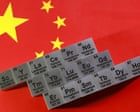
You can't build artificial intelligence servers, advanced fighter jets, or wind turbines out of thin air. You need rare earth metals, and right now, Britain is buying almost all of them from one single source.
A parliamentary report released by the Business, Innovation, Science and Trade Committee lays bare an uncomfortable truth: the United Kingdom is dangerously exposed to Chinese economic coercion. While politicians talk endlessly about tech futures and green transitions, they’ve ignored the gritty reality of supply chains. If Beijing decides to flip the switch, British industry grinds to a halt.
The Hidden Vulnerability Behind the Tech Boom
Most people assume modern technology lives entirely in the cloud. It doesn't. Every advanced GPU powering generative AI, every guided missile system, and every offshore wind turbine relies heavily on minor metals like gallium, germanium, and dysprosium.
China controls over ninety percent of the global processing capacity for these elements. Sixteen years after Beijing first demonstrated its willingness to weaponize this chokehold during a diplomatic dispute, Westminster is still caught flat-footed. British policy has drifted, relying on reactive measures rather than structural fixes. You can't build a sovereign tech sector if your raw materials arrive courtesy of a geopolitical rival.
Why Domestic Extraction and Recycling Remain Stalled
The government's Vision 2035 strategy sets targets to source ten percent of critical minerals domestically and twenty percent through recycling. On paper, it sounds proactive. In practice, progress is painfully slow.
Projects involving tin and tungsten in Cornwall, or lithium exploration in County Durham, face a wall of regulatory delays and local pushback. Building a processing plant or a new mine takes a decade. Meanwhile, the capital required to build a single major processing facility can reach billions of dollars. Without aggressive financial backing—such as a dedicated Critical Minerals Finance Facility with guaranteed price floors—private investors will look elsewhere.
The G7 Illusion and Allied Buyers
Can Britain solve this alone? Absolutely not. The market is too consolidated, and the domestic resource base is too small to achieve complete self-sufficiency.
The committee argues that the most realistic path forward is forming allied "buyers' clubs" with G7 partners and Indo-Pacific nations. By aggregating demand, Western nations can pool resources, share the staggering costs of new mines, and negotiate on equal footing. Relying on temporary reprieves in US-China trade tensions is a bad strategy. Every day of delay turns a manageable supply risk into an existential national security crisis.
If Britain wants to protect its defense capabilities and secure its economic future, the time for half-measures has passed. Stop treating resource security as an afterthought and start funding the mines and processing plants required to keep the lights on.