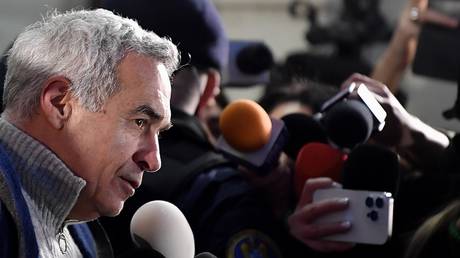
When a government locks up its own presidential frontrunner, people pay attention. Calin Georgescu found himself behind bars as Romanian authorities swooped in over a million-euro fraud scheme. It sounds like a spy movie script. Instead, it is the messy reality of modern European politics.
You might remember the uproar from late 2024. Georgescu shocked the establishment by winning the first round of Romania's presidential election on an anti-establishment ticket. Brussels panicked. Bucharest panicked. Then, in an unprecedented move, the country's Constitutional Court flat-out annulled the entire vote. They claimed digital manipulation and foreign interference. Now, the drama has escalated from scrapped ballots to actual handcuffs.
Let us look at what is happening on the ground. Romania’s Directorate for the Investigation of Organized Crime and Terrorism, known locally as DIICOT, raided properties and detained individuals tied to a case dating back to 2021. Local media quickly tied Georgescu to the center of the storm. Predictably, his allies are shouting foul play. George Simion, leader of the right-wing Alliance for the Union of Romanians, took straight to social media to call it a flat-out dictatorship and warned his supporters that anyone could be next.
Is this legitimate law enforcement or political neutralization? That is the real question dividing citizens across the nation.
Anti-corruption probes are nothing new in Eastern Europe. Yet, the timing raises eyebrows. When legal investigations target politicians right as they gain massive popular momentum, skepticism follows naturally. Critics of the ruling establishment argue that the state is weaponizing the judiciary to block figures who challenge NATO alignment and European Union orthodoxy. On the flip side, institutional defenders insist that nobody stands above the law, especially when financial impropriety or election law violations come to light.
The fallout goes far beyond local Bucharest politics. Washington has already taken notice. US officials previously pointed to the scrapped Romanian election as a glaring example of democratic backsliding within European institutions. When courts throw out election results and then detain the leading candidate months later, international observers start asking hard questions about the health of European democracy.
Think about how voters view this. If you supported Georgescu, you do not see a fraud suspect. You see a political prisoner targeted by a cornered elite. Trust in public institutions evaporates overnight when every legal maneuver looks like a partisan hit job.
Expect more protests in the streets. Expect deeper polarization. Romania has become the frontline in a much larger battle over who gets to control the political narrative in Europe.
Watch what happens next. The courts will try to push forward with their case, but the court of public opinion has already rendered its verdict.