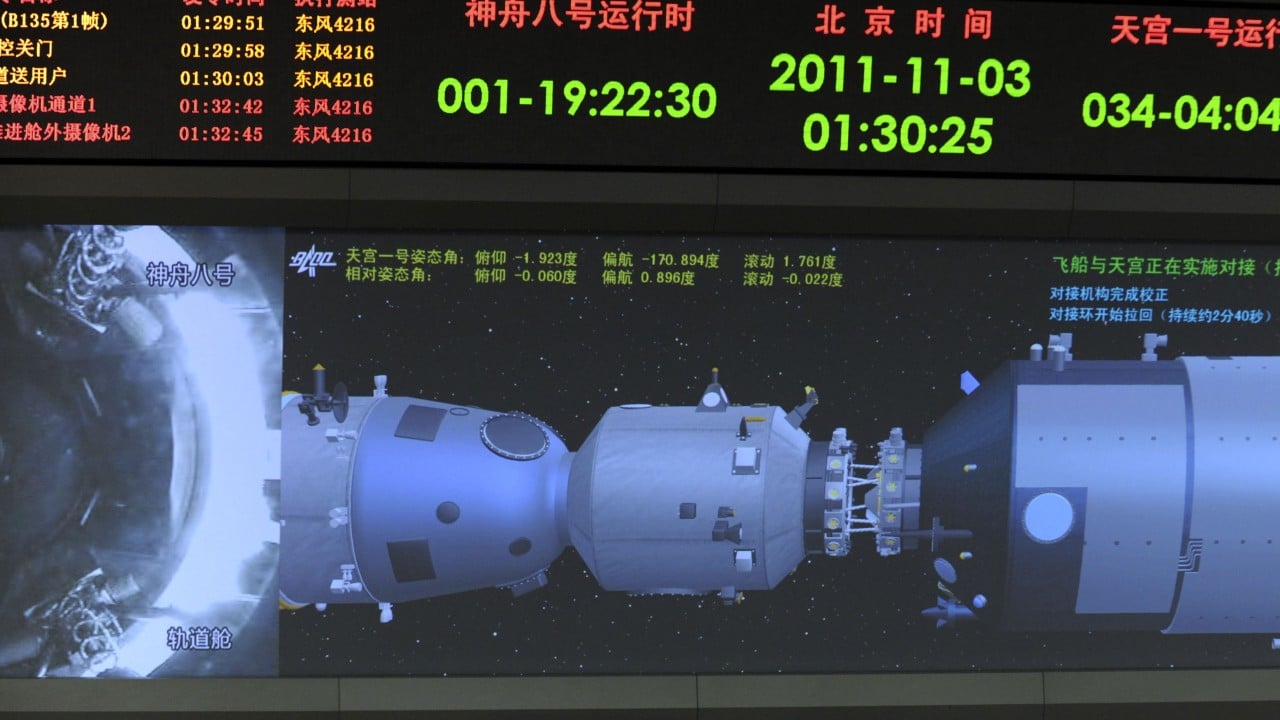
Getting two massive metal objects to lock together while hurtling through the vacuum of space at thousands of miles per hour sounds impossible. Back in November 2011, China proved it could pull off this high-stakes orbital ballet. The unmanned Shenzhou-8 spacecraft latched onto the Tiangong-1 lab module roughly 340 kilometers above Earth, rewriting the nation's aerospace trajectory forever.
If you want to understand how modern orbital outposts are built, you have to look past the routine launches we see today. You have to examine the raw engineering hurdles of orbital rendezvous. Docking isn't just about crashing two things together carefully. It requires millimeter-level precision, automated guidance systems that can calculate trajectories in real-time, and zero room for error.
The Setup for the 2011 Breakthrough
Before Shenzhou-8 ever left the pad at the Jiuquan Satellite Launch Center, Beijing laid out a methodical multi-step blueprint. They didn't rush into building a full orbital station. They started small with Tiangong-1, a target vehicle launched in September 2011 designed specifically to test life support components and automated docking collars.
Space agencies across the globe watched closely. Executing an autonomous docking maneuver requires mastering orbital mechanics that only a few nations had conquered by then. The US and the Soviet Union had spent decades perfecting these techniques during the Apollo and Mir eras, but China was writing its own playbook from scratch.
Why Orbital Docking Matters
You can't sustain a permanent human presence in low Earth orbit if your vehicles can't link up. Cargo delivery, crew rotations, and module assembly all depend entirely on reliable docking technology.
When Shenzhou-8 closed the final gap with Tiangong-1 on November 2, 2011, ground control teams in Beijing didn't just celebrate a single milestone. They unlocked the gateway to building modular infrastructure in space. That exact success paved the way for subsequent crewed missions like Shenzhou-9 and Shenzhou-10, eventually leading straight to the Tiangong space station currently operating in orbit today.
The Technical Reality Behind the Scenes
People often assume astronauts are flying these capsules like fighter jets during a docking sequence. In reality, the 2011 mission relied heavily on automated systems backed by rigorous ground telemetry.
Tianlian data relay satellites deployed earlier that year played a massive silent role. They kept constant communication links open with the moving spacecraft, ensuring mission controllers could monitor telemetry data without losing signal blackouts as the vehicles orbited the globe.
Mastering this capability transformed China from a nation catching up to a major independent space power. The engineering lessons learned during those tense November days in 2011 formed the foundation of every complex orbital maneuver executed since.
Review the technical logs, study the automated guidance parameters, and watch China Completes Its First Space Docking to see actual archival footage of the orbital meet-up between Shenzhou-8 and Tiangong-1.