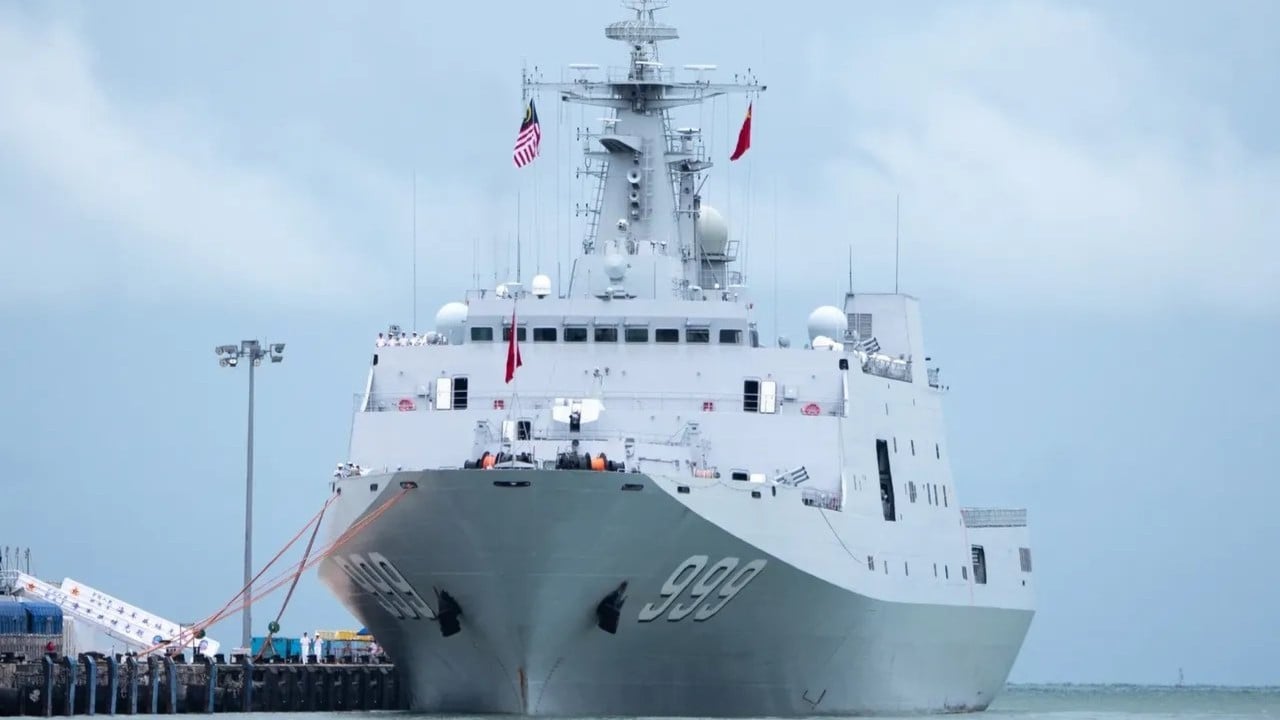
Military build-ups don't happen by accident. When a nation expands shipyards to churn out massive amphibious transport docks, it sends a clear, unvarnished message about its strategic priorities. Beijing's recent move to scale up the production of Type 071 amphibious warships by bringing a second shipyard online changes the calculus across the Taiwan Strait.
If you look past the standard diplomatic statements, the industrial reality on the ground tells the true story. Naval analysts tracking satellite imagery recently caught wind of this second production line. It means the People's Liberation Army Navy (PLAN) isn't just maintaining its current fleet; it's accelerating its capability to move heavy armor and thousands of troops across open water.
Anatomy of a Power Projection Workhorse
The Type 071, known by its NATO reporting name Yuzhao, is a beast of a ship. Displacing around 25,000 tons, these vessels serve as the backbone of China's modern amphibious warfare fleet. They are designed to do one thing exceptionally well: bridge the gap between sea and land when infrastructure is non-existent or heavily contested.
Inside that hulking hull lies a massive well deck capable of deploying multiple Type 726 air-cushioned landing craft (LCACs). These hovercraft can rocket across the water at high speeds, bypassing traditional beaches to drop tanks and combat engineers directly onto hostile shores. Above deck, a sprawling flight deck and hangar can accommodate up to four heavy transport helicopters, like the Harbin Z-8, allowing for vertical envelopment behind enemy lines.
Carrying roughly 800 troops alongside a fleet of armored personnel carriers, a single Type 071 acts as a floating staging ground. Doubling down on this specific class reveals a calculated preference for versatile, reliable workhorses rather than relying solely on the newer, larger Type 075 landing helicopter docks.
The Taiwan Strait Factor
Why expand production lines now? The answer sits roughly 100 miles off China's eastern coast. Amphibious assault is notoriously difficult. Crossing the Taiwan Strait requires massive sealift capability to sustain hundreds of thousands of troops if a conflict ever broke out.
For years, Hudong-Zhonghua Shipbuilding in Shanghai held a near-monopoly on building these heavy hitters. Bringing a second shipyard into the mix dramatically shortens delivery windows. It signals that military planners want a larger, more resilient amphibious fleet ready for deployment in regional contingencies.
Critics often point out that aircraft carriers grab the biggest headlines in naval parades. Yet, in any serious cross-strait scenario, it's the unglamorous landing ships, transport docks, and logistics vessels that win or lose the campaign. Without massive numbers of hulls capable of carrying heavy equipment across the water, air power alone cannot hold territory.
Shifting Industrial Capacities and Strategic Realities
Defense manufacturing is ultimately an exercise in industrial output. By diversifying construction to a second facility, Beijing insulates its naval expansion from single-point bottlenecks. This kind of dual-yard production strategy mirrors how major powers scale up hardware when they believe timelines are tightening.
It also highlights a broader evolution within the PLAN. Over the past two decades, China transitioned from a coastal defense force into a "blue-water" navy capable of projecting power far beyond its immediate shores. The Type 071 has already proven its mettle in distant operations, ranging from anti-piracy patrols in the Gulf of Aden to international humanitarian missions. But its primary design parameters remain anchored to regional amphibious dominance.
Watch the shipyards. They rarely lie about a government's long-term intentions. As these new hulls take shape, the regional balance of power shifts quietly piece by piece, rivet by rivet.