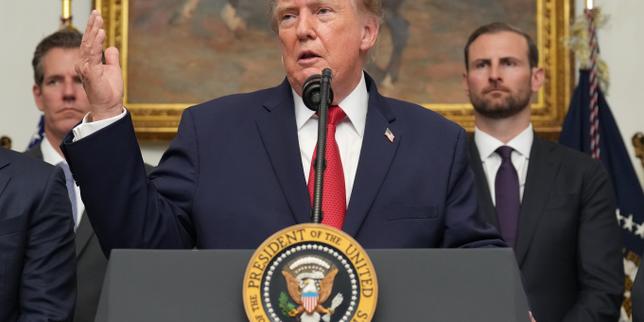
Donald Trump recently threw a specific number into the public conversation: 57. That is how many nuclear weapons the former president claims North Korea currently holds.
It sounds precise. It sounds authoritative. But in the world of nuclear non-proliferation and intelligence, that number is basically a guess—and it’s one that has put Washington and Seoul on noticeably different pages.
The Math Behind the Curtain
When a head of state drops a figure like 57, the natural reaction is to treat it as classified truth. It isn't. The real issue here isn't whether the actual count is 57, 80, or 120. It's that we have absolutely no way to verify it.
South Korean Defense Minister Ahn Gyu-back recently shared a starkly different outlook. During a parliamentary hearing, he noted that estimates floating in the intelligence and research community place Pyongyang’s stockpile between 80 and 120 warheads.
Notice the gap? It’s not just a rounding error. If you're a negotiator trying to craft a treaty or a deal, you need to know if you're dealing with 60 bombs or 120. The difference dictates everything from delivery system capability to the "survivability" of their force during a hypothetical conflict.
Why Nobody Knows for Sure
You might wonder how modern satellite technology and high-level surveillance can miss an entire stockpile of nuclear weapons. Honestly, the North Korean regime has mastered the art of opacity.
- Hardened Sites: Many of their facilities are buried deep underground, immune to standard optical reconnaissance.
- Fissile Material Tracking: Intelligence agencies track the amount of plutonium and highly enriched uranium produced. But tracking raw material is a long way from confirming how many warheads have been assembled and deployed.
- Dual-Use Infrastructure: North Korea frequently uses industrial facilities for both civilian and military purposes, making it incredibly difficult to pinpoint exactly where the final assembly happens.
The Danger of Ignoring the Discrepancy
When Washington and Seoul operate on different intelligence assessments, the alliance cracks.
If the U.S. thinks the threat is smaller—57 weapons—it might be more inclined to pursue a "management" strategy, treating the regime as a static entity that can be handled through personal diplomacy. If South Korea believes the stockpile is twice that size, their risk appetite is naturally much lower. They are the ones in range of the entire array of those weapons.
This isn't just about the hardware. It's about how we define "success." During the summits in 2018 and 2019, the goal was complete denuclearization. Today, the conversation has shifted. The regime has only grown more aggressive, strengthening ties with Moscow and Beijing while expanding its production of fissile materials.
Beyond the Headlines
Trump’s recent comments—including his stated intent to meet with Kim Jong-un again this year—suggest he’s looking for a repeat of his earlier diplomatic theater. But the strategic landscape of 2026 is miles away from the environment of 2018.
The most important takeaway isn't the number 57. It’s that we are still effectively flying blind. Relying on such specific numbers ignores the reality of a program that has been in "exponential growth" mode for years.
If you want to understand the threat, stop fixating on the count. Pay attention to the infrastructure growth, the delivery systems being tested, and the shifting alliances that make verifying any of these numbers almost impossible.
Negotiating with a regime that has "irreversibly" declared itself a nuclear state means the old playbook is obsolete. We don't need better counting; we need a strategy that admits the current reality: the weapons are here to stay, and the gap between what we know and what we think we know is the biggest danger of all.
Keep a close eye on the upcoming diplomatic sessions. If the U.S. and South Korea can't agree on the size of the threat, they certainly won't agree on how to face it.


