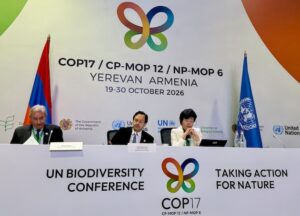
Governments love signing ambitious environmental treaties, but they hate writing the checks to fund them. As the UN Biodiversity Conference (COP17) wrapped up in Yerevan, Armenia, delegates celebrated a fresh wave of financial pledges aimed at saving collapsing ecosystems. Yet, beneath the diplomatic handshakes and press releases, a massive financial chasm remains wide open.
The math simply doesn't add up. While international bodies and state actors managed to rally roughly $1.8 billion in new commitments during the high-level segments, the global requirement sits at an estimated $200 billion annually by 2030. We are trying to plug a multi-billion dollar leak with loose change. If you're wondering why global conservation targets continue to stall, you don't need to look any further than this chronic underfunding.
The Reality Behind the COP17 Pledges
When delegates gathered in Yerevan, the primary item on the agenda was evaluating progress toward the Kunming-Montreal Global Biodiversity Framework. The results weren't pretty. A UN review published right before the summit revealed that the vast majority of national targets are currently off-track.
To counter this momentum loss, a mix of national and sub-national governments chipped in over $60 million specifically for the Global Biodiversity Framework Fund (GBFF). Interestingly, support isn't just coming from traditional national treasuries anymore. Sub-national entities like the City of Berlin and the Canadian province of Quebec stepped up with direct contributions. Quebec kicked in CAD 1.5 million, following up on earlier independent donations.
It is a positive sign of grassroots and regional accountability, but it highlights a glaring weakness. When municipal governments have to rescue global biodiversity funds, national financial architecture is failing.
The Battle Over Who Pays
The core argument at COP17 wasn't just about how much money is missing; it was about who should be footing the bill. Traditional developed nations argue that economic powerhouses like China, alongside wealthy Gulf states, need to join the donor pool as formal contributors. On the other side, developing countries point out that historical responsibility rests squarely on wealthy industrialized nations who depleted natural capital during their own economic ascents.
This ideological gridlock freezes actual progress. While diplomats argue over classification and historical guilt, forests, wetlands, and marine ecosystems degrade at an unprecedented pace. Astrid Schomaker, Executive Secretary of the Convention on Biological Diversity, noted that while international finance grew to roughly $19 billion by 2024, state aid budgets are tightening everywhere. Governments are cutting back on foreign aid just as planetary life-support systems require massive cash injections.
Subsidies Are Doing More Damage Than Pledges Can Fix
Money coming into conservation funds is only half the problem. The other half is the trillions of dollars actively subsidizing ecological destruction.
Experts at the summit pointed out an inconvenient truth: the world pumps roughly $2.4 trillion annually into environmentally harmful subsidies, particularly in agriculture, fossil fuels, and industrial resource extraction. Think about that for a second. Governments spend trillions making it cheaper to destroy nature, and then pat themselves on the back for pledging a few billion to fix it.
The COP17 presidency pushed hard on initiatives like the Yerevan Call on Incentives to tackle this exact issue. Reforming harmful economic subsidies under Target 18 of the global framework isn't just an environmental wish list item; it's basic fiscal common sense. Until public money stops funding deforestation and overfishing, no amount of philanthropic donor pledges will save our ecosystems.
Moving Past Empty Rhetoric
If biodiversity summits are going to survive their own irrelevance, the strategy has to shift. Relying entirely on voluntary state donations clearly doesn't work.
First, national finance ministries must integrate biodiversity strategies directly into domestic budgets rather than treating conservation as an afterthought funded by foreign aid. Second, corporations profiting from natural resources need mandatory disclosure and strict alignment with ecological health, moving far beyond voluntary greenwashing.
Nature isn't a charity case you fund when the economy is booming. It's the underlying infrastructure of the global economy. Until political leaders treat it that way, expect future climate and biodiversity COPs to repeat the exact same cycle of empty targets and broken budgets.