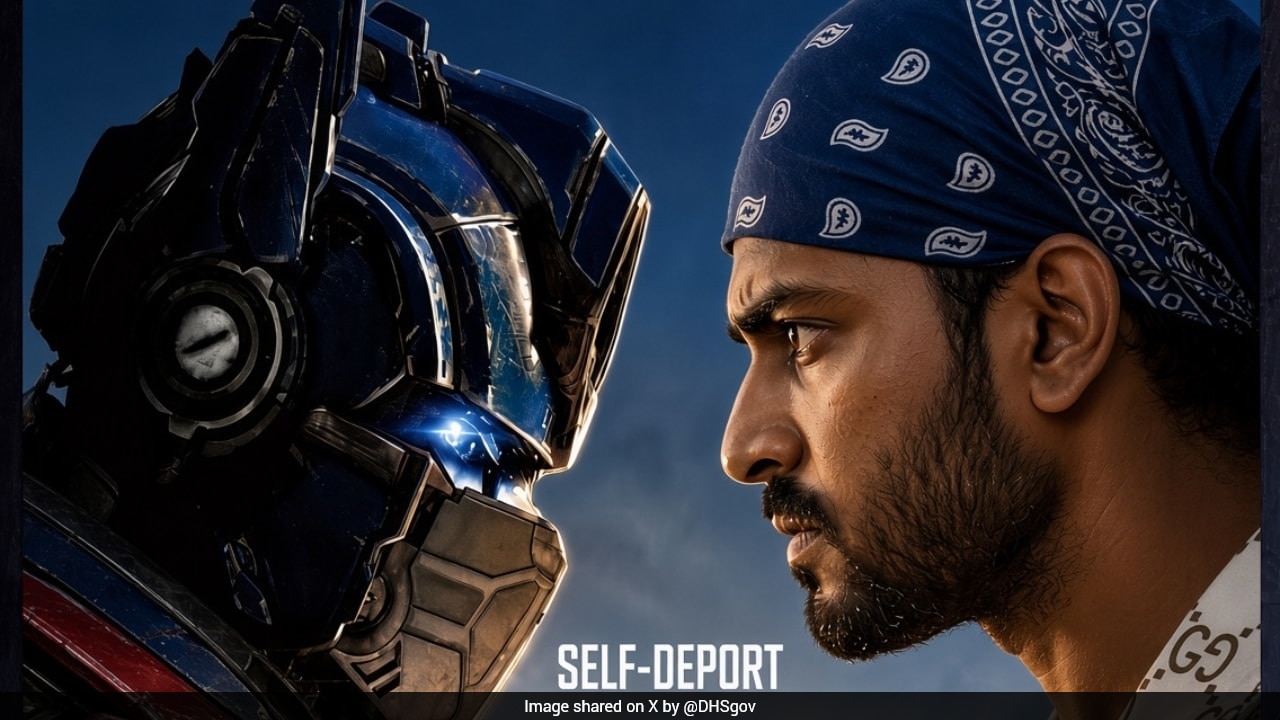
Government agencies should communicate policy, not drop memes using Hollywood villains. Yet, that is precisely what happened when the US Department of Homeland Security published a bizarre, AI-generated image campaign targeting foreign commercial truck drivers. The center of the storm is a fictionalized poster telling "Mr Singh" to self-deport, wrapped in Transformers branding and designed to inflame immigration debates.
When digital propaganda crosses the line into crude stereotypes, it sparks immediate outrage. But the subsequent public bickering between federal officials and state leaders reveals an ugly truth about how modern political warfare operates.
How the Mr Singh Controversy Blew Up Online
The digital campaign launched on X featured characters like Megatron and Optimus Prime alongside an AI-generated portrait of a brown-bearded man in a turban. The accompanying text demanded that "Mr Singh" self-deport or face consequences. Civil rights organizations, the Sikh Coalition, and the Hindu American Foundation instantly condemned the material as a harmful generalization of South Asian communities.
Critics pointed out that using a common surname alongside a caricature creates collective guilt. It paints an entire diaspora with the same brush, associating millions of law-abiding citizens and legal immigrants with isolated criminal acts. California Governor Gavin Newsom's office called the messaging "disgusting" and accused the administration of peddling raw bigotry.
Instead of backing down or issuing a standard bureaucratic apology, the DHS fought back instantly. They fired off direct replies linking the campaign to Harjinder Singh, an undocumented truck driver facing trial over a tragic 2025 Florida highway crash that claimed three lives. They turned a civil rights complaint into a partisan slugfest by shifting the blame straight back to California's licensing system.
The Defense That Misses the Mark
The agency's primary argument is that the poster wasn't an attack on an ethnicity, but a specific reference to an individual accused of a violent crime. They threw punchy retorts at Democratic lawmakers like Adam Schiff, dismissing counter-arguments as lazy lies while re-sharing footage of the Florida crash.
Here is where the strategy falls apart. Defending an enforcement action is one thing. Using clumsy, AI-generated tropes that caricature a specific religious and cultural demographic is entirely different. When a federal entity relies on broad brushstrokes to mock a surname tied to a specific community, pointing to a single criminal case doesn't erase the collateral damage done to innocent people who share that background.
The exchange deteriorated into schoolyard comebacks on social media. Federal spokespeople traded digital jabs with state officials while real policy issues surrounding commercial driver's license oversight, interstate commerce, and background checks took a backseat to viral point-scoring.
The Real Cost of Viral State Media
We are watching public institutions trade dignity for engagement metrics. When official government accounts start behaving like internet trolls, trust evaporates.
The underlying problem—how commercial driver's licenses are issued, verified, and audited across state lines—deserves serious administrative attention. If states are failing to catch fraudulent documentation or ineligible applicants behind the wheel of 80,000-pound commercial trucks, that is a massive public safety failure. It demands rigorous audits, bipartisan legislative fixes, and actual competence.
Instead, the public gets a cartoon character telling a demographic group to get off the road.
The DHS eventually pulled the controversial creative down, but the damage to public discourse is already done. Real safety solutions get lost in the noise when governance turns into a meme war. If officials want to fix highway safety, they need to ditch the graphic design studio, stop trying to go viral, and fix the actual bureaucratic loopholes that let unqualified drivers slip through the cracks in the first place.