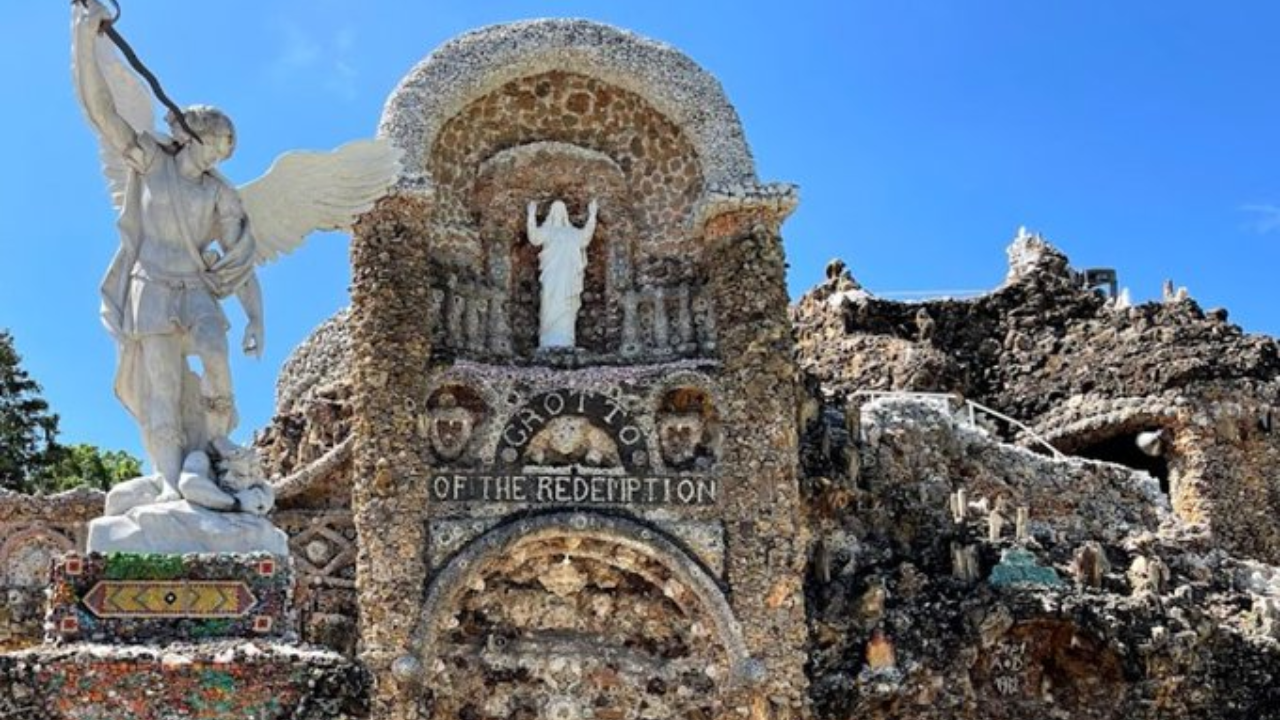
Illness changes people. Sometimes, it triggers a lifelong obsession that reshapes an entire landscape.
Picture a young seminarian lying flat on his back in Wisconsin during the late 19th century, fighting a brutal, suffocating bout of pneumonia. Doctors offered little comfort. Death felt close. Father Paul Matthias Dobberstein did what many desperate people do. He made a bargain with the divine. If he survived the sickness, he swore he would build a massive shrine dedicated to the Virgin Mary.
He didn't die. He recovered completely. True to his word, he spent the next 42 years of his life hauling over 100 train carloads of rocks, minerals, and fossils into the flat farmland of West Bend, Iowa to build the Grotto of the Redemption.
If you think this sounds like a quaint weekend hobby, you've got it backwards. This project became a massive, obsessive architectural marvel built completely without blueprints.
How a Sick Seminarian Sparked a Decades Long Obsession
Dobberstein arrived in West Bend in 1898 as the new pastor of Saints Peter and Paul Catholic Church. The surrounding terrain offered endless cornfields, flat horizons, and precious few rocks. If you want to build a stone monument in northern Iowa, you have to import your raw materials from everywhere else.
For more than a decade, he quietly stockpiled geological specimens. He didn't rush into construction. He collected samples piece by piece, waiting until 1912 to lay down the first permanent mortar.
Most people fail at large creative projects because they overcomplicate the planning phase. Dobberstein took the opposite path. He used zero blueprints or architectural sketches. He worked intuitively, letting the physical shape of the stones dictate how the religious narrative would unfold.
The site eventually expanded into nine interconnected grottos. They mapped out the entire Christian story of redemption, starting with the Garden of Eden and working through the life of Jesus, the Crucifixion, and the Resurrection.
Sourcing Stones from the Ends of the Earth
You can't just pick up these materials at a local hardware store. Dobberstein scoured the globe for rare geological finds.
The Grotto of the Redemption holds specimens gathered from every single US state and numerous countries abroad. We aren't just talking about ordinary river rocks. The complex features:
- Amethyst shipped straight from the Andes mountains.
- Lapis lazuli originating from the Near East.
- Rare jade imported from China.
- Alexandrite linked to old Russian emerald mines.
- A physical rock recovered from Admiral Richard Byrd's famous expedition to the South Pole.
- Roughly 65 tons of heavy petrified wood packed into a single grotto.
Surrounding these geological oddities are 65 intricate statues carved from Carrara marble by Italian sculptors. The result looks less like a traditional church courtyard and more like a fever dream of earth science and religious devotion.
Building a Monument Entirely by Hand
The sheer physical labor required to erect this structure defies belief. For decades, there were no heavy cranes or modern Bobcat loaders.
Until 1947, all the heavy lifting relied on raw human muscle, wooden buckets, and simple wheelbarrows. Dobberstein carted heavy cement, mortar, raw steel, and precious gems across the site manually. By the time an electric hoist was finally installed to help his aging body, roughly 80 percent of the entire massive project was already finished.
He didn't work alone, either. Matthew Szerensce served as his primary partner, acting as the steady right hand who stayed by his side through decades of heavy construction. Dobberstein suffered multiple injuries in automobile and job-site accidents over the years, yet he always crawled back to the mortar.
When Dobberstein died in July 1954 at age 81, he left behind a monument that had consumed the better part of his adult life. Other local priests, including Louis Greving, stepped in to help Szerensce carry the architectural vision forward.
What Most Visitors Miss When They Visit West Bend
Today, thousands of tourists pull off the highway to walk through the stone arches of West Bend. They marvel at the glittering colors of quartz and the ancient weight of fossilized coral.
Most people look at the grotto as a monument to faith. That's true, but it's also a masterclass in long-term execution. Dobberstein didn't wait for ideal conditions. He didn't wait for a clean blueprint, a massive budget, or a team of professional contractors. He started with a chaotic pile of rocks and a stubborn promise, then spent 42 years stacking them one by one until the work matched his vision.
If you are facing down a massive, intimidating project in your own life or career, stop waiting for the perfect plan to materialize. Grab a wheelbarrow, start stacking your materials, and let the design reveal itself through the actual work.