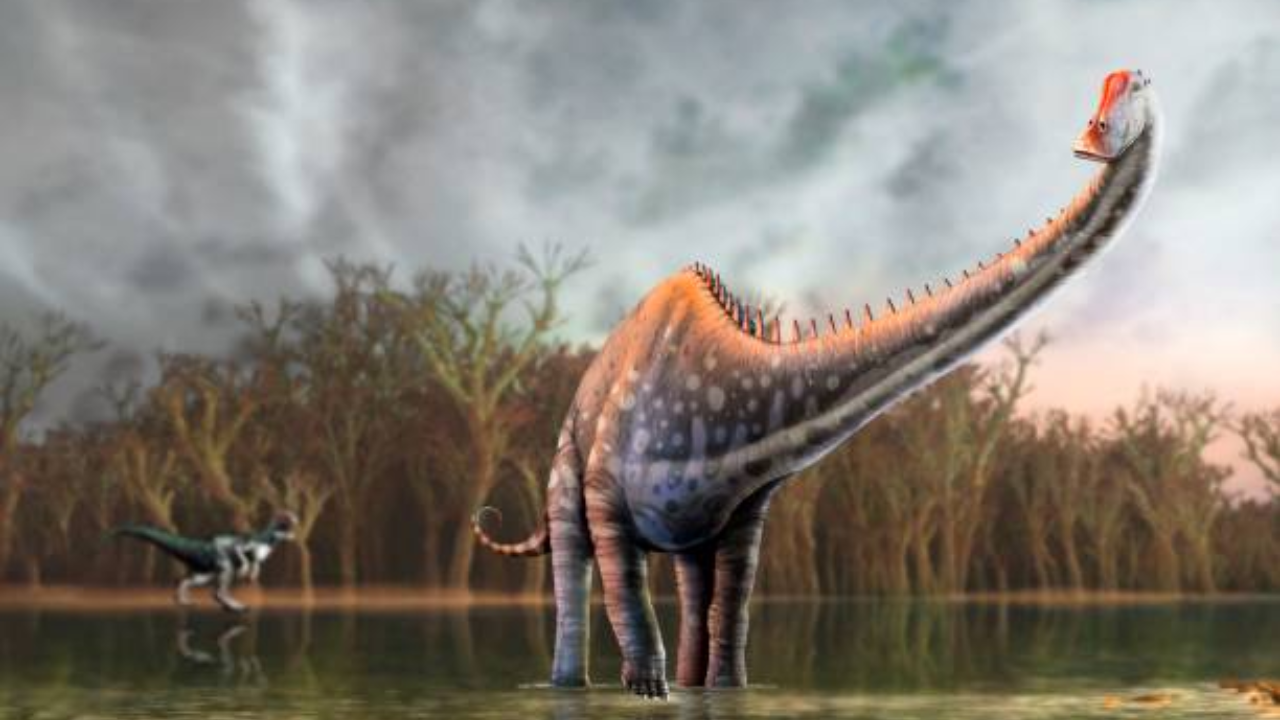
For nearly a century and a half, North America held a tight monopoly over one of history's most iconic dinosaurs. If you wanted to study Diplodocus fossils, you booked a flight to the western United States and dug through the Morrison Foundation. Every single confirmed bone of this long-necked giant came from American soil.
That exclusive club just dissolved.
Palaeontologists working in Teruel, Spain, have officially identified fourteen tail vertebrae and associated chevrons as belonging to Diplodocus. Published in the Journal of Vertebrate Palaeontology by lead author Sergio Sánchez Fenollosa, Alberto Cobos, and Josué García Cobeña, this discovery shifts our understanding of Late Jurassic biogeography. North America isn't the only home of Diplodocus anymore.
How Fourteen Tail Bones Broke a 150-Year Dinosaur Monopoly
The discovery didn't happen overnight. The first five vertebrae surfaced way back in 2008 at a site called La Tejeria. Excavations in 2014 and 2015 brought another nine vertebrae to light, along with distinct forked chevron bones that sit beneath the tail. The entire cluster spanned roughly 108 square feet.
Co-author Alberto Cobos notes that the animal measured about 82 feet long. While it is only a partial tail, it ranks among Europe's most complete finds from this specific sauropod family. Earlier European recoveries consisted of isolated teeth or scattered hip scraps.
Researchers measured the bones by hand using callipers and tape measures, comparing them line-by-line with published descriptions of North American sauropods. The diagnostic traits were unmistakable:
- Large pneumatic cavities honeycombed inside the vertebrae.
- Deep longitudinal grooves running along the underside of the tail bones.
- Distinctive forked chevron bones with unique medial fossae.
- Elongated vertebral centra completely devoid of lateral ridges.
When the team ran computer phylogenetic analyses to map out evolutionary trees, every single model placed the Spanish specimen firmly on the Diplodocus branch. While they couldn't pin down an exact species due to missing skull material, the analyses show it sits closest to the North American species Diplodocus hallorum.
How Did a Giant Dinosaur Cross the Atlantic
Finding a Diplodocus in Spain forces a hard look at paleogeography 150 million years ago. During the Late Jurassic, the Atlantic Ocean was still tearing itself apart, but it wasn't the vast barrier it is today.
Falling sea levels periodically exposed temporary land bridges or shallow corridors. These pathways likely stretched between what is now Newfoundland and the Iberian Peninsula. Massive plant-eaters didn't care about modern continental borders. If there was vegetation and solid ground, they walked across it.
Diplodocus now shares European real estate with other heavyweight Jurassic genera like Allosaurus and Stegosaurus. Teruel itself was a bustling coastal plain cut through by winding rivers, shared with other massive sauropods like Turiasaurus and Losillasaurus.
What This Means for Future Palaeontology
If you visit the Dinópolis foundation in Teruel today, the original tail bones are on display, while visitors to El Castellar can inspect exact replicas. But the real impact of this find goes far beyond local tourism.
It proves that iconic Late Jurassic dinosaur genera were far more cosmopolitan than textbook maps suggest. Assumptions built on a century of American fossil hunting are giving way to a more interconnected prehistoric globe.
Finding a more complete skeleton in Europe will ultimately reveal how closely these Spanish dinosaurs mirrored their American cousins. Until then, the monopoly is broken, and prehistoric geography just got a lot more interesting.