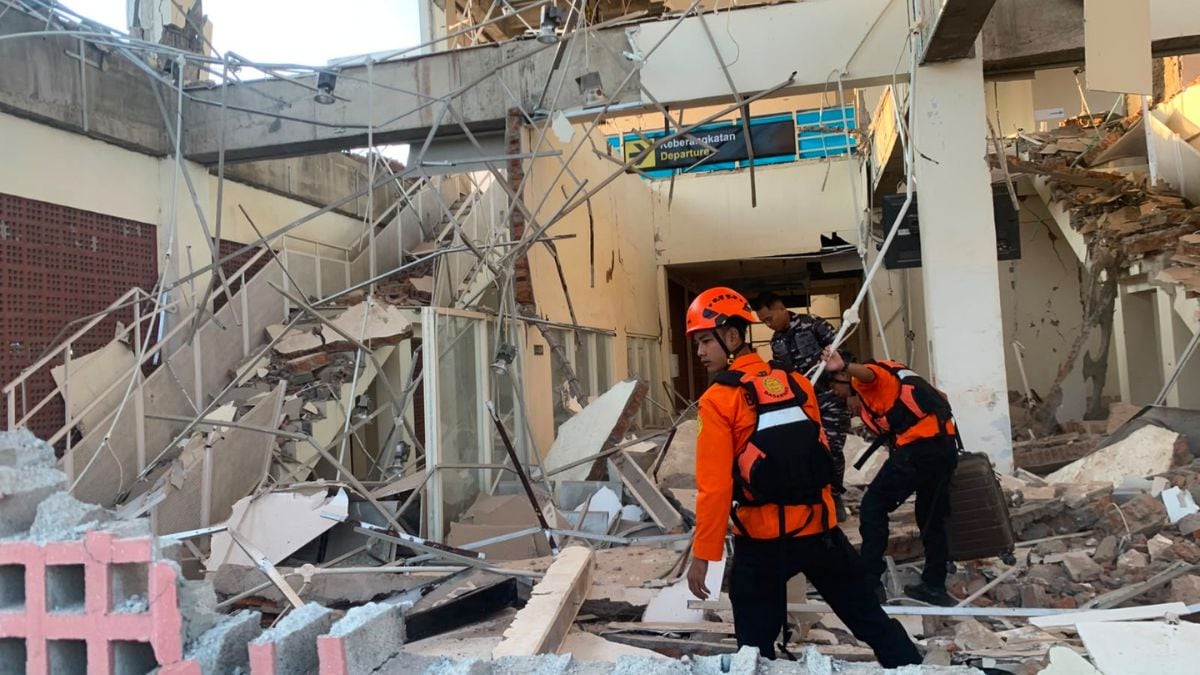
Ground doesn't just shake in Indonesia; it violently resets. Early on Saturday morning, a massive 7.7-magnitude earthquake slammed off the coast of Flores Island, waking up thousands of residents with terrifying, violent jolts that turned concrete walls into dust.
If you track seismic events, you know this region sits right on the edge of tectonic survival. The shallow quake struck at a depth of roughly 10 to 15 kilometers, amplifying the destructive energy hitting East Nusa Tenggara. Initial figures point to at least 20 deaths, with dozens more injured as homes, schools, and port terminals buckled under the strain.
When a magnitude 7.7 tremor hits before sunrise, chaos is guaranteed. People scrambled into the dark streets of Maumere, Ende, and Ruteng, clutching children and fleeing crumbling structures. Hospitals had to wheel patients straight onto the grass, setting up IV drips under open sky because indoor ceilings were no longer safe.
The Anatomy of the Flores Back-Arc Thrust
Geologically speaking, this disaster comes down to relentless plate mechanics. Indonesia straddles the Pacific Ring of Fire, a chaotic collision zone where major tectonic plates grind against each other daily. In this specific case, the culprit is the Flores back-arc thrust fault.
Shallow thrust faults are notoriously brutal. Because the epicenter was located roughly 68 kilometers northwest of Ende and sat at such a shallow depth, the seismic waves didn't have to travel far to vent their fury. Ground acceleration readings hit severe thresholds across local regencies, meaning buildings constructed without proper seismic reinforcement stood zero chance.
We saw this exact script play out during the tragic 1992 Flores earthquake and tsunami. History loves to repeat itself here, largely because building codes in regional Indonesian towns are rarely enforced with the strictness you see in major metropolitan hubs like Jakarta. When homes are built using unreinforced masonry, a minute of violent shaking is all it takes to flatten an entire neighborhood.
Tsunami Panic and the Logistics of Mass Evacuation
Minutes after the primary shockwaves rattled the coast, Indonesia's Meteorology, Climatology, and Geophysics Agency (BMKG) issued an urgent tsunami warning. For coastal communities in East and West Nusa Tenggara, that meant immediate, blind panic.
Roughly 2,000 residents in Nagekeo alone abandoned their homes, scrambling up hillsides and fleeing to higher ground. Sirens blared, power grids failed, and telecommunication lines went dark, cutting off real-time updates for emergency responders trying to figure out where help was needed most.
BMKG lifted the tsunami alert about three hours later after sea-level monitors recorded minor waves under one meter. While a massive sea surge was averted, the psychological toll of the warning drove home a harsh reality. Coastal evacuation routes in eastern Indonesia are still dangerously congested and unprepared for sudden midnight alerts.
Search Operations Face Crushed Infrastructure
Search and rescue teams from Basarnas and local disaster mitigation units face a brutal bottleneck right now. In Maumere, a maritime passenger terminal partially collapsed, trapping travelers beneath heavy concrete debris. Up in Ruteng, the roof of the Frans Sales Lega Airport suffered structural failures, and seminary buildings saw dramatic escapes as students and faculty jumped from upper-story windows to survive.
Governors and local disaster agencies are scrambling to coordinate heavy machinery for remote villages in Sikka, Manggarai, and West Manggarai regencies. Roads blocked by landslides and cracked bridges are slowing down medical convoys. Every hour counts when people are trapped under pancaked concrete, but logistics in an archipelago are painfully slow when local bridges snap.
What Needs to Change Right Now
Disaster management in earthquake zones cannot rely on reactive relief forever. If you live or travel through high-risk seismic corridors, standard survival habits need an upgrade.
First, structural retrofitting has to move past government speeches. Small-scale residential buildings in East Nusa Tenggara require low-cost retrofitting techniques, like steel banding for masonry walls, to stop them from turning into dust during a thrust-fault rupture.
Second, early warning systems need localized community drills that work even when power lines snap instantly. Sirens powered by solar arrays and satellite-backed emergency radios are non-negotiable when the main grid fails within the first five seconds of a quake.
Check your local evacuation maps if you are traveling through the region, stay away from compromised concrete structures while aftershocks continue to rattle the fault line, and expect relief operations to take days reaching isolated pockets of Flores Island.