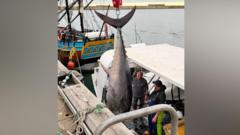
The North Sea was once a playground for legends. In the 1930s, Hollywood titans like John Wayne and Clark Gable descended upon Scarborough to battle the Atlantic bluefin tuna. Then, the silence fell. By the 1960s, these apex predators had vanished, driven out by industrial overfishing and the collapse of herring shoals. For sixty years, the Yorkshire coast was just a quiet stretch of water.
That silence finally broke this week.
A 745-pound bluefin tuna was landed in Whitby, marking the first commercial catch in nearly 90 years. It’s not just a trophy for the record books; it’s a biological statement. The return of these massive fish signals that our marine ecosystem is finally healing. If you’ve spent any time on the water, you know that the presence of a top predator like the bluefin is a barometer for a healthy sea. It means the baitfish are back, the food web is functioning, and the ocean is doing its job.
Why the tuna went missing and why they are back
The disappearance wasn't a mystery. It was a choice. We over-extracted. Herring, the primary fuel for these high-speed predators, were decimated by mid-century fishing practices. Without their prey, the tuna moved on, or worse, were simply fished into local extinction.
Their recent reappearance is largely down to strict, often controversial, fishery management. Atlantic bluefin tuna are highly migratory. They travel thousands of miles between the Mediterranean and the Gulf of Mexico. Their choice to return to the North Sea isn't just a sign of luck. It’s proof that when you give nature a chance to recover, it takes it. Scientists from the University of Exeter are now on the ground in Whitby, tagging these giants to track their movements. They are trying to figure out if these fish are part of a shifting migration pattern or a permanent recolonization.
The economics of a giant return
There’s a tension between conservation and commercial opportunity that we need to be honest about. When you see a 745-pound fish, your first thought might be the market value. Bluefin tuna is essentially the gold standard of the seafood world. It is incredibly valuable.
However, we shouldn't repeat the mistakes of the past. The return of the bluefin isn't just a new "product" for the industry to exploit. It is an opportunity to build a sustainable model—one that values the health of the population over a quick payday. Some argue for a total ban to allow numbers to rebound to 100% of their historical levels. Others see the return as a chance to boost local tourism and small-scale, rod-and-line fisheries.
Honestly, the middle ground is usually where the mess happens. If we rush to put bluefin on every menu in the UK, we risk losing them all over again. We need to be careful.
What you need to know about the tagging project
If you’re wondering why researchers are so focused on this, look at the data. They’re using satellite tags that record light, temperature, and depth. These tags stay on the fish for two years. They provide the evidence needed to manage quotas through the International Commission for the Conservation of Atlantic Tuna.
This isn't just "science for the sake of it." Without this data, international management is essentially guessing. If the fish in our waters are genetically distinct or following unique paths, current quotas might be completely wrong. We need facts before we set the rules.
Practical steps for the future
We are in a transitional period. If you’re a fisherman, an angler, or just a coastal resident, keep an eye on how these management decisions play out.
- Watch the quotas: Keep track of the catch limits set by official bodies. If they start rising too quickly, it’s a red flag.
- Support research: Organizations like the University of Exeter rely on cooperation from local skippers. If you’re in the industry, your logs and sightings are the most valuable data they have.
- Choose sustainability: If you see bluefin on a menu, ask where it came from. If the restaurant can’t provide a clear, sustainable source, walk away.
The bluefin tuna is back. It took sixty years of absence to remind us what we lost. Let’s not let greed or short-sightedness make it another sixty-year story.
INSANE Tuna Fishing Moments of 2026! Giant Catches Nobody Thought Were Possible
This video provides a firsthand look at the scale and intensity of current deep-sea tuna fishing, highlighting the massive size of the fish and the specialized techniques required to land them in modern waters.