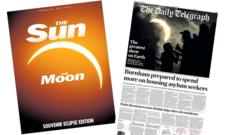
We love a good spectacle in the sky. When millions across Europe and parts of the globe recently craned their necks to watch a rare solar eclipse darken the afternoon, it felt like an ancient ritual playing out in real time. Newspapers splashed headlines about the moon meeting the sun, calling it the greatest show on earth.
It turns out our obsession with looking up has a chaotic history. Long before modern astronomy and live broadcasts, a series of sensational newspaper reports convinced New York that the moon was packed with unicorns, bipedal beavers, and flying man-bats.
The Penny Press and the Birth of Fake News
Back in August 1835, The New York Sun was a cheap tabloid sold on street corners for a single penny. It survived on working-class readers who wanted fast drama, crime stories, and scandal. Then, editor Richard Adams Locke published a piece claiming a famous British astronomer had discovered alien life using an impossibly massive telescope in South Africa.
Readers bought it completely. Yale students waited eagerly for the next installment. Missionaries even tried to figure out how to send Bibles to the lunar creatures.
The story was entirely fabricated. Locke meant it as satire to mock wild scientific theories of the era, but the public treated it as hard truth. Circulation skyrocketed, proving that people will believe almost anything if it sounds scientific enough and plays into our deepest cosmic curiosities.
Why Celestial Events Still Draw Crowds
Fast forward to today, and our collective reaction to a total solar eclipse proves we haven't changed much. When the moon crosses paths with the sun, blocking out the light and dropping temperatures, cities empty out. Millions travel hundreds of miles just to stand in the path of totality.
You don't need a telescope or a fake report about lunar bats to feel that same sense of wonder. Nature provides its own rare events. Governments deploy thousands of police officers for crowd control, and stores sell out of protective glasses weeks in advance because nobody wants to miss out.
The Danger of Believing What We Want to See
The gap between what we want to believe and what is actually happening gets narrow during big events. In 1835, people wanted life on the moon to be real because it made the universe feel less lonely. Today, misinformation spreads across social media during eclipses just as fast as newspapers printed hoaxes back then.
If you are tracking major celestial happenings, stick to verified astronomical data from agencies like NASA or local observatories rather than viral clickbait. Real science is wilder than a fabrication anyway.
Keep your certified viewing glasses handy, check reliable forecasts, and stop looking for man-bats on the dark side of the moon.


