Most people quit projects that take longer than a weekend. Karl Bushby spent nearly three decades doing one single thing: walking home.
On November 1, 1998, a 29-year-old former British paratrooper left Punta Arenas, Chile, with about $500 in his pocket, a two-wheeled cart, and an absurdly simple rule. To complete a true continuous-footstep journey around the world, he could not use any motorized transport to skip ahead. If he had to step away for a visa or a geopolitical barrier, he had to return to the exact spot where he left off and keep walking.
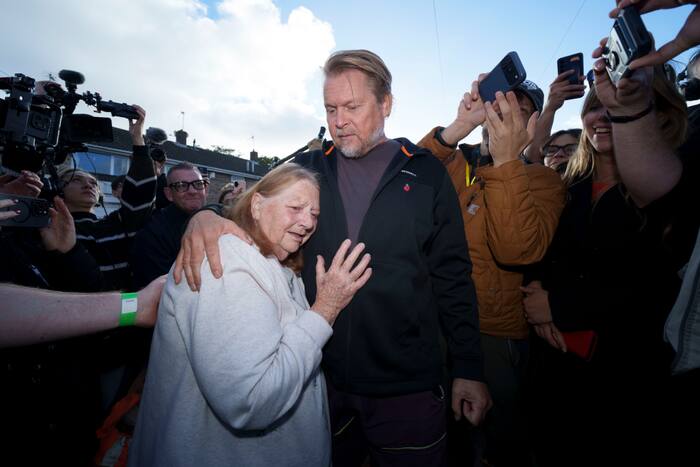
Twenty-eight years later, he finally walked up to his mother's rowhouse in Hull, England. The man who left as a young soldier returned at 57 years old—grayer, weather-beaten, and carrying the weight of 31,000 miles across four continents and 30 countries.
His mom opened the door with a question only a mother would ask: "Where have you been?"
The Brutal Math Behind the Goliath Expedition
Bushby originally figured the trek would take about 12 years. That was already an aggressively long timeline, but reality quickly shredded his schedule. Bureaucracy, hostile borders, visa denials, and global politics added nearly two decades of delays.
The rules of the Goliath Expedition meant he couldn't just catch a flight over a closed border or a restricted zone. He had to slog through literal ice, deserts, and detention cells. Early on, he crossed the freezing Bering Strait from Alaska to Russia on foot, navigating shifting pack ice with an expedition partner. Russia alone consumed years of his life due to tangled red tape, visa battles, and political freezes.
Every 90 days, administrative hurdles forced him to pause, regroup, and figure out how to satisfy foreign governments that didn't quite know what to do with a man walking across their territory with a handcart.
When the Finish Line Feels Like a Black Hole
You would think walking through the front door of your childhood home after 28 years would bring pure, unadulterated joy. For Bushby, the final stretch triggered a terrifying psychological crisis.
Just weeks before reaching England, he admitted to reporters that he felt a crushing sense of dread. For nearly three decades, his entire existence was defined by the next step, the next border, and the next physical obstacle. Survival was his routine. Purpose was built into every sunrise.
"I'm about to lose my purpose for living," he told reporters as the finish line closed in. "It's about to abruptly end."
Stepping off the road meant stepping into a modern society that had evolved past recognition while he was out on remote tracks. Smartphones, changing economies, and a sedentary lifestyle waited for him on the other side of his front door.
Surviving on the Kindness of Strangers
Bushby didn't cross the globe backed by a massive corporate sponsorship or a convoy of luxury support vehicles. He relied on human beings.
From tiny remote villages in Central Asia to bustling cities across Europe, everyday people fed him, gave him a place to sleep, and pointed him in the right direction. When asked how he pulled it off, he routinely credits the planet itself.
"They say it takes a village, but literally it took a world to get me here," Bushby told the crowds gathered in Hull. "The kindness of strangers, so many, from individuals to nation states to get me back here today. I didn't do this alone."
By the time he reached the final legs of Europe in 2025, crossing the Bosphorus Bridge and pushing toward Western Europe, new roadblocks appeared. When French rules and tunnel authorities blocked him from walking or taking standard routes across the English Channel, he didn't quit. He spent three grueling days swimming the English Channel, logging roughly 20 hours in the water and sleeping on a safety vessel before stepping back onto British soil at Shakespeare Beach in October.
What Comes After the Walk of a Lifetime
Most endurance athletes cross a finish line, lift a trophy, and fade into the corporate speaking circuit. Bushby faces a much harder transition: learning how to sit still.
He's considering retraining as a teacher, having discovered a genuine passion for speaking to students about his travels along the way. His personal gear, photographs, and artifacts from the road are heading into museum and gallery exhibitions to document one of the wildest human-powered feats in modern history.
He started the journey looking for a horizon. He ended it by answering a knock at his mother's door. Drop the excuses and take the first step toward whatever finish line you've been putting off.