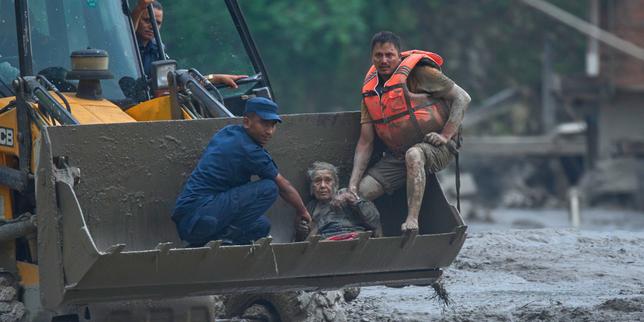
Water moves fast when mountains collapse. Late August 2026 brought a brutal wake-up call to the roof of the world, leaving entire communities buried under mud and rock. If you are tracking the aftermath of the catastrophic floods across Nepal and Tibet, you already know the numbers are grim. The death toll climbed past 470, while more than 1,400 people remain missing.
Behind these chilling figures lies a stark reality about our changing planet. This wasn't just heavy seasonal rain. It was a massive disaster born of high-altitude physics, warming ice, and geography that leaves zero margin for error.
The Trigger Behind the Disaster
People often assume mountain floods come from non-stop rainstorms. In this case, the root cause was far more violent. On August 26, 2026, an intense glacial collapse triggered a chain reaction in the Himalayas. According to the United States Geological Survey (USGS), a sudden ice and rock avalanche registered as a seismic event, unleashing a wall of debris and water down the slopes into valleys near the border.
When a glacier gives way, it doesn't just slide gently. It acts like a destructive battering ram. The debris choked rivers, formed unstable natural dams, and created flash floods that wiped out roads, bridges, and villages in minutes. Rescue teams in Nepal found themselves entirely cut off from the hardest-hit zones.
Things grew even more tense across the border. Chinese authorities had to halt emergency rescue operations in parts of Tibet. Why? Because a massive upstream retention lake threatened to burst its banks. When a natural dam forms from landslide debris, it fills up like a ticking time bomb. One heavy aftershock or sustained downpour can send millions of cubic meters of water crashing onto downstream towns.
Why the Hindu Kush-Himalaya Region Is a Flashpoint
You cannot look at this tragedy in isolation. The Hindu Kush-Himalaya region is warming at a rate that outpaces the global average. Scientists in Kathmandu have documented a terrifying trend: regional ice loss has doubled since the year 2000.
Think about what happens when glaciers vanish. The ice acts as natural cement for high-altitude rock walls. As it melts away, mountain slopes lose their structural integrity. Landslides become common. At the same time, meltwater pools into high-altitude lakes held back by fragile moraines. These glacial lake outburst floods, or GLOFs, happen with almost no warning.
Communities living along Himalayan river valleys are paying the ultimate price for a climate crisis they did little to create. Infrastructure built decades ago simply isn't engineered to withstand these sudden, high-energy mega-floods.
The Human Toll and the Search for Answers
The numbers tell an administrative story, but the ground reality is heartbreaking. Families searching for missing loved ones find themselves wandering through fields of thick grey sludge where houses used to stand. Roads are obliterated, making logistics a nightmare for local authorities.
International concerns spiked as details emerged about who was caught in the torrent. Officials noted that hundreds of foreign nationals and cross-border travelers were among the missing in remote parts of Tibet and northern Nepal.
Governments and international aid organizations are scrambling to deliver clean water, medical supplies, and temporary shelters. Yet, relief efforts remain painfully slow. When infrastructure crumbles overnight, helicopters are the only way in. Heavy cloud cover and continued rain risks keep grounding those flights.
Preparing for the Next Crisis
We need to talk about what comes next. Catastrophes like this will happen again unless adaptation strategies shift drastically. Early warning systems in high-altitude regions must be upgraded to detect glacial movements and lake swelling before they breach. Governments across South Asia need to restrict new construction in high-risk river corridors.
If you live in or travel through mountainous regions, you have to respect the volatility of modern weather patterns. The old seasonal rhythms are gone.
Check local geological alerts before heading into high-risk valleys, support regional climate resilience funds, and pay attention to how quickly our mountain ecosystems are shifting. The Himalayas are sounding an alarm we can't afford to ignore.