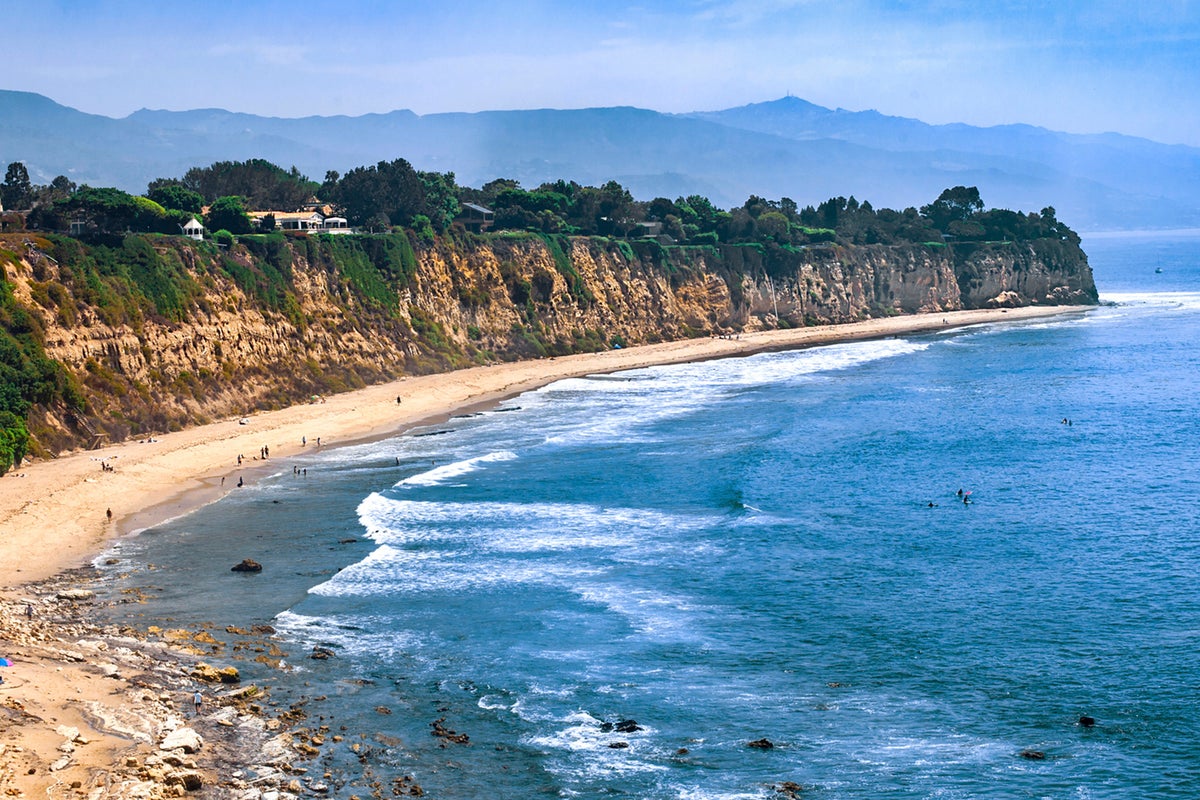
You can't drive down to the sand at Point Dume Beach right now. The Los Angeles County Department of Beaches and Harbors locked down Westward Beach Road past the pay gate and shut the main parking lot with zero timeline for reopening.
If you are planning a weekend trip to Malibu expecting a quick park-and-walk to the shoreline, you need to change your route immediately. Severe coastal erosion has chewed away at the asphalt and left unstable bluffs with terrifying eight-foot drop-offs. This isn't just a routine seasonal inconvenience. It's a flashing red light for Southern California infrastructure. For a closer look into similar topics, we recommend: this related article.
What Actually Happened to Point Dume
High tides and heavy surf didn't just arrive and vanish. They slammed into a coastline that was already deeply vulnerable.
Back in January 2025, the devastating Palisades Fire scorched the hills and destroyed multiple oceanfront homes along the Pacific Coast Highway corridor. When those houses burned, their protective seawalls went down with them. Without physical barriers to absorb the wave energy, subsequent storms and high-surf cycles hammered the unprotected burn areas. For broader context on this issue, extensive coverage can also be found on The Guardian.
The ocean advanced right up to the infrastructure. Underground water lines and meters serving restrooms one, two, and three were smashed by shifting earth, leaving those facilities completely non-functional. Temporary chemical toilets and hand-washing stations are currently serving as makeshift replacements while Los Angeles County Public Works engineers try to figure out what to do next.
Meanwhile, the California Highway Patrol closed Westward Beach Road at Birdview Avenue. If you try to cross the caution tape, safety cones, or physical barriers, you're risking a catastrophic drop or heavy fines.
The Double Threat of Waves and Rainfall
Most people think beach erosion is strictly a marine problem. Waves crash, sand disappears, cliffs retreat. Simple.
Reality is much worse. Coastal experts like University of California, Irvine climate scientist Kathleen Treseder point out that California faces a destructive two-front war. Atmospheric rivers drop massive volumes of rain onto saturated inland hills, triggering interior landslides and mud movement. At the exact same time, ferocious ocean swells batter the base of the sea cliffs.
The cliffs get eroded from the bottom by the surf and destabilized from the top by heavy rainfall. It's a crushing squeeze. Homeowners who live along these ridges check the cliffs outside their windows hourly because the ground literally shifts beneath their feet.
Why Traditional Seawalls Are Failing
For decades, the default fix for coastal erosion was simple: build a concrete wall or stack heavy boulders.
That playbook is officially dead. Hard armor solutions often deflect wave energy onto neighboring patches of sand, accelerating erosion right next door. Once a wildfire strips away the native vegetation holding the upper bluffs together, traditional barriers become completely useless against combined hydrological and marine stress.
Cities across Southern California are realizing that engineering our way out of sea-level rise with concrete is a losing battle. The ocean always wins in the end.
What You Should Do Instead
Don't let local road closures ruin your Pacific Coast Highway itinerary, but do adapt your expectations.
- Check live county beach advisories before leaving your house or hotel. Do not rely on old Google Maps pins that promise parking at the end of Westward Beach Road.
- Respect all barricades, caution tape, and sheriffs' warnings. The eight-foot drop-offs at the bluff edge are actively unstable and prone to sudden secondary collapses.
- Pivot your beach day to alternative public access points along the Malibu coast that maintain stable parking and functioning utilities.
Keep your eyes open, stay off closed paths, and stop treating coastal stability as a permanent guarantee.


