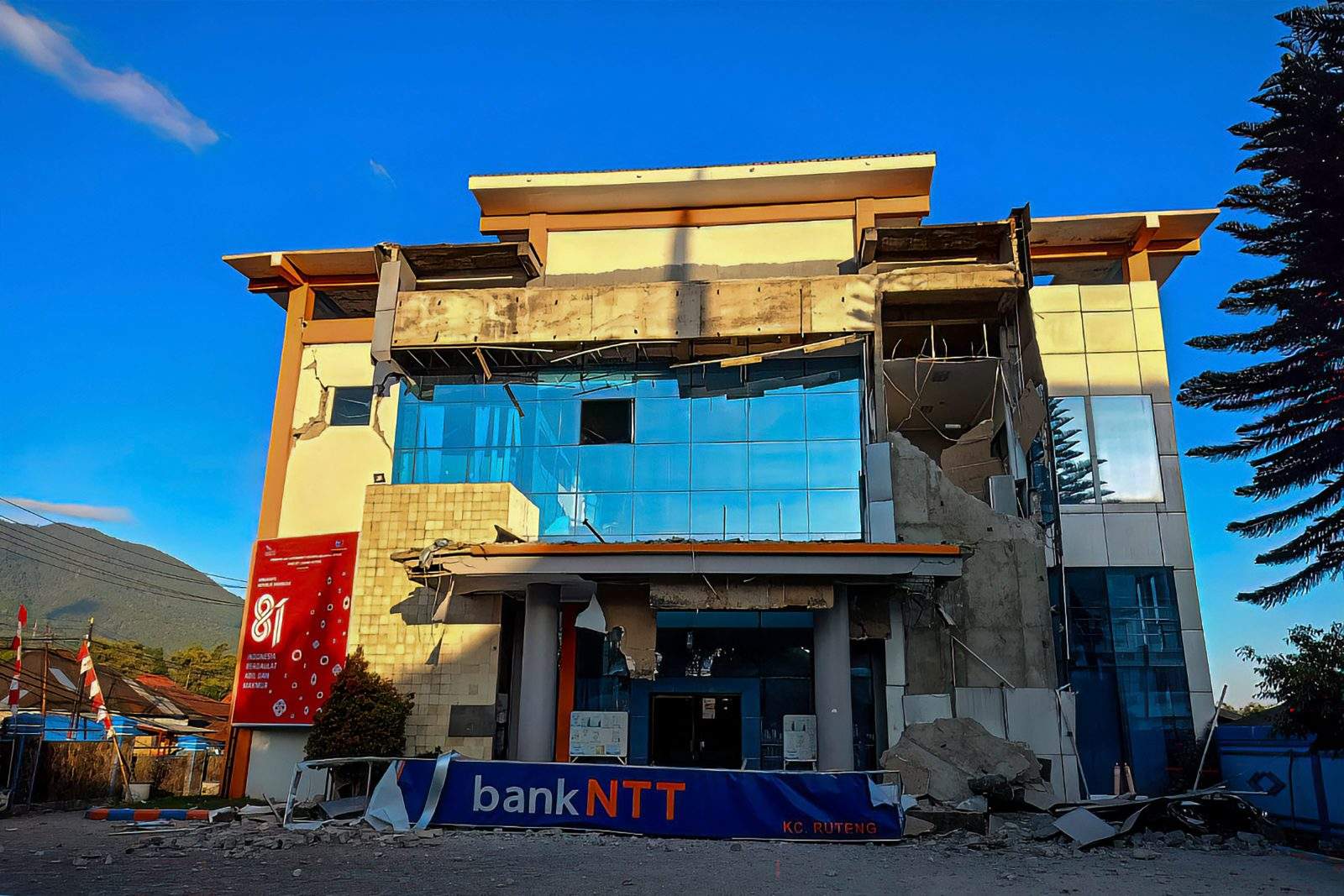
Early Saturday morning in Indonesia's Flores region, the earth tore open violently. A massive magnitude 7.7 earthquake struck off the coast, sending shockwaves through communities and forcing terrified residents to flee their homes.
If you're tracking the aftermath of this disaster, you already know the headline numbers: at least five people lost their lives, buildings crumbled into dust, and a frantic tsunami warning sent thousands scrambling for high ground. But official bulletins miss the chaotic reality on the ground. Let's look at what actually happened during those terrifying hours.
The Epicenter and Shallow Destruction
The U.S. Geological Survey pinned the earthquake at a shallow depth of just 10 kilometers, striking at 5:58 a.m. local time. Its epicenter sat roughly 68 kilometers north-northwest of Ende in the East Nusa Tenggara province.
Shallow earthquakes are notoriously dangerous. Because the rupture happens close to the earth's surface, the seismic energy doesn't dissipate before hitting populated areas. The result was severe structural damage across Flores Island.
Port terminals cracked open. Parts of the waiting room at the Maumere port collapsed entirely. At the Ritapiret Seminary, students and nuns scrambled in panic as the roof of their assembly hall caved in during morning prayers. One priest even broke his leg after jumping from a second-floor window to escape the collapsing structure.
Hospitals faced immediate crises. Medical staff had no choice but to roll beds, IV stands, and oxygen tanks outdoors, treating patients under the open sky while aftershocks rattled the region.
The Tsunami Panic and Why It Was Lifted
Minutes after the main tremor, Indonesia’s Meteorology, Climatology and Geophysics Agency (BMKG) issued an urgent tsunami warning. Officials urged anyone near the coastlines of East Nusa Tenggara, West Nusa Tenggara, and parts of Sulawesi to run inland or climb to higher ground.
People remember December 1992 too well. Back then, a magnitude 7.0 earthquake triggered a devastating tsunami that killed roughly 2,500 people on Flores. That generational trauma means a tsunami alert isn't just an advisory here—it's an immediate trigger for mass panic.
Fortunately, this time the sea behaved differently. BMKG officials canceled the warning hours later after monitoring stations confirmed no significant, destructive sea-level changes. Small waves were recorded, but the catastrophic wall of water everyone feared never materialized.
Living on the Edge of the Ring of Fire
Indonesia isn't unlucky. It's just built on restless geology.
Spanning more than 17,000 islands, the nation sits squarely on the Pacific Ring of Fire. Tectonic plates grind against each other here daily. Most tremors pass unnoticed, but events like this 7.7 magnitude monster serve as brutal reminders of nature's indifference.
Rescue teams are still combing through rubble. Aftershocks continue to shake the nerves of survivors sleeping on sidewalks and makeshift evacuation camps. Check local disaster mitigation agency updates if you have family in East Nusa Tenggara, and expect infrastructure repairs to take months.