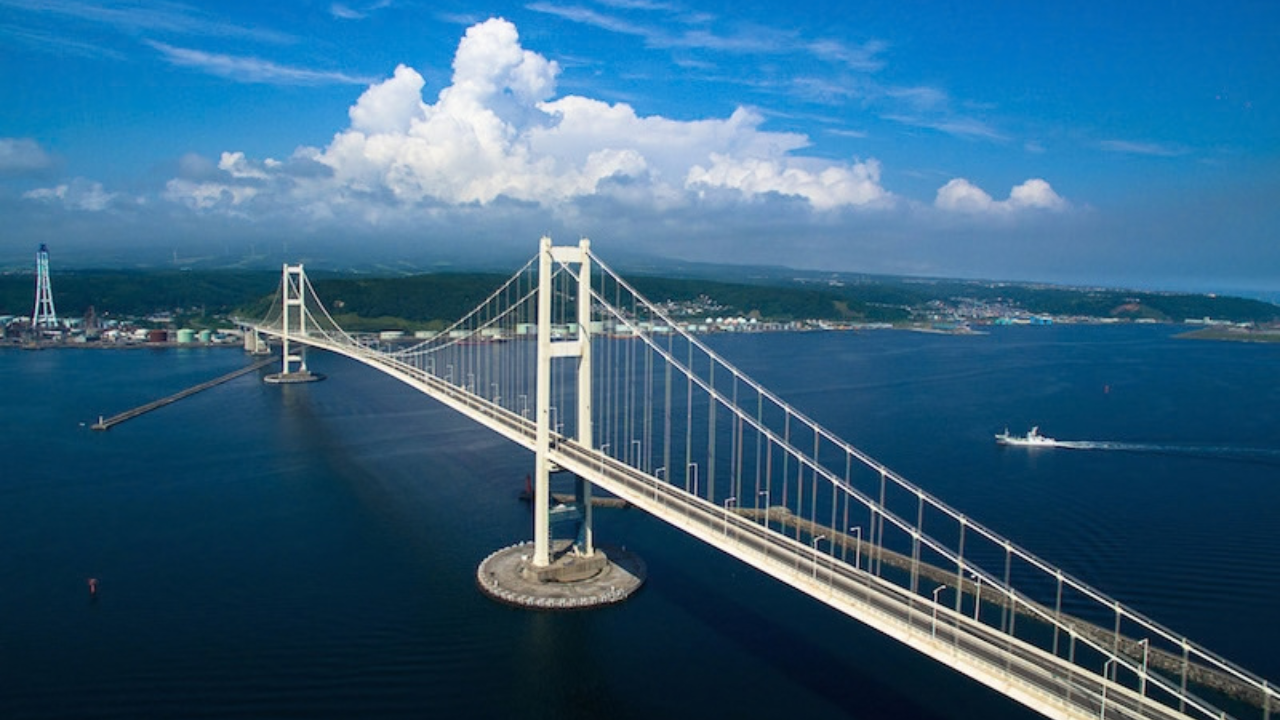
Engineering problems usually have standard textbook solutions. When you encounter a soft seabed 17 meters underwater, standard procedure tells you to dredge, dump heavy sand, or drive massive piles down to bedrock. But in the mid-1980s, the engineers planning Hokkaido's Hakucho Ohashi Bridge threw out the standard playbook. They looked at a massive pile of industrial waste and decided to pour it straight into the ocean.
The strategy sounded radical, even risky. Decades later, that unusual foundation is still holding up the towers of a giant bridge.
The Soft Seabed Trap at Muroran Port
Building the Hakucho Ohashi Bridge across Muroran Port wasn't straightforward. The main span needed to stretch 720 meters across deep coastal water, with the entire structure clocking in at 1,380 meters long. When crews surveyed the locations for the two main support towers, they hit a major roadblock. The seabed sat roughly 14 to 17 meters below the surface, composed entirely of soft, unstable sediment.
Constructing massive concrete tower foundations directly on this mushy ground was impossible. Crews needed a stable working platform around each tower base before any real heavy construction could begin.
Standard engineering practice called for filling large steel cofferdams with massive amounts of ordinary sand or soil. Yet, physics presented a harsh reality check. Filling those enclosures with conventional heavy fill would generate crushing lateral pressure against the temporary steel walls, risking catastrophic displacement or structural failure.
Engineers needed a material that could flow smoothly underwater, fill every corner of the cofferdam, and harden into solid ground without exerting excessive pressure on the temporary walls.
Turning Industrial Ash Into Solid Ground
The solution came from an unexpected source: coal-fired power plants.
Every day, power stations burn coal and produce massive quantities of fine powdery residue known as coal fly ash. For decades, disposing of this byproduct created logistical headaches and environmental concerns. Instead of treating it as useless trash, the project team formulated a self-hardening slurry combining coal fly ash, volcanic ash, cement, and seawater.
Between October 1988 and January 1989, construction crews pumped approximately 53,600 cubic metres of this unique slurry directly into the underwater cofferdams. The sheer scale of the operation was massive. The mixture contained roughly 46.1 gigagrams of fly ash, 22.2 gigagrams of volcanic ash, and 2.6 gigagrams of cement.
This liquid concoction hardened right on the seabed, forming artificial islands roughly 67 meters in diameter. Once cured, these solid platforms gave workers the stable working ground they needed to excavate and build the massive concrete tower foundations.
Why the Slurry Method Outperformed Standard Sand
Using industrial waste wasn't just an environmental gimmick; it solved specific mechanical hurdles that traditional fill materials simply couldn't touch.
Research published in the Journal of Materials in Civil Engineering highlighted how the self-hardening slurry behaved compared to standard sandy fill. Because the material set into a semi-rigid mass, it exerted substantially lower lateral earth pressure against the steel cofferdams. Lower pressure meant less bending, minimal displacement, and a much safer working environment for the crews on site.
Temperature played a fascinating role during the curing phase. As the chemical reactions inside the slurry took place, the material generated internal heat. Even during harsh winter conditions, temperatures inside the mixture remained above 10 degrees Celsius. This natural warmth allowed the slurry to develop proper strength despite the freezing marine environment surrounding it.
The Foundation That Kept Getting Stronger
Most construction materials reach their peak strength shortly after curing and then slowly degrade due to weathering and stress. The coal-fly-ash islands under the Hakucho Ohashi Bridge did something entirely different.
Long-term studies following the construction revealed that the unconfined compressive strength of the hardened slurry kept increasing for more than 10 years after placement. Continuous hydration reactions deep within the material structure kept binding the particles tighter over time. The composition of the coal ash used in the initial mix dictated how well this long-term strengthening process unfolded, proving that industrial byproducts could form infrastructure foundations that actually improved with age.
When the bridge officially opened to traffic in June 1998, the artificial islands had already fulfilled their primary mission. They provided a stable platform to build the main towers over a treacherous, soft seabed.
What This Means for Modern Infrastructure
More than 25 years after its opening, the Hakucho Ohashi Bridge stands as a testament to unorthodox engineering. Routine maintenance over the decades has focused on deck protection and pavement repairs, while the underwater fly ash foundations remain completely stable.
Projects like this change how you look at industrial waste. Instead of viewing fly ash as a disposal problem, innovative engineering turned it into an asset that could conquer difficult marine environments. When you cross a major bridge, you assume the foundations are made of standard quarried rock and poured concrete. Sometimes, the most resilient ground beneath our feet comes from the smoke stacks of yesterday.