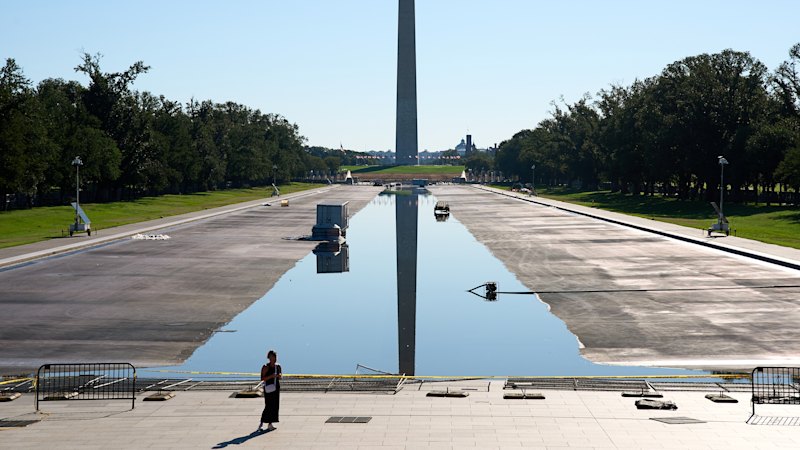
When a multi-million-dollar government renovation literally starts peeling away, someone has to take the blame. For months, the Trump administration insisted that the damage to the newly coated Lincoln Memorial Reflecting Pool was the work of malicious vandals wielding knives and razor blades. Prosecutors even went so far as to indict individuals, including a former Olympic canoeist, on felony vandalism charges.
Turns out, the vandals weren't to blame at all.
Internal government documents and contractor reports reveal a much more mundane and entirely avoidable reality. Atlantic Industrial Coatings—the firm hired under a $14.7 million no-bid contract—admitted that its own rushed work, chemical incompatibilities, and even worker sweat ruined the pool's "American flag blue" liner.
If you're wondering how a high-profile national landmark renovation went off the rails so spectacularly, you have to look past the political finger-pointing. Let's break down what actually happened during the Lincoln Memorial Reflecting Pool fiasco and why rushing big construction projects always backfires.
The Pressure of a Hard Deadline
Deadlines drive construction, but arbitrary deadlines destroy quality. The Trump administration wanted the Lincoln Memorial Reflecting Pool fully renovated and reopened in time for the United States' 250th birthday celebrations on July 4.
That tight timeframe triggered a chain reaction of shortcuts:
- Bypassing standard competitive bidding processes to award a rapid contract.
- Using an untested repair approach designed in part by a golf club general manager.
- Pushing workers to spray and layer coatings at breakneck speeds under the scorching Washington summer sun.
When you rush a multi-million-dollar public works project, margin for error shrinks to zero. In this case, human oversight and faulty engineering proved fatal to the pool's finish.
Chemical Clashes and Worker Sweat
Why did the blue liner peel? The contractor's own August 14 and September 2 reports tell a fascinating story of engineering failures.
First, human error played a direct role. In several sections of the pool, workers simply didn't spray enough primer. Without adequate primer, the distinct layers of the coating couldn't bond properly.
Second—and more critically—the repair plan itself required mixing two chemical compounds that turned out to be chemically incompatible. The top chemical compound reached temperatures far higher than the bottom layer could withstand. That excess heat caused the base layer to blister, bubble, and pull away entirely from the concrete slabs underneath.
To make matters worse, the contractor later identified another bizarre culprit: sweat. Workers wearing heavy protective suits in the humid Washington heat were leaving droplets of perspiration trapped between the sprayed layers. Workers reportedly had to open their suits and wrap cloth around their heads and wrists just to keep the moisture out of the epoxy.
The Political Reversal and Dismissal of Charges
The fallout wasn't just physical; it was legal and political. Federal prosecutors had originally run with the administration's narrative, slapping felony charges on citizens accused of slicing up the pool liner.
By late July, reality caught up with the rhetoric. US Attorney Jeanine Pirro moved to dismiss the charges after discovering that the Interior Department had misled prosecutors about the true cause of the damage. The Justice Department dropped the cases because the peeling was clearly the result of a botched installation, not a knife attack.
Even after the charges were dropped, public messaging lagged behind the facts. Officials continued to suggest that vandals had reached into the pool to rip at the coating, while Donald Trump conceded on social media that contractor rushing played a role, though he minimized it as a "very small area."
Documents show otherwise. Power-washing the pool required filling massive rubbish bags with chunks of discarded liner, while workers had to resort to razor blades, hammers, and crowbars to scrape off stubborn remnants stuck to the concrete.
What We Can Learn From the Reflecting Pool Debacle
Major infrastructure updates require patience, rigorous testing, and experienced oversight. When speed supersedes engineering standards, projects fail.
If you manage projects or oversee contractors, take these concrete steps to avoid a similar fate:
- Never skip competitive bidding: Competition ensures competence and filters out vendors who overpromise on timelines.
- Test chemical compatibility: Always verify that multi-layer coatings or compounds won't react adversely under thermal stress.
- Allow buffer time in schedules: Environmental factors like extreme heat, humidity, and labor constraints demand realistic padding in construction timelines.
The Lincoln Memorial Reflecting Pool remains drained while Atlantic Industrial Coatings attempts repairs under warranty. Next time, slow down and get the chemistry right the first time.