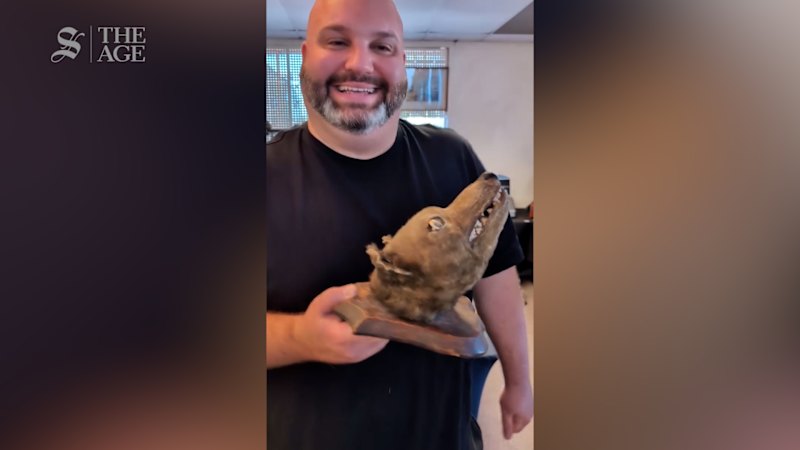
A taxidermist in England recently walked away from an auction with what is arguably the most significant natural history find of the decade. He paid £60,000 for a preserved animal head that the previous owner thought was a fox. It turns out, that "fox" is likely the only known taxidermy head of a thylacine, or Tasmanian tiger, left in existence.
If you’re wondering how something that rare could end up at a local market for the price of a cheap dinner, you aren't alone. It’s a wild story that highlights how easily history slips through the cracks.
The Mistake That Saved a Treasure
The previous owner didn't know what he had. He bought the taxidermy head for around £50 at an antique market, mostly because he thought the plastic, movable eyes were amusing. For years, it sat in obscurity, labeled as a common fox.
James Cranfield, a professional taxidermist and collector based in Essex, saw the auction listing and felt that something was off. He wasn't just looking at the eyes. He was looking at the mouth.
Cranfield knew his anatomy. Foxes and domestic dogs are canids; they have a very specific dental structure. When he scrutinized the teeth of the specimen, he realized it wasn't a canine at all. He spotted eight upper incisors. Dogs and foxes only have six.
That specific anatomical detail is the smoking gun. The thylacine—a carnivorous marsupial that went extinct in 1936—possesses a dental layout that is distinct from the placental predators that evolved on other continents. Once he saw those eight teeth, Cranfield knew he wasn't looking at a fox. He was looking at the "holy grail."
Why the Thylacine Still Matters
The thylacine captures our imagination because it’s a cautionary tale of human negligence. Bounty hunters and habitat loss drove them to extinction, with the last known specimen, "Benjamin," dying in the Hobart Zoo. For years, we thought we’d lost everything.
Finding this head isn't just about a cool antique; it’s about biological record-keeping. Because the thylacine was a marsupial, its evolutionary path is fascinating to scientists who study how predators develop in isolated environments. Every scrap of tissue or bone left behind offers researchers a chance to understand the species better.
Some researchers are actively looking into "de-extinction" projects, attempting to use DNA to bring the species back. Whether you think that’s visionary science or a media-hungry gimmick, having a rare specimen like this head is a major asset for genomic research.
The Reality of Owning Extinct Remains
You might wonder if you can just go out and buy rare animal remains. The answer is: proceed with extreme caution. Owning remains of endangered or extinct species is heavily regulated. In many countries, you need ironclad provenance—documentation that proves the item is an antique and was collected before strict protections were enacted.
Cranfield now plans to have the specimen scanned and authenticated. He has expressed a willingness to lend it to museums and research institutions, which is exactly where an item of this historical significance belongs. If he hadn't stepped in, this piece of history could have stayed in a private home, or worse, been thrown out by someone who truly believed it was just a "funny-looking fox."
What Comes Next for the Specimen
The next step is the scientific verification process. Cranfield needs to use advanced imaging to confirm the origin without damaging the taxidermy. If the DNA and skeletal markers align, it confirms this as a one-of-a-kind discovery.
This story is a reminder to keep your eyes open. Antique markets and estate sales are still graveyards for historical artifacts. Most of the time, that "odd item" is just junk. But once in a generation, it’s a missing piece of the natural world.
If you're into collecting, don't just trust the labels. Study the anatomy. Learn the dental structures. Check the provenance. History isn't just in textbooks—sometimes it's sitting in a box at a local auction, waiting for someone who actually knows what they're looking at to pick it up.
Stop assuming everything has been discovered. There is still a lot of lost history hiding in plain sight. Keep your eyes on the details, because that’s where the truth usually hides.