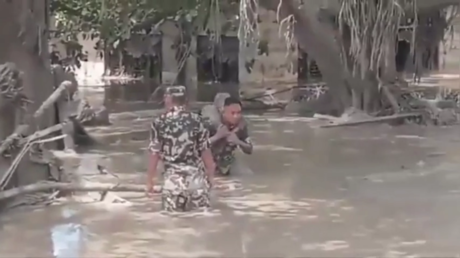
When a massive wall of mud, rock, and water tore down the Bhote Koshi River into Nepal’s Rasuwa district, it didn't just wipe out roads and hydropower plants. It exposed a brutal contradiction at the heart of Himalayan modernization. Rasuwa has long stood as a crown jewel of regional infrastructure growth and cross-border trade with China. Yet that exact economic integration turned into a death trap when a high-altitude ice and rock avalanche triggered a catastrophic debris flow, leaving scores dead and hundreds missing.
You're looking at a region that spent years building up its economic potential, only to watch it get flattened in a matter of minutes. Let's look at why this disaster happened, what people get wrong about modern development in fragile mountain zones, and why the physical reality of the Himalayas always wins.
The Paradox of Rapid Himalayan Growth
For years, development planners treated the Rasuwa district and the Rasuwagadhi border corridor as a vital economic lifeline. Roads were paved, customs offices expanded, and multiple hydropower projects came online to power local towns and export energy. Tourists and pilgrims crossed through in droves, heading toward Tibet on upgraded tracks.
The strategy worked on paper. Money flowed, jobs appeared, and remote mountain communities felt connected to the global economy.
The mistake planners make is assuming concrete and asphalt can tame dynamic geology. The steep slopes of the Himalayas are constantly shifting. When a glacier collapse or a high-altitude ice avalanche occurs miles upstream—such as the recent event near the Lhende Khola—infrastructure built right on the riverbanks acts as a target rather than a defense.
What Actually Triggered the Rasuwa Disaster
Initial reports pointed toward a sudden seismic event, with the USGS noting that a massive landslide generated seismic waves equivalent to a 5.2 magnitude event. But calling it a simple earthquake misses the point.
The core mechanics of the disaster involve cryosphere instability. Rising global temperatures are destabilizing high-altitude ice and permafrost across the roof of the world. When a massive mass of ice and rock breaks loose, it slams into narrow river gorges, creating a debris-laden surge.
Water levels on the Trishuli River spiked by up to nine meters in just thirty minutes. That kind of velocity gives communities zero time to evacuate. Sirens don't help when the riverbed itself rises overnight and bridges vanish before dawn.
Economic Ambition Versus Geological Reality
Local authorities are now tallying the human and financial toll. Dozens of bodies have been recovered, while hundreds of tourists, locals, and cross-border traders remain unaccounted for. Critical infrastructure like the Chilime Hydropower Project and police posts were smashed to pieces.
You can't insure against a mountain collapsing. Governments want economic corridors to drive growth, but they often ignore the compounding risks of putting heavy infrastructure in narrow, flood-prone gorges. Every new road cut into a cliffside destabilizes the slope further. Every hydropower dam alters sediment flow, creating a delicate balancing act that nature disrupts with a single avalanche.
Practical Lessons for High-Risk Mountain Regions
If you are studying disaster management or investing in infrastructure projects across fragile mountain belts, you have to throw out old planning playbooks.
- Move heavy permanent structures away from active floodplains and narrow gorge bottoms, no matter how convenient the terrain looks for transport.
- Install real-time upstream acoustic and satellite sensors that can detect glacial lake outbursts or massive slope failures before the water hits populated zones.
- Build redundancy into energy and transport networks so that the destruction of a single corridor doesn't cut off entire districts from rescue operations.
The tragedy in Rasuwa proves that economic development without geological humility is a gamble you eventually lose. The mountains are changing faster than our engineering standards can adapt.