For years, science fiction promised us total invisibility. We got cloaks that bent visible light or made people vanish on a cinema screen. But in the real world, the physics of heat always gave the game away. If you hide an object behind a flat thermal shield, an infrared camera still spots the weird temperature anomaly or the edges standing out like a sore thumb.
That is changing.
Researchers at the University of Illinois Urbana-Champaign, alongside collaborators at the Technical University of Denmark, built something that bridges the gap between lab theory and reality. Led by civil and environmental engineering professor Shelly Zhang, postdoctoral researcher Weichen Li, and graduate student Yibo Wang, the team successfully engineered a true three-dimensional thermal invisibility cloak. Published in Nature Communications, this device doesn't just block heat—it bends it smoothly around intricate shapes while shielding whatever is inside from extreme temperatures.
Why 2D Thermal Cloaks Fell Short
If you look back at earlier attempts at thermal manipulation, you'll notice a massive limitation. They only worked in two dimensions or required heat to move in one strict, predictable direction. Nature doesn't work that way. Heat flows from all angles, and objects in the real world are rarely flat or simple.
Transformation thermotics is the mathematical study of how heat moves through materials. For a long time, researchers understood the equations on paper, but turning those equations into actual physical properties was brutally difficult. You needed a material whose thermal conductivity could be adjusted independently in multiple directions. Previous prototypes failed the moment you tested them against complex geometries or multidirectional heat sources.
The Illinois team solved this by changing the physical architecture of the shield itself.
Inside the Metal Lattice Design
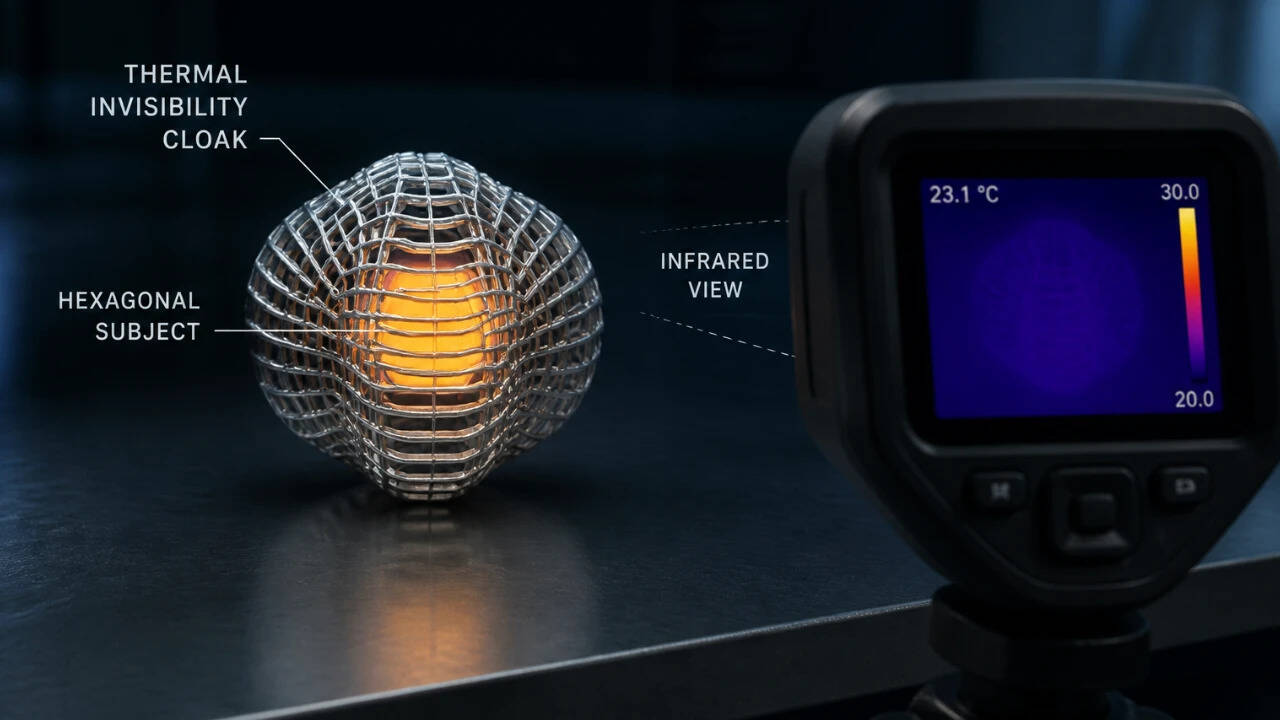
The breakthrough relies on a specialized lattice structure. Instead of solid blocks of material, the researchers designed a meshy aluminum framework—think of a complex lettuce-like structure—and filled the empty spaces with a rubber-like insulating compound.
By varying the geometry of this aluminum lattice along three distinct directions, the team gained precise control over how heat flows through the structure. When they manufactured these prototypes using advanced metal 3D printing, they created a system that forces external heat to navigate around the hidden void rather than crashing straight into it.
When placed between hot and cold zones during testing, the device performed exactly as the math predicted. Infrared cameras pointed at the setup did not see a hot spot or a distorted anomaly. They saw a smooth, uniform temperature gradient as if nothing was even there.
Even more impressive? The team successfully tested the cloak on intricate three-dimensional figures, including complex geometries resembling human heads. Earlier iterations would have completely distorted the thermal map under those conditions.
What This Means for Real-World Engineering
You might wonder where a device like this actually matters outside of an academic lab. The applications stretch across several major industries.
First, consider high-performance electronics. Microchips, power systems, and dense computing hardware generate massive amounts of localized heat. Managing that heat without destroying adjacent components is a constant battle for hardware engineers. A 3D thermal architecture allows precise control over thermal pathways, routing heat away from sensitive regions while protecting delicate parts from external temperature spikes.
Second, there's the defense and security sector. Anytime you need to mask the thermal signature of valuable assets or secure installations from infrared detection, advanced thermal management becomes critical. As Professor Zhang points out, the core principle is about controlling and protecting information carried by heat.
The Roadblocks Ahead
Before you picture sci-fi stealth suits marching across a battlefield, honesty requires noting the massive hurdle still left on the table.
This current iteration works by redirecting external heat around a concealed space. It keeps the inside safe and tricks the infrared camera into seeing a blank background. But what happens if the object itself generates heat?
Active heat generators—like running engines, active electronics, or living organisms—radiate thermal energy from the inside out. Redirecting ambient room heat doesn't solve the problem of internal thermal radiation bleeding through the barrier. Building a cloak that can manage and neutralize heat produced from within remains the next big mountain for researchers to climb.
Solving that puzzle will take the technology from passive defense to active thermal concealment. For now, this 3D lattice breakthrough marks a massive leap past flat-surface limitations, proving that managing heat flow in three dimensions is no longer just a math problem on a chalkboard.