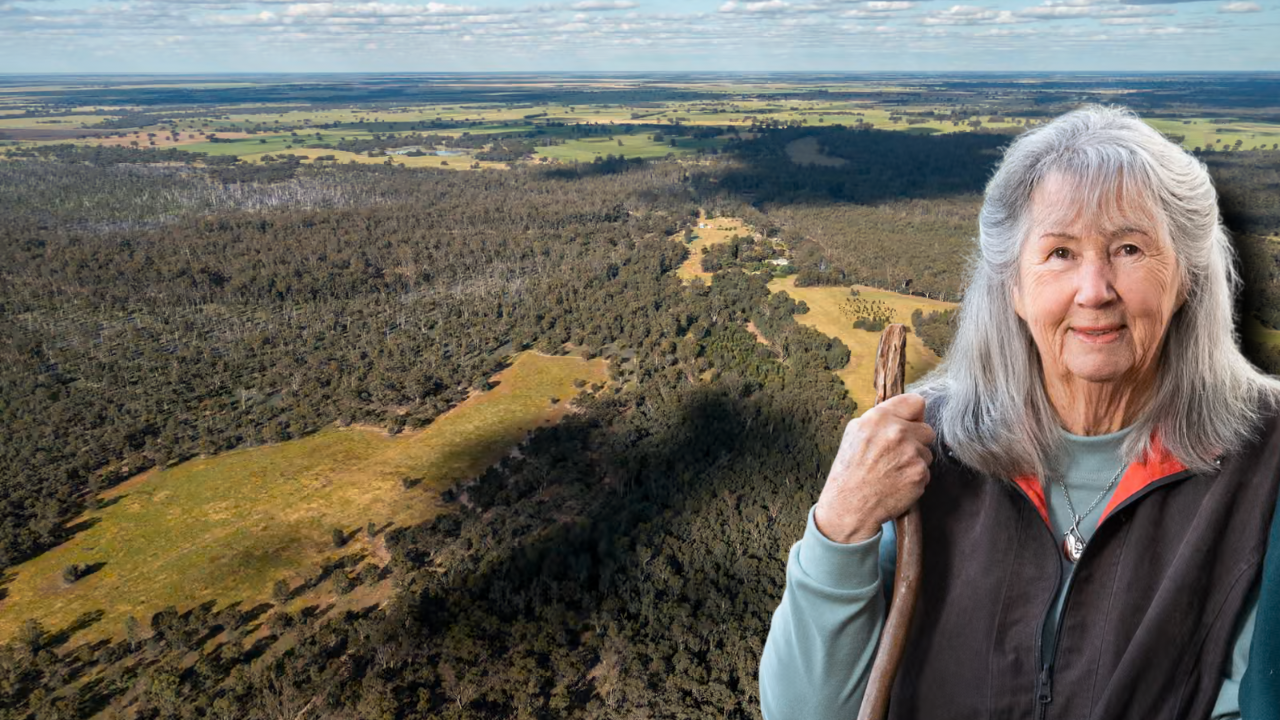
Most people retire to play golf or travel. Susan Downes bought an old farmhouse in York, Western Australia, and decided to bring an entire hill back to life.
When she first inspected the property in her sixties, she wasn't looking for a massive environmental undertaking. She wanted a quiet country house. But a walk to the back of the land revealed Mount Mackie, a 295-metre hill holding ancient York gums and wandoos that had survived a century and a half of grazing. The trees were there, but the understorey was completely gone. The soil was tired, and the landscape was begging for intervention.
Now, at 76, this retired general practitioner has restored 120 hectares of her 200-hectare property. She has planted roughly 45,000 native seedlings by hand and watched as another 45 plant species re-emerged naturally from the soil's dormant seed bank. It is an extraordinary feat of individual ecological restoration, proving that private landowners can make a massive dent in land degradation.
Finding Connection Through Ecological Restoration
Downes started her professional life as a botanist before pivoting to medicine. That foundational plant knowledge gave her a head start, but large-scale restoration is brutal physical work. It takes more than passion to fix a broken landscape. You need capital, stubborn patience, and an active strategy against invasive species.
Her first move wasn't planting trees. It was predator control. She secured a local grant to manage foxes and feral cats, which wreaked havoc on native wildlife and ground-nesting birds. Once the pest pressure dropped, she secured funding for her first batches of trees, scaling up her efforts over nearly two decades.
Restoring land at this scale requires understanding how ecosystems bounce back when given half a chance. Many modern landowners assume you have to replant every single blade of grass or shrub. Downes discovered that the earth often remembers what it used to be. Once grazing pressure stopped and weeds were cleared, native species started popping up from the underground seed bank all on their own.
The Power of Community Action
Nobody accomplishes a project of this magnitude in isolation. Downes leans heavily on community involvement through the Friends of Mt Mackie, a volunteer network featuring a core group of about eight dedicated locals alongside more than 80 occasional participants who show up for mass planting and seed-collection days.
Private land conservation often fails when the original owner burns out or passes away. Downes knows this reality well, noting how the aging of her peers and unexpected health crises brought mortality into sharp focus. To prevent future owners from undoing her decades of labor, she is working to place the restored land under a strict conservation covenant. This legal arrangement locks in protection against future clearing and development, ensuring Mount Mackie stays wild long after she is gone.
The project also bridges modern conservation with indigenous heritage. Ballardong women from York visit the hill multiple times a year for cultural healing sessions. Downes works closely with Ballardong elders to honor the land's original custodians, planning community events that look toward a sustainable future.
What Property Owners Can Learn From This Effort
If you own land—whether it is a sprawling rural acreage or a modest suburban plot—you can apply these exact principles to restore biodiversity.
- Kill the pests first: Planting trees while invasive predators and herbivores run rampant is a waste of money. Protect your seedlings by managing grazers and pests before putting shovels in the dirt.
- Trust the seed bank: Stop fighting every native weed immediately and look at what grows naturally when you remove livestock and reduce soil compaction. Nature often has a backup plan buried under the dirt.
- Secure the future legally: If you invest time and money into fixing a piece of land, look into local conservation covenants or land trusts to protect your work from future owners who might not share your vision.
Individual action matters. You do not need a government decree or a multi-million-dollar corporate endowment to reverse habitat loss. You just need persistence, dirt under your fingernails, and the willingness to start small.