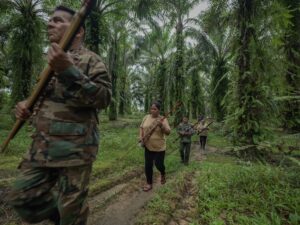
You rarely hear about the people who actually keep the earth alive. They don't sit in air-conditioned boardrooms in Geneva or draft empty climate pledges at international summits. They stand in front of bulldozers, patrol ancestral forests at night, and block illegal mining operations with their bare hands. And increasingly, they pay for it with their lives.
According to data compiled by Global Witness in their report titled Collective Power, at least 124 land and environmental defenders were killed globally in 2025 alone. That number brings the total tracked death toll since 2012 to a staggering 2,375. Don't let a minor year-over-year dip fool you into thinking the situation is improving. The danger has simply evolved. The boots on the ground are fighting a massive global resource war, and the powers driving the violence are adapting faster than the laws meant to protect them.
The Front Lines of a Global Resource War
When a forest gets clear-cut for timber, or a river gets poisoned by wildcat mining, someone usually tries to stop it. That someone is almost never a wealthy lobbyist or a government regulator. It is a local farmer, an indigenous guard, or a community leader who relies directly on that ecosystem to survive.
The data tells a grim story about who bears the heaviest burden. Indigenous peoples and small-scale farmers accounted for nearly three-quarters of all defenders killed in recent tracking cycles. These communities aren't fighting out of abstract environmentalism. They are fighting for their homes, their water, and their physical survival. When loggers and syndicates move in, they view these traditional populations as an inconvenient obstacle to profit.
Take the Amazon or the remote regions of Southeast Asia. Industrial expansion doesn't happen peacefully. It requires displacing people who have lived on the land for generations. When those people refuse to leave, the corporate machinery and criminal networks behind the extraction often turn to brute force.
Beyond the Body Count: The Hidden Iceberg
Murders get the headlines, but they are only the tip of a much larger pyramid of intimidation. Human rights groups accurately describe non-lethal repression as a hidden iceberg.
Governments and corporate actors have learned that killing an activist sparks international outrage and messy investigations. Instead, they increasingly rely on silent tactics that grind opposition down over years. We are talking about malicious criminal charges, digital surveillance, smear campaigns, and targeted online harassment.
Social media platforms get weaponized to destroy a defender's reputation within their own region. Activists find themselves tied up in endless court cases, drained of money, and isolated from their communities. In countries where civic freedoms are heavily restricted—categories ranging from repressed to entirely closed down—the legal system becomes just another weapon for land grabbers. You don't need a hit squad if you can simply throw a community leader in prison on trumped-up charges of sedition or trespassing.
The Dangerous Convergence of Crime and Conservation
Environmental defense used to be about standing up to corrupt local officials or logging companies. Today, it frequently means going toe-to-toe with transnational organized crime.
Illegal gold mining, drug trafficking syndicates, and large-scale poaching operations have merged with legitimate supply chains. They launder money through timber exports and agricultural products. When indigenous guards form patrols to protect their borders, they aren't just clashing with corporate security; they are intercepting dangerous criminal syndicates.
That shift changes the stakes entirely. Communities are left completely exposed because local state institutions are either entirely corrupt or too weak to push back. When governments abandon these remote areas, local people have to build their own security networks just to stay alive.
The Disappearing Safety Net
Compounding the crisis is a quiet financial retreat by the international community. Recent budget cuts from major global donors in the United States, Europe, and the UK have slashed foreign aid funding for human rights groups.
That money isn't lost in abstract bureaucratic accounts. It pays for satellite phones in remote rainforests, legal defense funds for jailed activists, and security training for indigenous guards. When that funding dries up, defenders standing in the path of heavy machinery are left completely alone.
We can't talk seriously about stopping climate change while allowing the people protecting the most crucial carbon sinks on earth to get hunted down. Protecting the environment isn't just about reducing emissions or planting trees. It requires keeping the people alive who stop the destruction before it starts.