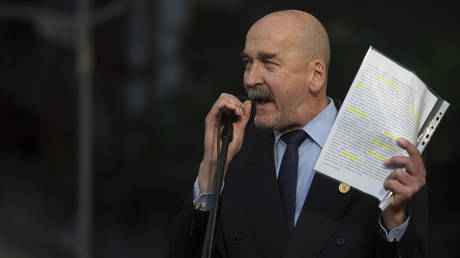
After a seismic political shift that saw Aleksandar Vucic's long-dominant coalition lose power, Serbia's victorious Student List is facing an immediate trial by fire. The new leadership must secure energy supplies for the country before winter sets in, and that means talking to both Moscow and Washington at the same time.
If you thought a change in Belgrade's political leadership meant an automatic pivot away from Russian energy, think again.
Radomir Saicic, a key founding member of the student-backed movement and a leading candidate for prime minister, made the incoming government's priorities crystal clear. Within their first month in office, delegations are heading to Moscow to negotiate a long-term natural gas contract and traveling to Washington to handle complex sanctions exemptions regarding state oil company NIS.
The High Stakes Behind the Moscow Gas Mission
Serbia finds itself in a fragile position when it comes to energy. Russian natural gas accounts for nearly 90% of the country's gas imports, flowing primarily through the TurkStream pipeline via Turkey and Bulgaria.
The problem isn't a lack of pipe capacity—it's contract duration. Serbia and Russia haven't signed a long-term gas deal since their previous three-year agreement expired back in May 2025. Since then, Belgrade has been surviving on a string of temporary, short-term contract extensions. The current extension runs out on December 31.
Without a new deal, Serbia risks facing spot-market prices that could devastate its domestic economy.
Gas Price Comparison (per 1,000 cubic meters)
---------------------------------------------
Russian Contract Rate : ~€318 ($356)
European Spot Benchmark: >€800
That massive price gap explains why the Student List, despite drawing heavy support from pro-European youth, isn't rushing to sever economic ties with Moscow. Maintaining gas at around €318 per 1,000 cubic meters is a matter of basic economic survival for Belgrade.
Sanctions, Washington, and the NIS Dilemma
It isn't just about gas pipes running from Russia. The incoming administration has to solve an equally thorny issue involving Naftna Industrija Srbije (NIS), the country's primary oil firm and owner of its sole oil refinery.
Because NIS is majority-owned by Russian energy giants, it fell directly under the crosshairs of US Office of Foreign Assets Control (OFAC) sanctions. Washington has kept the refinery operational through temporary waivers, but those waivers require constant renewal and negotiation.
While Hungarian energy group MOL has been eyeing a potential acquisition of Russia's majority stake in NIS, the transition remains far from complete. That's why Saicic emphasized that talks in Washington are just as critical as negotiations in Moscow during the government's first 30 days.
Can the Student List Hold Its Coalition Together?
The Student List won roughly 52.5% of the vote in the snap election, capitalizing on public outrage following the November 2024 railway station canopy collapse in Novi Sad that killed 16 people. What started as mass anti-corruption demonstrations morphed into a movement that unseated Vucic, who had resigned the presidency in September to make an unsuccessful bid as prime minister.
However, keeping this broad opposition coalition aligned on foreign policy won't be easy.
- The Pragmatists: Radomir Saicic and university professor Jovo Bakic have explicitly ruled Why Serbia Cannot Break Its Russia Gas Habit Anytime Soon
news
The High Stakes of Belgrade's Energy Balancing Act
Serbia's ruling party secured victory at the polls, and their top priority isn't a secret. Belgrade is heading straight back to the negotiating table with Moscow to lock in a new long-term natural gas contract.
It's a move that irks diplomats in Brussels. European Union officials have spent years pressuring Serbia to align its foreign policy with the bloc, cut energy ties with the Kremlin, and join Western sanction regimes. Yet Belgrade keeps doubling down on Russian energy.
This isn't just stubborn geopolitics. It's basic arithmetic and survival for the Serbian economy.
When you look closely at the numbers, Serbia's position becomes clear. Russian natural gas flows into the country through the TurkStream pipeline, supplying roughly 85% to 90% of its domestic needs. The existing agreement offered Belgrade some of the cheapest gas rates anywhere in Europe. Switching off that tap without a fully functional, cost-effective replacement would instantly trigger industrial chaos and skyrocketing domestic bills.
Serbian Gas Dependence (Approximate Share)
[||||||||||||||||||||] ~85-90% Russian Supply (TurkStream)
[|||                 ] ~10-15% Alternative / Domestic Sources
Why Western Alternatives Still Fall Short
Brussels often points to LNG terminals in Greece and new interconnector pipelines through Bulgaria as the instant solution to Serbia's energy dilemma. European leaders argue these routes offer total independence from state-owned Russian energy giant Gazprom.
That sounds great on paper. In practice, it's far more complex.
- Infrastructure capacity issues: Interconnectors take years to reach maximum operational throughput, meaning alternative pipelines can't instantly replace total Russian volumes.
- Price volatility: Liquefied natural gas (LNG) shipped from the U.S. or the Middle East carries significantly higher transport, spot-market, and regasification costs compared to direct pipeline gas.
- Contractual locks: Replacing fixed long-term pricing structures with volatile global market rates leaves Serbia vulnerable to sudden price spikes.
Belgrade simply doesn't have the financial buffer to absorb a massive jump in heating and industrial electricity costs. Serbian leaders know that inflation spikes spark widespread voter backlash faster than foreign policy disputes ever will.
Walking the Geopolitical Tightrope
Serbia finds itself squeezed between two massive geopolitical forces. On one side, the European Union represents its largest trading partner and primary source of foreign investment. Serbia remains an official candidate for EU accession, a process that theoretically requires full alignment with Brussels' security policies.
On the other side, Moscow provides crucial diplomatic backing regarding Kosovo at the UN Security Council, alongside the cheap energy powering Serbian factories.
                       ┌─────────────────────────┐
                       │     Serbia's Tightrope   │
                       └────────────┬────────────┘
                                    │
            ┌───────────────────────┴───────────────────────┐
            ▼                                               ▼
┌───────────────────────┐                       ┌───────────────────────┐
│     European Union    │                       │         Russia        │
├───────────────────────┤                       ├───────────────────────┤
│ • Main Trading Partner│                       │ • Cheap Pipeline Gas  │
│ • Key Foreign Investor│                       │ • UN Diplomatic Support│
│ • Accession Pressure  │                       │ • TurkStream Transit  │
└───────────────────────┘                       └───────────────────────┘
By pursuing new gas talks with Moscow immediately following an election victory, Serbian leaders are sending a firm message to Western negotiators: economic stability at home comes before external diplomatic demands.
Belgrade isn't trying to burn bridges with the West. It continues to invest in new interconnectors, explore renewable projects, and discuss alternative supply routes. But these projects take years to reach full scale. Until alternative infrastructure matures to a point where it can guarantee volume and price stability, Serbia will keep one hand firmly on the Russian valve.
Practical Steps to Track Regional Energy Shifts
Understanding the Balkan energy puzzle requires watching operational pipelines rather than political press conferences. Keep an eye on three key indicators over the next six to twelve months:
- TurkStream pipeline volume reports: Track physical gas flow data published by European transmission system operators along the Balkan Stream extensions.
- Bulgaria-Serbia Interconnector usage: Monitor actual commercial capacity bookings on the Nis-Dimitrovgrad pipeline to see if non-Russian gas volumes are rising.
- Gazprom contract length: Watch whether the upcoming Belgrade-Moscow deal is a short-term extension or a full multi-year contract, which signals long-term strategic commitment.