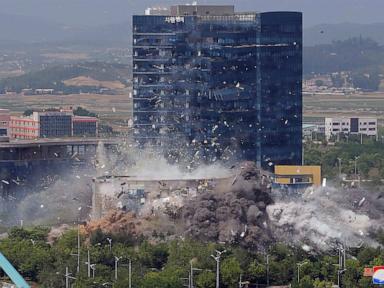
A South Korean court just handed down a massive judgment against Pyongyang, ordering the regime to cough up 44.6 billion won—roughly $32.5 million USD—for blowing up the inter-Korean joint liaison office in Kaesong back in 2020. It sounds like a decisive win on paper. Seoul's central district court granted the full claim.
Here is the catch. Pyongyang isn't going to pay a single dime.
If you are wondering how a court expects to collect money from an isolated, nuclear-armed state that treats its southern neighbor as its absolute principal enemy, the short answer is that it cannot. This legal action, initiated by the South Korean Unification Ministry in June 2023, marks the first time the Seoul government has directly sued Pyongyang. It is entirely symbolic. But looking past the headlines reveals a lot about the current state of frozen peninsular politics, shifting presidential administrations, and why diplomatic optics matter even when physical enforcement is impossible.
Breaking Down the 2020 Kaesong Explosion
Let's wind the clock back to June 16, 2020. Relations were already frayed following the spectacular collapse of the Hanoi summit between Kim Jong Un and Donald Trump in 2019. North Korea was furious over balloons carrying anti-Pyongyang propaganda leaflets sent across the border by defectors.
Pyongyang demanded that Seoul crack down on the activists. When Seoul failed to stop them completely to Pyongyang's satisfaction, the North didn't just issue a angry statement. They rigged the multi-story joint liaison office in the border town of Kaesong with explosives and blew it sky-high.
The building itself cost roughly 10.25 billion won, while an adjacent support facility heavily damaged in the blast pushed the total bill to 34.45 billion won. The total tally reached 44.6 billion won. At the time, the demolition served as a dramatic warning shot aimed at pressuring the liberal administration of then-President Moon Jae-in.
Fast forward three years through court filings, and the Seoul Central District Court finally ruled in favor of the government, ordering Pyongyang to cover the principal amount plus accumulating interest until paid in full.
Why Seoul Sued Now
People often ask why a government would waste time and resources filing a lawsuit it knows it can never collect on. The move was originally launched under the conservative administration of former President Yoon Suk Yeol, which took a hardline stance against North Korea.
Suing Pyongyang served a specific political and legal purpose:
- Establishing a precedent: It formally codified the destruction of state property as an unlawful, violent violation of international and inter-Korean agreements.
- Documenting damages: It created a permanent legal ledger of financial losses incurred by North Korean aggression.
- Shifting domestic accountability: It signaled to conservative voters that Seoul would not simply absorb hostile acts without pushing back, even if that pushback was confined to a courtroom.
Even though current South Korean leadership under President Lee Jae Myung has shifted toward a softer tone since taking office, the legal machinery set in motion years prior ground forward to its inevitable conclusion.
The Reality of Enforcement
Can South Korea actually seize assets to cover the $32.5 million? Realistically, no. North Korea holds no transparent commercial assets within South Korean jurisdiction that bailiffs can impound.
Pyongyang has completely cut off communication channels, rejected recent olive branches, and pivoted heavily toward Moscow and Beijing. With Kim Jong Un labeling the South his primary adversary and sending troops and weapons to support Russia's war in Ukraine, North Korean state media didn't even bother to issue an immediate response to the court ruling. They view Seoul's judicial branch with total contempt.
Simultaneously, international dynamics continue to shift. Washington is navigating its own diplomatic landscape as Trump enters his second term, occasionally signaling a desire to restart talks while Pyongyang continues to reject any preconditions demanding early denuclearization. Against this chaotic geopolitical backdrop, a domestic civil judgment from a Seoul court is little more than a drop in an ocean of hostility.
The Unification Ministry stated that it respects the ruling and hopes dialogue can eventually resume to solve outstanding bilateral disputes. Until that unlikely day arrives, the paperwork sits in a Seoul archive while the rubble in Kaesong remains undisturbed.