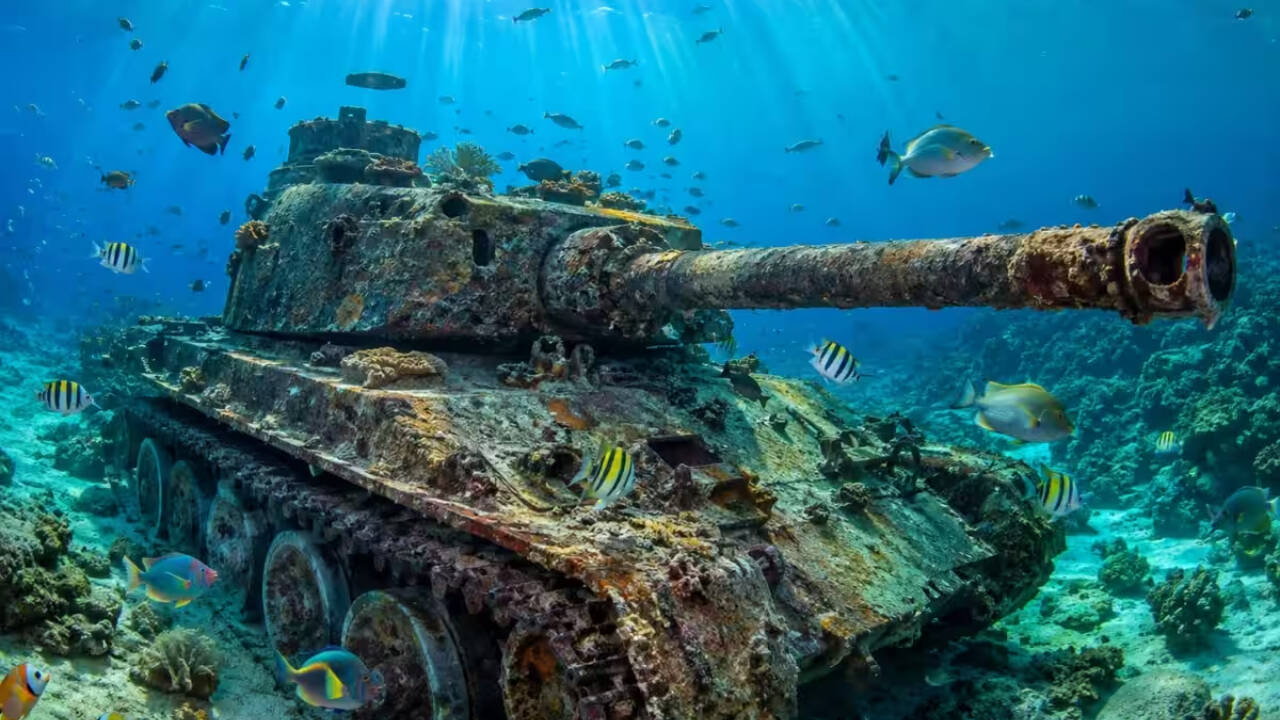
We usually build tanks to destroy things, not to create life. But back in 2010, the Thai military did something entirely unexpected. They drove 25 retired battle tanks, along with 273 old train carriages and 198 scrapped rubbish trucks, straight into the Gulf of Thailand off Narathiwat province.
Local fishermen were struggling. Years of overfishing had stripped the coastal waters bare, and communities dependent on the sea had watched their catches plummet to alarming lows. When they appealed to Queen Sirikit for help, the response wasn’t a standard government subsidy. It was an unconventional marine restoration project using heavy scrap metal.
Nearly a decade later, researchers from Ramkhamhaeng University took a closer look at what happened down there. The results change how we look at industrial waste and ocean conservation.
The Science Behind Underwater Scrap Metal
Why use army tanks instead of buying expensive, purpose-built concrete reef modules? The answer comes down to pure physics and logistics.
A retired battle tank is massive, heavy, and structurally sound. It features thick steel plates, hollow compartments, crevices, and overhangs that a flat sandy seafloor completely lacks. When you drop something like that into shallow coastal waters, you give marine life an instant anchor point.
Algae and barnacles attach to the metal surfaces almost immediately. Small invertebrates follow. Within a short time, that bare piece of military hardware transforms into a vertical ecosystem. It creates a three-dimensional living space where fish can hide from strong currents and evade larger predators.
The Narathiwat project wasn't just about tanks, either. The project deployed a mix of 25 tanks, 273 railway wagons, and 198 trucks to build 72 separate artificial reefs across the region. Each material behaved a bit differently once it hit the ocean floor.
What Researchers Found Nine Years Later
When the university research team completed their dive surveys, they documented a total of 53 fish species spread across 21 families living around the submerged infrastructure.
That is a massive turnaround for what used to be a dead zone of sand. Among the species recorded were commercial mainstays like snappers, which turned out to be the most diverse family at the site with seven distinct species. Researchers also spotted damselfishes, wrasses, and even the critically endangered humphead parrotfish using the structure for shelter.
Interestingly, the tanks and the train wagons didn't attract the exact same crowds.
The railway carriages offered a wider footprint across the seabed, giving passing fish a large surface area to graze on. But the tanks were a different beast entirely. Thanks to their enclosed compartments and complex interior angles, the tanks supported massive aggregations of small, secretive, group-living fish. Even though the wagons recorded a slightly higher overall species diversity score due to their wider spread, the tanks became absolute magnets for dense populations of marine life.
Are Artificial Reefs a Magic Bullet for Overfishing?
It is easy to look at photos of coral-encrusted tanks and assume we've solved the global fishing crisis. Marine biologists warn us not to celebrate too quickly.
There's a well-documented trap with artificial reefs known as the "attraction versus production" debate. Sometimes, sunken structures don't actually create new fish populations. Instead, they just act like a beacon, drawing fish away from surrounding natural areas into one convenient spot.
If fishermen concentrate entirely around these man-made hotspots, it can actually make overfishing worse in the long run because every fish in the neighborhood is suddenly sitting in a predictable, easy-to-target location.
At the same time, when managed properly, structures like the Narathiwat tanks provide essential juvenile habitat and safe zones where species can breed away from commercial trawlers. The trick is balancing habitat creation with strict local management so the reefs don't become fish traps.
What We Can Learn From Thailand's Experiment
The success off the coast of Narathiwat proves that creative problem-solving beats throwing money at a bureaucratic committee every single time. Instead of letting obsolete military equipment rust away in a depot or paying millions to recycle heavy armor, Thailand turned a liability into an ecological asset.
We don't need to sink tanks everywhere, but we do need to rethink how we treat discarded infrastructure. Bridges, ships, and heavy transport equipment can find a second life beneath the waves if engineers and marine biologists work together.
Stop looking at conservation as a purely delicate, pristine science. Sometimes, saving the ocean requires heavy metal.