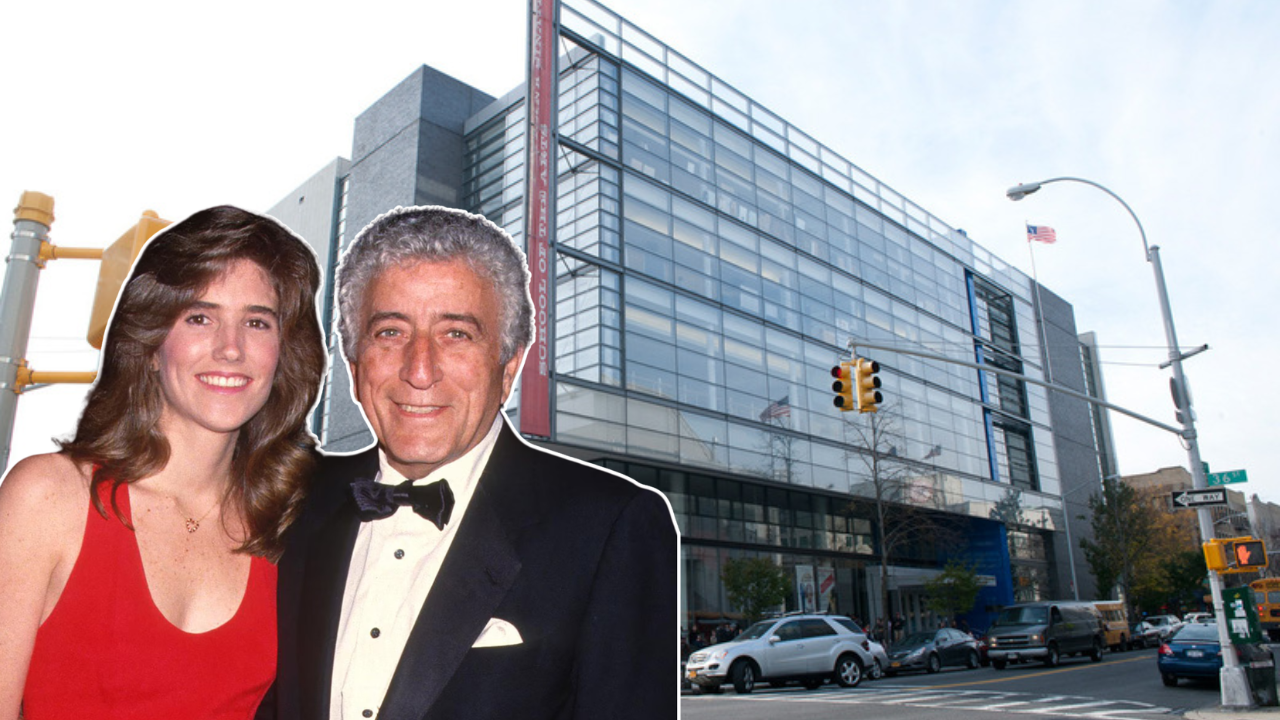
Most celebrities slap their names on vanity projects and walk away. Tony Bennett didn't do that. Back in 2001, the legendary singer and his wife, Susan Benedetto—a former public school teacher—looked at budget cuts squeezing creative programs out of classrooms and decided to build something real. They didn't just donate a check. They founded a public high school dedicated to shaping the next generation of artists.
Quarter of a century later, that initial experiment has transformed into a massive creative powerhouse in Astoria, Queens. What started inside temporary quarters with room for just 250 kids has evolved into the Frank Sinatra School of the Arts, a sprawling professional-grade facility offering young New Yorkers a custom path through rigorous academics and intense artistic training.
From Temporary Classrooms to a Permanent Cultural Hub
Building a public arts school from scratch sounds impossible. Doing it in New York City feels like moving mountains. In 1999, Bennett and Benedetto laid out their vision alongside the New York City Department of Education and local advocates. They wanted a public institution where kids could study serious craft without sacrificing their core education.
The school opened its doors in 2001 in temporary spaces, but the real turning point arrived in 2009. That's when the institution moved into its permanent, purpose-built home at the Kaufman Astoria Studios complex. Designed by architect Susan T. Rodriguez of Ennead Architects, the building was engineered to mirror professional production environments rather than traditional, cramped school facilities.
Walk through the doors today, and you won't find standard high school lockers and dingy multi-purpose rooms. Instead, students navigate a campus built specifically for creative output.
Inside the Facilities That Changed Public Education
If you judge high schools by outdated textbooks and leaking gymnasium roofs, this place will shock you. The campus at Kaufman Astoria Studios gives teenagers access to heavy-duty infrastructure most colleges would envy.
The facility boasts two professional-grade dance studios, two black-box theatres, a stagecraft workshop, fine-art studios, private instrumental practice rooms, choral and orchestral suites, and a dedicated film lab. There's even an outdoor rooftop performance space. At the heart of the complex sits the Tony Bennett Concert Hall, an 800-seat venue hosting everything from student-directed plays and dance revues to screenings of student films and full orchestral performances.
Crucially, this is a public school. Admission requires an audition, but tuition is free for city residents. Kids don't need wealthy parents to afford top-tier studio space or professional equipment. They just need talent, drive, and the willingness to work.
Choosing a Discipline and Committing to the Craft
Students at the Frank Sinatra School of the Arts don't just dabble in creativity. They audition to enter one of six distinct arts specializations:
- Dance
- Drama
- Film
- Fine Art
- Vocal Music
- Instrumental Music
Balancing these intensives with a demanding college-preparatory academic schedule requires discipline. The curriculum isn't designed to give kids an easy escape from math or science. It demands excellence across the board. Graduates routinely head off to competitive universities and top conservatories, proving that artistic rigor and academic strength reinforce each other.
The Long-Term Impact of Exploring the Arts
Bennett and Benedetto knew that opening a single school wasn't enough to fix a broken system. To sustain the momentum, they launched Exploring the Arts, a non-profit organization designed to support arts education across public schools in New York City and Los Angeles. Through this initiative, students gain access to hands-on internships, mentorships, and scholarships that bridge the gap between classroom theory and industry reality.
When Bennett passed away, Benedetto reflected on his deep personal connection to the students and teachers who walked those halls every day. He wasn't just a figurehead lending his prestige to a ribbon-cutting ceremony. He spent years visiting classrooms, talking with teenagers, and watching them discover their voices.
Naming the school after his close friend Frank Sinatra was classic Bennett—generous, respectful, and rooted in jazz history. But the venue bearing his own name stands as a testament to what happens when public vision meets relentless execution.
If you want to support arts education in your own community, look beyond distant policy debates. Support local public school programs, fund classroom materials directly, or advocate for creative spaces where kids can build real, tangible skills.