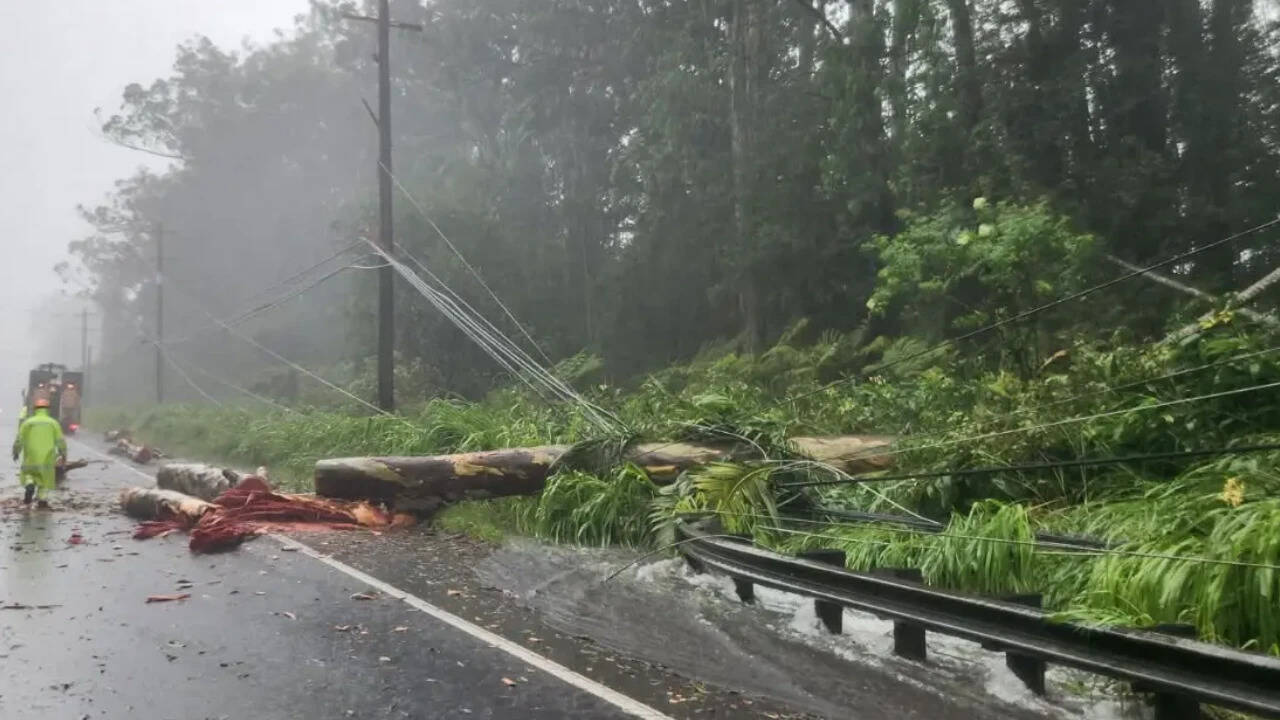
You don't need a direct landfall to experience total chaos. Tropical Storm Lala proved that over the weekend when it skirted past Hawaii's Big Island, leaving more than 200,000 homes and businesses in the dark and washing over 100 homes off their foundations.
Even though the center of the storm stayed offshore, its fierce eyewall raked the southern coast, proving that meteorology charts matter less to people trapped in flash floods than the raw distance of a weather band. Governor Josh Green estimated the statewide damage at hundreds of millions of dollars, marking another severe infrastructure test for an island chain still recovering from previous natural disasters.
The Anatomy of an Offshore Strike
Lala initially formed as a tropical storm before rapidly organizing into a Category 1 hurricane. As it approached the Big Island, forecasters tracked sustained winds hitting 75 mph and higher elevations recording wind gusts topping 100 mph (161 kph) near the Mauna Kea volcano.
Because the eye didn't officially cross over land, technical definitions say it missed a direct hit. Tell that to the residents of Na'alehu and Wai'ohinu. Torrential downpours dumped over 30 inches of rain in specific pockets of the Big Island, turning roads into rivers and triggering catastrophic mudslides that isolated mountain communities.
Why the Power Grid Broke Down So Fast
Grid vulnerability remains a constant headache during Pacific storms, and Lala exposed every weak link. Hawaiian Electric reported massive outages affecting roughly two-thirds of customers on the Big Island alone, while Honolulu and Maui counties suffered extensive disruptions.
High winds snapped utility poles and tore down lines across multiple regions. Compounding the problem, several independent power providers were completely disconnected from the grid due to physical storm damage. Utility crews couldn't deploy safely while wind gusts screamed across the ridges, forcing repair teams to stand down until weather conditions improved. Essential facilities like hospitals had to rely heavily on backup generators, highlighting the fragile nature of remote island infrastructure during extreme weather events.
Real Dangers on the Ground
Beyond the darkened homes and flooded roadways, the human toll required urgent intervention. Search and rescue teams—bolstered by the National Guard and Coast Guard helicopters—scoured areas where flash floods swept homes away. In one dramatic rescue, an elderly woman was pulled safely from a tree after floodwaters obliterated her dwelling.
First responders in Honolulu faced hundreds of weather-related calls, dealing with everything from blown-off roofs to fallen trees crushing vehicles. Tragically, severe weather conditions also contributed to fatal vehicle accidents and injuries on the Big Island, reminding everyone that staying indoors during a tropical weather advisory isn't just a precaution—it's survival.
What Happens Next
As Lala tracks further west into the open Pacific, forecasters warn that warmer waters could allow it to reorganize and regain hurricane strength. Meanwhile, back in Hawaii, the real work begins. Emergency management teams are prioritizing road clearances and damage assessments, but officials caution that full restoration in remote rural sectors could take weeks.
If you're tracking recovery efforts or planning travel to the islands, check local transit updates directly through state transportation portals, keep emergency kits stocked, and stay clear of downed lines or compromised bridges.


