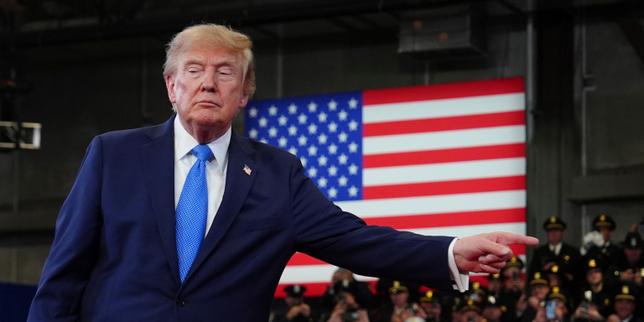
The maritime world just got a fresh dose of rhetoric. Donald Trump recently declared that he intends to label the Strait of Hormuz as "United States territory" once the current conflict with Iran concludes. It sounded like a massive power move. But if you look at the reality of the situation in the Persian Gulf, it’s mostly just noise.
You don't just "declare" a global chokepoint as your own territory because you want to. International maritime law doesn’t work on executive orders or rally speeches. The Strait of Hormuz is one of the most critical waterways for global energy, handling roughly 20% of the world’s petroleum consumption under normal conditions. It's not a patch of land you can simply annex; it’s a shared, high-stakes corridor that borders Iran and Oman.
The Reality of the Blockade
Since February 2026, when the current conflict ignited, this waterway has effectively been a war zone. Traffic has plummeted to a fraction of its historical average. We’re talking about a massive, ongoing disruption. Iran has leveraged its geographic position to maintain a de facto blockade, resulting in mines, vessel seizures, and constant tit-for-tat skirmishes.
When you hear politicians talk about "total control," you have to separate that from the daily grind on the water. Even with a significant naval presence, the United States hasn’t been able to force the strait open in a way that makes commercial shipping feel safe. The insurance premiums for tankers alone have created a "war risk" market that makes transit prohibitively expensive.
Why the Claim Falls Flat
Trump’s declaration is aimed at a domestic audience, but it ignores the fundamental geopolitical nightmare currently playing out in the Gulf. Here’s what you need to understand:
- Sovereignty isn't a gift. You can’t claim another nation’s coastal waters as your own. That’s not how international law operates. Even if the U.S. successfully "defeats" Iran in a military sense, occupation is an entirely different beast than ownership.
- The "Steel Wall" is porous. While there’s talk of a "Wall of Steel" blockade, the reality is that the Iranian Revolutionary Guard Corps (IRGC) continues to intercept and threaten vessels with startling frequency. As of mid-August 2026, ships are still being held, and the threat of mines remains a constant, deadly concern for captains and crews.
- Stalemate is the default. Negotiations have stalled multiple times. Neither side seems willing to back down. When the official status of the strait remains "closed" for nearly six months, empty promises don't do anything to lower the price of oil or get goods moving again.
Ignoring the Practical Costs
If you’re a business owner or an investor relying on global supply chains, ignore the political grandstanding. The bottleneck isn't going anywhere. We are looking at a long-term shift in how maritime commerce functions in the Middle East. Shipping routes are being adjusted permanently to avoid these waters. Companies are sinking money into alternatives that don't involve the Persian Gulf, and that capital isn't coming back even if the shooting stops tomorrow.
Don't mistake a loud statement for a strategic change. The "territory" claim is essentially a rhetorical flourish designed to signal strength. It changes zero facts on the ground. The IRGC is still there. The mines are still in the water. The tankers are still sitting idle.
Focus on the logistical reality, not the headlines. The situation remains volatile, and until there is a concrete, enforced, and internationally recognized maritime security framework, the risks to your cargo—and the global economy—aren't going anywhere. Keep your eyes on the shipping data and the actual transit reports. That’s where the real story is written.
Understanding the 2026 Strait of Hormuz Crisis
This video provides a clear overview of the current status of the waterway, explaining why the ongoing blockade has persisted despite political rhetoric.


