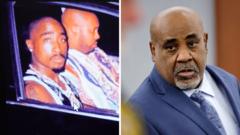
Nearly thirty years have passed since Tupac Shakur was gunned down in Las Vegas. For decades, the case was a ghost story, fueled by conspiracy theories and street rumors. Now, it’s a courtroom drama. The trial of Duane "Keffe D" Davis has finally kicked off, and it’s unlike any homicide case you’ve ever seen.
The prosecution’s entire theory rests on a foundation that the defense calls pure fiction. It’s a strange, high-stakes game where the state is trying to prove the defendant is a credible witness against himself.
The Prosecution Strategy
Chief Deputy District Attorney Binu Palal didn't waste time in his opening statement. He laid out the motive: revenge. The story goes back to September 7, 1996. Hours before the shooting, Tupac and his entourage were filmed beating up Orlando "Baby Lane" Anderson, who happened to be Davis’s nephew.
The prosecution claims Davis, sitting in the front seat of a white Cadillac, orchestrated the retaliation. Palal admitted plainly that Davis didn’t pull the trigger. Instead, he allegedly handed the gun to someone in the backseat and gave the order.
The most jarring part? The prosecution is going to use Davis’s own words—from his 2019 memoir Compton Street Legend, his podcast appearances, and his various police interviews—to prove it. They’re basically telling the jury: "He bragged about killing Tupac for years, and he wasn't lying."
Why The Defense Is Calling Bluff
If the prosecution thinks Davis is their star witness, the defense is busy trying to torch that witness’s reputation. Michael Sanft, Davis's lawyer, hit back hard. He argued that the book Compton Street Legend was a product of show business, not a confession.
Sanft’s angle is simple: Davis was a man desperate for money and attention. He claims the book was a collaboration with author Yusuf Jah and that Davis likely didn’t even read the final draft. It’s a smart, cynical argument. In an era of true-crime podcasts and clickbait biographies, "sensationalizing for profit" is a defense strategy that resonates.
The defense is banking on the fact that for thirty years, no one could corroborate his stories. They want the jury to see Davis not as a cold-blooded mastermind, but as a "fraud" who inflated his own importance to secure a book deal.
The Legal Paradox
There’s a massive tension here. Usually, the defense tries to distance their client from the narrative of the crime. Here, they are forced to paint their client as a pathological liar.
The irony is thick. The state is essentially arguing that a known gang member finally decided to tell the truth in a book he wrote for profit. If the prosecution fails to thread that needle, the case could fall apart. They have to prove that his public claims—which he has walked back in recent months, even telling news outlets he wasn't there—are the absolute truth.
What Comes Next
The trial is expected to last weeks. You should expect a parade of witnesses trying to bridge the gap between street legend and forensic evidence.
Here is what you need to watch for as the trial progresses:
- Witness Credibility: Will the state’s witnesses actually confirm the details Davis gave in his interviews, or will their stories conflict with the "Keffe D" version?
- The Book's Origins: Expect the defense to grill any witnesses associated with the publishing of his memoir. If they prove the publisher or co-author pushed for "extra spice," the state’s star evidence starts to look radioactive.
- Gang Dynamics: Since Davis is charged with furthering a criminal gang, look for the state to spend a lot of time on the hierarchy of the South Side Compton Crips. They need to prove he wasn't just there; they need to prove he had the authority to order a hit.
The outcome of this trial won't just decide the fate of a 63-year-old man. It will effectively write the final chapter on one of the most famous cold cases in American history. Whether or not it’s a satisfying ending depends on whether the jury believes the man who has told a dozen different versions of his own story.
Pay attention to the testimony regarding the 2008 "proffer" agreement. The defense is likely to press hard on why those statements were kept under wraps for so long. The legal battles over what the jury is allowed to see are just beginning.
WATCH: What we learned from opening statements in Tupac murder trial
This video provides a concise breakdown of the prosecution's central allegations regarding the retaliation motive and the defense's strategy to discredit the defendant's own memoir.
http://googleusercontent.com/youtube_content/1


