Most junk shop finds are worthless junk. You buy a dusty vase or a faded painting, stick it on a shelf, and secretly know you spent money on garbage. But every once in a while, a two-dollar bill hits the absolute historical jackpot.
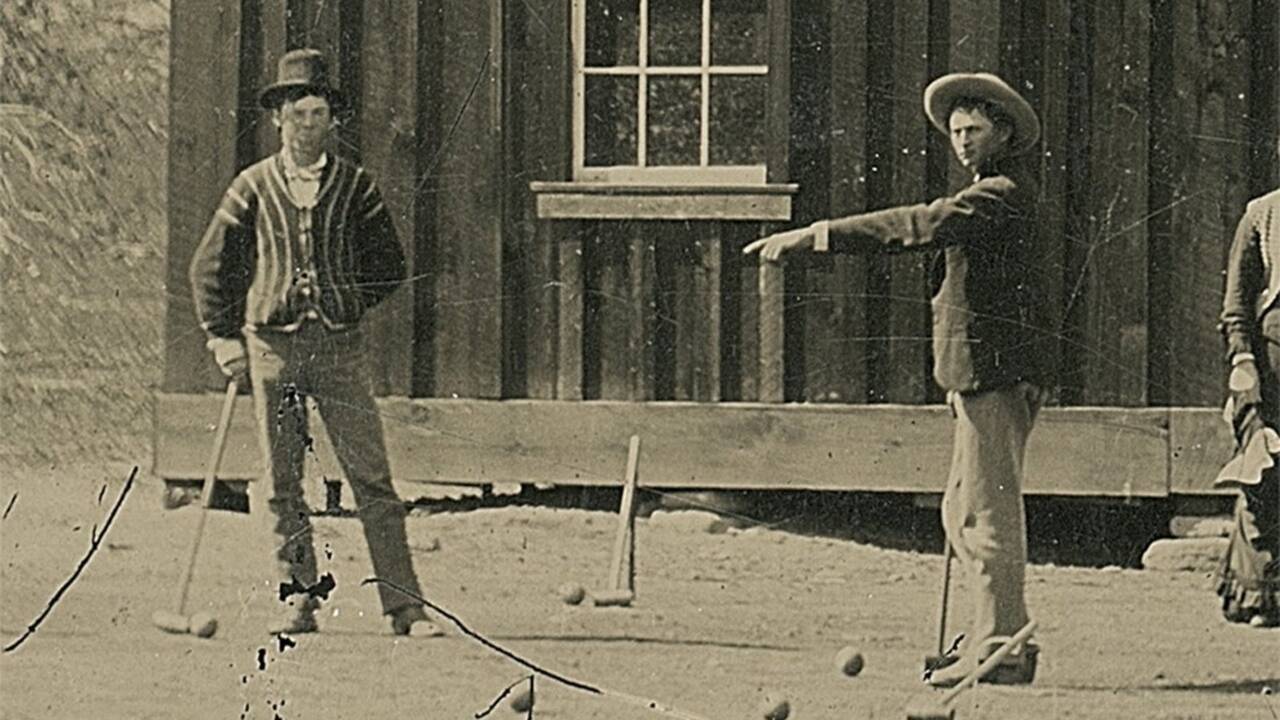
Back in 2010, Randy Guijarro walked into a junk shop in Fresno, California, and dropped a mere two dollars on a handful of old tintypes and photographs. Five years later, one of those tiny 4-by-5-inch images was authenticated as a genuine photograph of Billy the Kid—and insured for a jaw-dropping five million dollars.
If you are wondering how a crumpled piece of old cardboard can turn into a multi-million-dollar asset overnight, you are looking at the holy grail of Western Americana. But authenticating a ghost from the 19th-century frontier is harder than most people think.
The Journey From a Dusty Junk Shop to a Five Million Dollar Valuation
Guijarro didn't immediately realize he was holding history. He kept the photos tucked away until a creeping suspicion made him look closer at the men in one specific image. The picture showed a group of rough-looking characters casually playing a game of croquet.
He took the photograph to Kagin's Inc., a firm specializing in rare coins and Western history. Senior numismatist David McCarthy and his team were naturally skeptical. After all, authenticated photographs of the notorious outlaw Billy the Kid—born William H. Bonney—are nearly impossible to find. Before this discovery, only one verified photograph of the gunman existed: a famous 1880 tintype that later sold to billionaire William Koch for 2.3 million dollars in 2010.
Finding a second image wasn't just a fun surprise. It launched a multi-year forensic investigation.
How Experts Proved It Was Really Billy the Kid
You can't just slap a famous name on an old photo and cash a check. The authentication process requires absolute proof of time, place, and people.
McCarthy flew out to New Mexico to track down the exact geographical location where the croquet game took place. His team matched the buildings in the background of the small photo to a specific site roughly a 15-minute walk from the home of John Tunstall, an English rancher who mentored Billy the Kid.
Historical records sealed the deal. Tunstall’s personal diaries explicitly mentioned playing croquet with friends and associates during the late summer of 1878. The photo captured Billy the Kid alongside members of the Lincoln County Regulators, accompanied by various friends, family members, and lovers.
The physical posture in the picture gave experts goosebumps. Billy stands with a distinct, confident slouch, staring dead-on into the camera with a casual grin. It shatters the Hollywood caricature of a cold-blooded killer who spent every waking second drawing pistols. Instead, it captures a teenager and young adult enjoying a lazy afternoon in rural New Mexico, long before the darkest days of the Lincoln County War.
What This Discovery Teaches Us About Antique Hunting
People love the fantasy of buying a garage sale item for pocket change and retiring on the proceeds. Reality is much harsher. Thousands of hopeful collectors waste money every weekend chasing ghosts, misidentifying mass-produced reproductions as rare artifacts.
If you want to spot real value at a flea market or antique store, you need to understand the difference between junk and genuine historical preservation:
- Look for context and paper quality: Nineteenth-century photographic formats like tintypes and cabinet cards have specific chemical signatures, weight, and wear patterns that modern printers cannot replicate easily.
- Trace the provenance: Provenance is everything. If an item lacks a paper trail or a logical chain of custody, proving its authenticity becomes an uphill battle against skepticism from serious institutions.
- Consult niche experts early: General appraisers often miss historical nuances. Guijarro succeeded because he eventually took his find to specialists who understood the micro-history of the American frontier.
Stories like this keep thrift store hunters searching through bins of old postcards and forgotten snapshots. Most will find nothing. But for one guy in California, a random two-dollar purchase cracked open a completely new window into the humanity of America's most infamous outlaw.