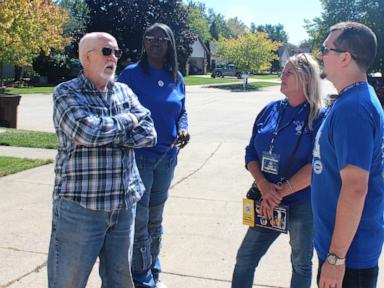
If you walk down a residential street in Shelby Township, Michigan, you might spot union canvassers knocking on doors, trying to bridge a widening gap between union leadership and everyday members. The United Auto Workers (UAW) is pushing hard to reassert its political clout in a premier battleground state ahead of the midterms. But this drive isn't happening in a vacuum. It's colliding with deep internal divisions, shifting member loyalties, and a changing industrial landscape that looks nothing like the heyday of the 1980s.
Back then, active and retired UAW members in Michigan numbered over 600,000. Today, that number hovers around 350,000. While the union remains the largest labor organization in the state, sheer numbers only tell part of the story. The real hurdle isn't total headcount. It's ideological fragmentation on the shop floor.
The Shop Floor Divide
You can't talk about modern union politics without addressing the elephant in the room: political polarization among blue-collar workers. For decades, union endorsements functioned like an unwritten rulebook for working-class voters. Leadership backed a slate of candidates, and members largely followed suit.
Those days are gone.
Today, union halls feature members who hold vastly different political views, with a notable faction drawn to populist conservatism and Donald Trump. Some rank-and-file members openly question whether national leadership represents their worldview, creating friction that canvassers face face-to-face. When union members talk to retirees like Walter Usakowski, who spent decades at Ford Motor Company’s Sterling Axe Plant and plans to back the union's endorsed Democratic slate, they find a receptive audience. But when they knock on doors elsewhere, they encounter members who feel alienated by national endorsements.
Labor experts point out a hard truth. You don't win elections off union endorsements printed on a website or read at a hall. You win them at the front door, at the local bar, or across the kitchen table. And right now, rebuilding that foundational trust is slow, gritty work.
Grassroots Mobilization Versus Top-Down Edicts
Under President Shawn Fain, who secured reelection amid preliminary results, the UAW has taken a combative, highly visible stance against corporate greed and political stagnation. The union's strategy relies on active mobilization, reporting that roughly 113,000 members voted early in recent primary cycles.
Yet, translating those numbers into unified political power requires more than just high-level speeches. Local organizers on the ground admit the scale of the challenge. As JJ Jewell from the UAW's Community Action Program executive committee notes, winning an election isn't a finish line. Even a stellar election cycle means only a tiny fraction of the long-term culture shift is complete.
Critics from opposing political camps argue that national leadership is out of step with the economic realities and personal values of working families. Spokespeople for political opponents frequently position the union's national apparatus as detached from the everyday concerns of autoworkers. This creates a dual-front war for the UAW: fighting external political opponents while convincing their own rank-and-file that solidarity still pays off.
What This Means for the Future of Labor
The fight in Michigan serves as a bellwether for the entire American labor movement. If a powerful, historic union like the UAW struggles to keep its base politically unified in a crucial swing state, other labor organizations face an even steeper climb.
Reviving political leverage requires hyper-local engagement, transparent conversations about policy, and a willingness to listen to dissenting voices on the shop floor instead of dismissing them. The UAW is pouring serious manpower into door-to-door outreach to prove it still dictates the political rhythm of the Motor City state. Whether those efforts heal internal fractures or just highlight them remains the defining question for the state's political future.