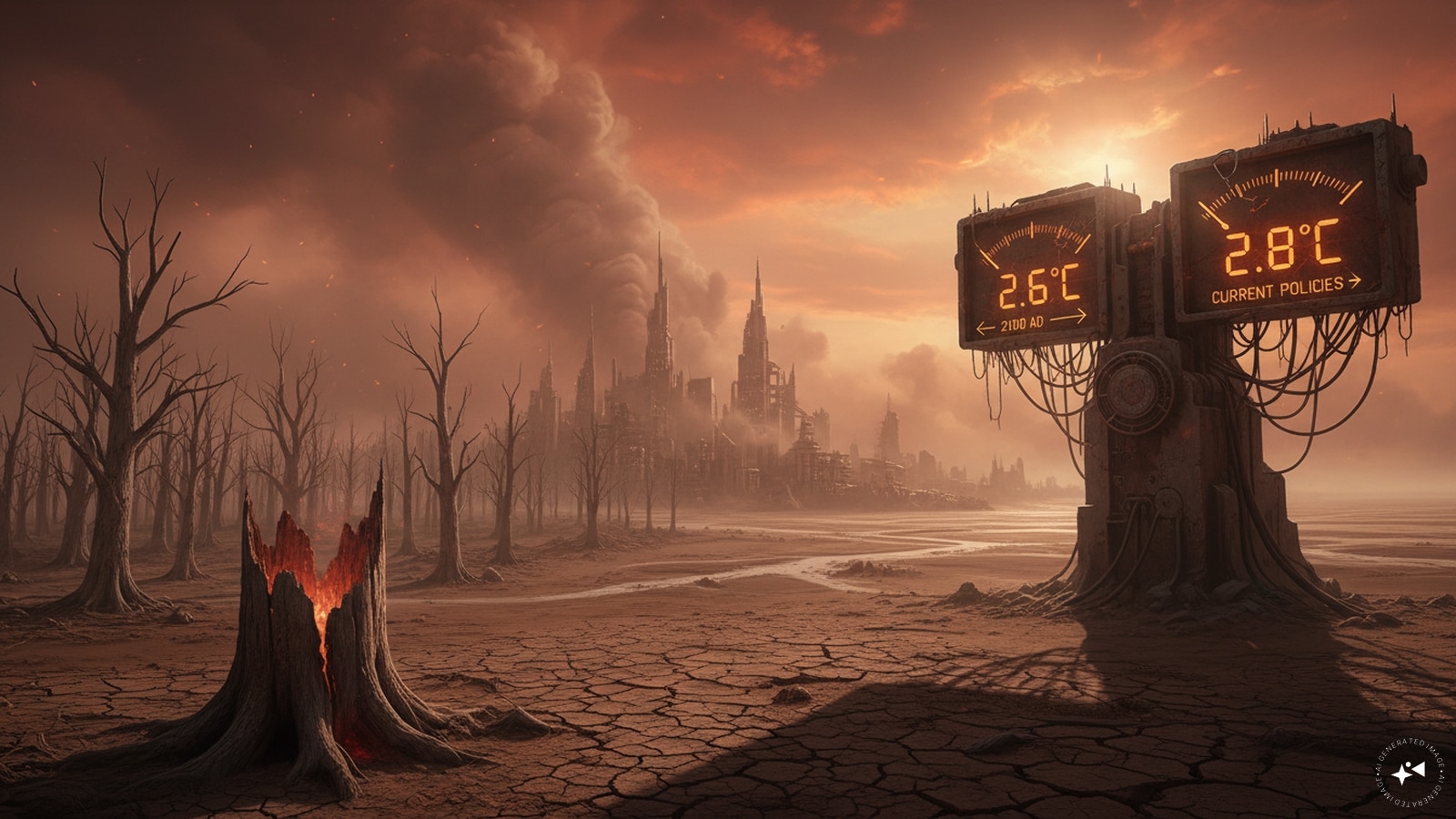
Let's stop pretending the world is on track to save the 1.5-degree Celsius climate target. According to the United Nations Environment Programme's Emissions Gap Report, that specific threshold is effectively history in its original form. Under current policies, Earth is hurtling toward a staggering 2.8 degrees of warming by 2100.
If you thought global leaders were finally getting their act together, the numbers tell a brutal truth. Greenhouse gas emissions hovered at record levels in 2025, totaling roughly 58.4 billion tonnes of carbon dioxide equivalent. While emissions flattened slightly due to fewer wildfires compared to previous years, fossil fuel consumption kept climbing. G20 countries alone account for 76 percent of global emissions, and their output rose rather than fell.
So, what does this mean for the future, and why are we missing the mark so dramatically?
The 2.8 Degree Reality Check
The math is unforgiving. If governments stick strictly to current policies, global warming will peak at 2.8°C by the end of the century. Even if every country fully delivers on its unconditional national climate plans, the world still faces 2.7 degrees of heating. Factor in plans that rely heavily on international financial support, and you get 2.6 degrees.
Why are these projections worse than last year's models? A major factor is policy backsliding among major economies, including the United States stepping back from the Paris Agreement, combined with updated estimates on historical emissions. New national climate commitments submitted by countries have barely budged the needle. By late 2025 and early 2026, the vast majority of nations missed original submission deadlines, showing a profound lack of urgency where it counts.
유엔 (UN) chief António Guterres didn't mince words when launching the report, titled The Point of Return. He noted that current national climate plans fall dangerously short. Every five years of delay in cutting emissions locks in roughly another 0.1 degree of warming.
The Era of the Climate Overshoot
We can no longer prevent global temperatures from temporarily breaching the 1.5°C limit. That ship has sailed. UN scientists emphasize that the priority must shift to minimizing the depth and duration of this inevitable overshoot, pulling temperatures back down to 1.5°C by 2100.
As Guterres put it, overshoot is not surrender. But avoiding permanent catastrophic damage requires a Herculean effort. To even have a fighting chance of returning to safe limits by the end of the century, global emissions must fall by 18 percent by 2030, 45 percent by 2035, and a massive 69 percent by 2040, relative to 2025 levels.
Those targets sound almost impossible because, frankly, they are politically and logistically grueling. Renewable energy is expanding rapidly, and the growth of coal and oil supply has slowed down compared to past worst-case projections. Yet, the sheer scale of the energy transition required right now dwarfs what governments are actually funding and enforcing.
What Needs to Happen Next
If you are wondering what practical steps remain, the focus shifts entirely to accountability, rapid clean energy deployment, and climate adaptation.
- Hold major emitters accountable: G20 nations drive three-quarters of global pollution. Without aggressive domestic policies in these specific capitals, global targets are meaningless.
- Demand aggressive short-term targets: Long-term net-zero pledges for 2050 are easy to promise and hard to enforce. Real survival depends on what happens before 2030.
- Prepare for the impacts: Communities everywhere must build infrastructure capable of withstanding extreme weather, intense droughts, and shifting ecosystems because a temporary overshoot is already baked into our immediate future.
The window to avoid severe environmental tipping points like permafrost thaw and coral reef collapses is closing fast. We are out of time for excuses.