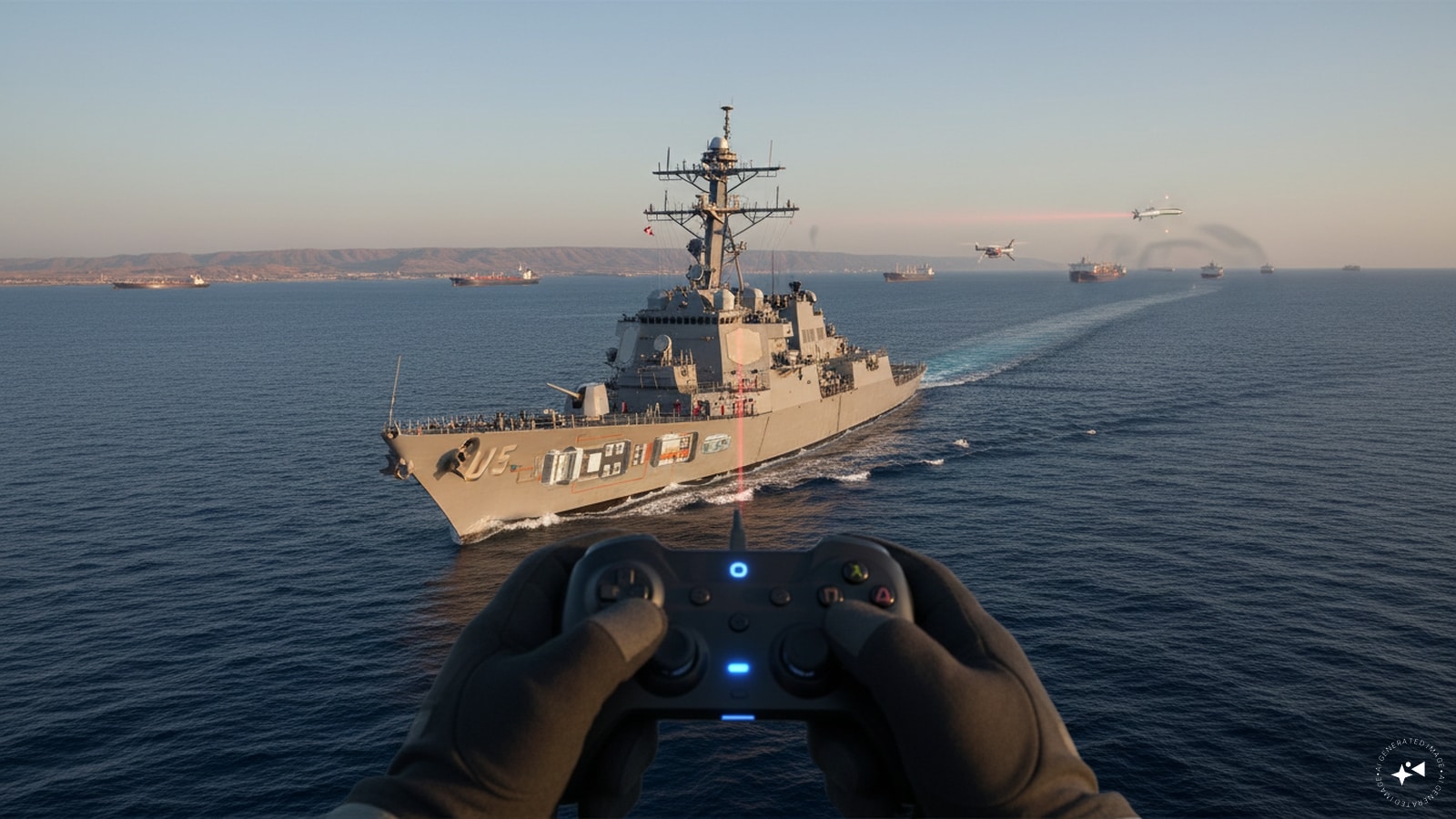
You've probably seen the headlines about the military shooting down drones with gaming controllers. It sounds like science fiction or a viral marketing stunt for the latest shooter franchise. But out on the choppy waters of the Strait of Hormuz and along contested borders, troops are actually tracking and frying aerial targets using modified Microsoft hardware.
The military didn't adopt gaming accessories because they're cheap. They did it because decades of ergonomic testing by the commercial electronics industry beat anything defense contractors could dream up in a lab. If a teenager can master complex movement mechanics on a console in their basement, a soldier can learn to operate a multi-million-dollar defense array in hours instead of months.
Why High-Energy Lasers Need a Different Approach
Traditional air defense is terrifyingly expensive. Firing a multimillion-dollar missile to take out a few-thousand-dollar surveillance drone is a math problem that bankrupts defense budgets. Directed-energy weapons completely change that equation.
Systems like AeroVironment’s LOCUST or ship-mounted heavy setups use battery banks and generators to concentrate photons into an invisible, hyper-focused beam of heat. There's no logistics tail full of heavy ammunition crates. There's no reloading. As long as you have power, you have shots.
When the beam hits an oncoming drone, it doesn't cause a cinematic Hollywood explosion. It quietly cooks the core components. Sensors melt, propellers shatter, and the machine drops out of the sky like a stone.
The Ergonomics of Modern Warfare
Military contractors have a bad habit of building custom control interfaces that look like cockpit panels from a 1960s sci-fi movie. They're heavy, counterintuitive, and require thick manuals to operate under stress.
When developers looked at how to aim a 360-degree, AI-assisted laser tracking system, they realized the commercial gaming industry had already solved the human interface problem. Xbox-style thumbsticks and trigger buttons offer precise, intuitive motor control that feels entirely natural to the current generation of service members.
An operator sits inside a tactical vehicle or on a ship deck, watching a tablet display feed while manipulating a familiar controller. They lock onto a target, let the internal tracking software hold the point, and fire a concentrated pulse of energy.
What the Coverage Misses About Real-World Limits
Media reports love the video game angle, but they often gloss over the brutal physical realities of directed energy. These systems aren't magic.
Weather remains a massive hurdle. Heavy dust, thick humidity, and heavy rain scatter laser light and severely degrade effective range. Furthermore, current mobile units are still heavy enough that they require dedicated vehicle integration, like Infantry Squad Vehicles or Joint Light Tactical Vehicles, rather than being carried around by individual infantrymen like rifle attachments.
You're also not going to see these used against human targets. International military frameworks and strict operational rules keep these focused strictly on hardware threats like incoming unmanned aerial vehicles and low-flying cruise missiles.
The Financial Reality Behind the Shift
The Department of War's massive multi-million-dollar push toward directed-energy deployment isn't about novelty. It's about attrition. Modern drone warfare relies on swarms designed to overwhelm expensive defense batteries through sheer volume.
When an adversary can throw dozens of cheap quadcopters at a target for pennies, defenders need an interceptor that costs practically nothing per shot. Lasers fill that exact gap.
If you're tracking how defense technology evolves, watch the software integration rather than the hardware shells. The real revolution isn't just that the US military is putting lasers on warships and trucks. It's that the barrier between consumer electronics and frontline combat gear has effectively vanished.