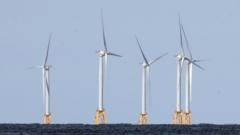
Governments usually spend public money to build infrastructure. They rarely hand out nine-figure checks to stop it.
Yet, the Trump administration just agreed to pay German energy heavyweight RWE a staggering $1.22 billion to surrender its federal offshore wind leases. It is a wild financial maneuver. It marks the fifth major settlement where federal authorities paid off renewable developers to abandon coastal projects entirely.
If you look past the political headlines, the mechanics of this deal reveal a massive shift in American energy policy. Let's break down what actually happened, where the money is going, and why RWE happily took the payout.
The Anatomy of the Big Wind Buyout
The agreement between the Department of the Interior and RWE US Offshore didn't happen in a vacuum. RWE had already poured over $1 billion into developing massive wind initiatives off the coasts of New York, California, and Louisiana.
Those projects hit a brick wall. Permitting hurdles, local pushback, and a hostile federal regulatory environment created an environment where moving forward became impossible.
Rather than dragging out years of litigation or letting capital sit trapped in dead-end asset limbo, RWE cut its losses. The company surrendered its New York Bight lease, the Canopy Offshore Wind site near Humboldt County in northern California, and the Lake Charles area off the coast of Louisiana.
For RWE stakeholders, walking away with a $1.22 billion resolution is a clean exit. For the administration, it marks another scalp in an ongoing campaign to purge renewable generation from federal waters.
Where the Money Is Actually Flowing
This isn't a simple cash-and-carry departure where RWE takes its euros and flies back to Essen. The deal comes with strict strings attached regarding reinvestment.
Under the terms of the settlement, RWE plans to redirect its capital toward traditional fossil fuel infrastructure and natural gas projects in the United States.
- RWE will invest $900 million to acquire an indirect 16% stake in a Louisiana liquefied natural gas (LNG) export terminal project.
- The company signed a $300 million turbine reservation agreement dedicated explicitly to natural gas peaking plants.
- RWE intends to build a portfolio of 15 gas-peaking projects across targeted domestic markets.
Even though RWE is giving up on wind in US waters, they aren't abandoning the American market. The firm still plans roughly €17 billion in total US investments over the next six years. They want to expand their overall generation capacity from roughly 13 gigawatts across 27 states to 22 gigawatts by 2031.
They are simply pivoting hard from turbines to gas.
The Broader Cost to Taxpayers
When you stack this agreement alongside previous administrative buyouts, the total public tab for killing offshore wind projects approaches $4 billion.
Critics point out the sheer irony of spending billions of tax dollars to halt energy production. Energy markets thrive on predictability. When rules change overnight and the federal government starts paying private contractors to pack up their gear, long-term capital planning gets thrown into chaos.
At the same time, companies like RWE are playing the hand they are dealt. Faced with an administration explicitly hostile to coastal wind generation, taking a guaranteed billion-dollar payout to pivot into lucrative LNG and gas infrastructure is just good business.
The offshore wind dream in America is facing an existential reckoning. Until political winds shift back, expect more developers to take the payout, count their cash, and build gas plants instead.