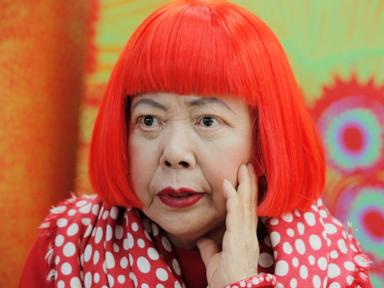
Yayoi Kusama spent decades painting dots to keep herself alive. When the legendary Japanese avant-garde artist passed away at a Tokyo hospital at the age of 97, she left behind a culture obsessed with her mirrored rooms and giant pumpkins. But most people completely misunderstand what drove her work. They see colorful Instagram backdrops. Kusama saw a desperate shield against terror.
Born in Matsumoto, Japan, in 1929, Kusama endured a brutal childhood defined by family trauma and severe psychological distress. Long before she became a global phenomenon wearing bright red wigs, she was a little girl experiencing terrifying hallucinations. Flowers would talk to her. Patterns on tablecloths would multiply, swallowing the walls, the furniture, and her own body. To stop herself from dissolving into panic, she picked up a pencil and started drawing the visions. Art wasn't a career choice. It was pure survival.
The New York Rebellion
Kusama didn't wait for permission to conquer the art world. In 1958, she packed her bags, left Japan, and landed in New York City with little money and fierce ambition. She walked straight into a fiercely male-dominated avant-garde scene and started making waves.
She invented her signature "Infinity Net" paintings—massive canvases covered in dense, repeating arcs of paint that felt dizzying and endless. While male contemporaries like Andy Warhol and Claes Oldenburg gained massive fame and fortune, Kusama watched quietly as ideas she pioneered turned up in their breakout exhibitions. She was marginalized, exoticized, and consistently broke. Yet she kept producing.
She staged radical anti-war "happenings" in Central Park, painting polka dots on naked protestors to protest the Vietnam conflict. She wrote an open letter to Richard Nixon offering to sleep with him if he stopped the war. Her antics scandalized her traditional family back home and alienated polite society, but they cemented her status as an unyielding creative force.
Choosing the Asylum
Exhausted by decades of frantic output, commercial indifference, and worsening health, Kusama returned to Japan in the 1970s. In 1977, she voluntarily checked herself into a psychiatric hospital in Tokyo.
She never left. For decades, she lived in the facility while walking across the street every morning to her dedicated studio. Critics thought her career was over. Instead, it was just getting started.
Working quietly inside her studio, she scaled up her obsessions. She built mirrored Infinity Rooms that forced viewers to experience her sensations of endless space and self-obliteration. She covered giant pumpkins, soft sculptures, and entire galleries in yellow-and-black polka dots.
The Digital Renaissance
By the time the twenty-first century arrived, the art establishment finally caught up to what Kusama had known for sixty years. Her immersive installations became the ultimate cultural ticket. Millions lined up for hours just to spend forty seconds inside a glowing, mirrored chamber.
Museums across the globe scrambled to exhibit her work. Her striking visual identity crossed over into high fashion, most notably through massive collaborations with Louis Vuitton that plastered her dots across luxury handbags worldwide. She became one of the best-selling living artists on the planet, breaking auction records that once felt entirely out of reach.
Yet fame didn't change her routine. Up until her final days, Kusama kept painting her My Eternal Soul series, holding onto her brush inside her Tokyo studio.
Look past the vibrant colors and the social media hype. Kusama's true legacy is an ironclad lesson in resilience. She took her deepest psychological pain, weaponized it against an exclusive art establishment, and transformed it into a universal language of light and infinity. Pick your obsession, protect it fiercely, and refuse to let the world dilute your vision.