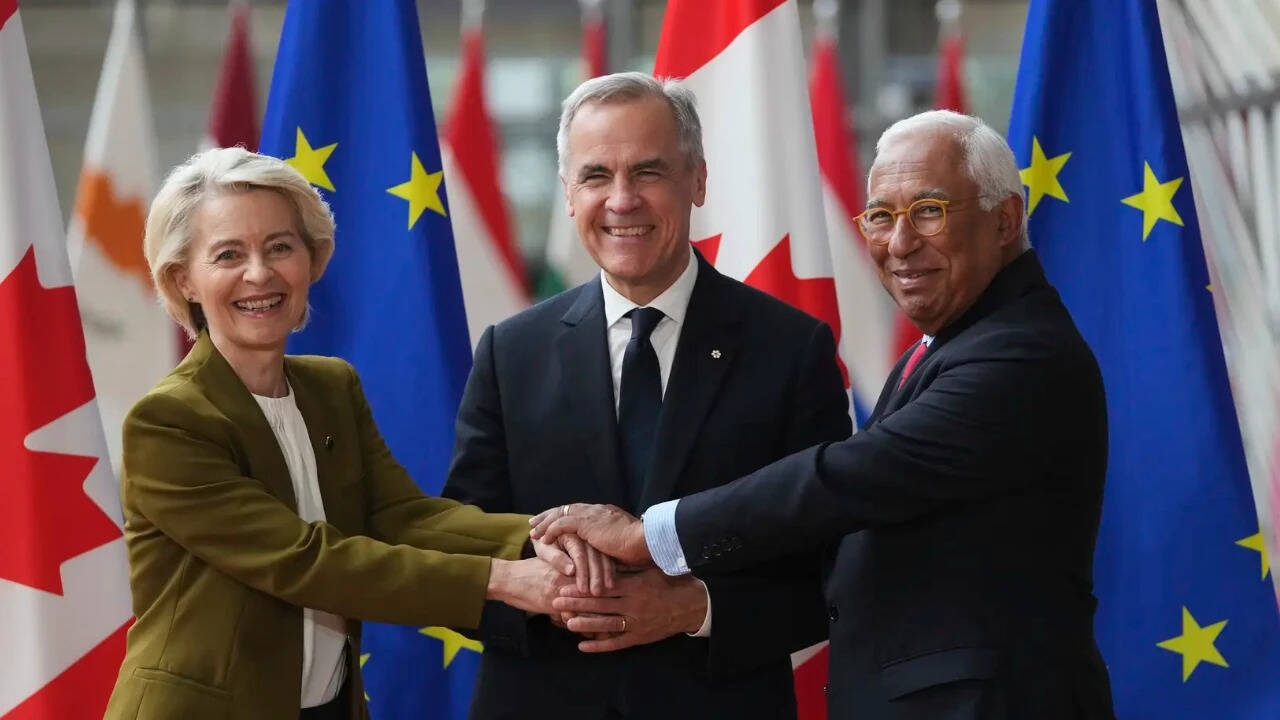
Trade relationships rarely shatter overnight, but Canada and the United States are currently watching a massive fracture widen in real-time. Since the return of Donald Trump to the White House and the sudden eruption of severe cross-border tariffs, Ottawa has realized that relying on a single dominant market is a recipe for economic self-harm. Prime Minister Mark Carney isn't wasting time complaining about the new normal. Instead, he is pivoting hard toward Europe, sparking serious conversations about Canada becoming the very first associate member of the European Union.
If you think this sounds like a diplomatic stunt, look closer. European Commission President Ursula von der Leyen publicly invited Canada to step into a brand-new tier of integration. This isn't just about trading maple syrup for cheese anymore. It is a fundamental realignment of western economic power driven by pure survival instincts.
The Breakdown of the North American Status Quo
For decades, geographic proximity dictated Canada's economic destiny. Roughly seventy percent of Canadian merchandise exports flowed south into the United States. It was convenient, lucrative, and comfortable.
Comfort is gone. When Washington started weaponizing tariffs and tossing around rhetoric about annexing its northern neighbor as a fifty-first state, Ottawa's baseline assumptions evaporated. Carney labeled this dynamic bluntly months ago, arguing that middle powers negotiating bilaterally with a global hegemon aren't exercising sovereignty at all. They are performing subordination.
The response? Diversify or die.
Canada didn't wait for things to cool down. Officials quickly enacted retaliatory tariffs and started looking for long-term safety harbors. Enter Europe.
What Associate Membership Actually Means
Let's clear up a major misconception right away. Canada is not trying to become a traditional member of the European Union. Article 49 of the EU treaties explicitly states that only European states can join the bloc. Geography prevents Ottawa from sitting at the standard leadership table in Brussels.
Instead, both sides are sketching out an entirely novel political category. An associate membership model.
While the precise legal mechanics are still being hammered out, the scope of the talks is staggering. We are looking at a system designed to shift the EU's economic border much closer to North America. Key areas on the table include:
- Free movement and integration within strategic supply chains, spanning critical minerals, green energy, and battery production.
- Deep cooperation on high-tech infrastructure, including joint data centers, cloud storage, quantum technologies, and secure underwater cables.
- Defense production alignment, building on Canada already becoming the first non-European country to join the EU's major defense procurement and loan initiatives.
- Discussions around worker mobility, potentially allowing Canadians and Europeans to live and work across jurisdictions without restrictive visa hurdles.
This goes far beyond CETA, the existing free-trade agreement that eliminated duties on most goods but left regulatory and institutional walls standing. This is about building a shared economic security space.
The Hurdles Standing in the Way
Of course, grand visions run into messy political realities. Anyone who thinks this alliance will happen overnight hasn't watched European bureaucracy function.
Consider the track record of existing trade pacts. CETA was struck over a decade ago and provisionally rolled out nine years back, yet several European national parliaments still haven't fully ratified it. Getting twenty-seven distinct European nations to agree on a brand-new, unprecedented associate status for a North American country will test every ounce of Carney's diplomatic leverage.
Then there is the reaction from Washington. Unsurprisingly, the White House has dismissed the concept entirely, with Trump labeling the talks laughable and threatening heavy retaliatory tariffs against European targets if the partnership moves forward with hostile intentions toward American economic dominance.
Europe and Canada are walking a fine line. They insist the alliance is built for mutual strength, not as a direct weapon against outside parties, but the geopolitical friction is obvious.
Why This Shift Matters for the Future
If you run a business, manage supply chains, or track global markets, you need to update your mental map. The era of frictionless globalization is dead, replaced by fragmented trading blocs where security dictates commerce.
Canada is betting that hitching its wagon to the European regulatory and economic engine provides a necessary hedge against unpredictable American protectionism. It is a bold, risky play. Ottawa is trading local geographic convenience for transatlantic institutional stability.
Watch the upcoming bilateral meetings between Canadian and European leadership closely. Pay attention to how quickly technical working groups form around critical minerals and digital infrastructure. The architecture of the next global economic order is being built right now, and Canada has decided it would rather help design the room than stay locked outside.