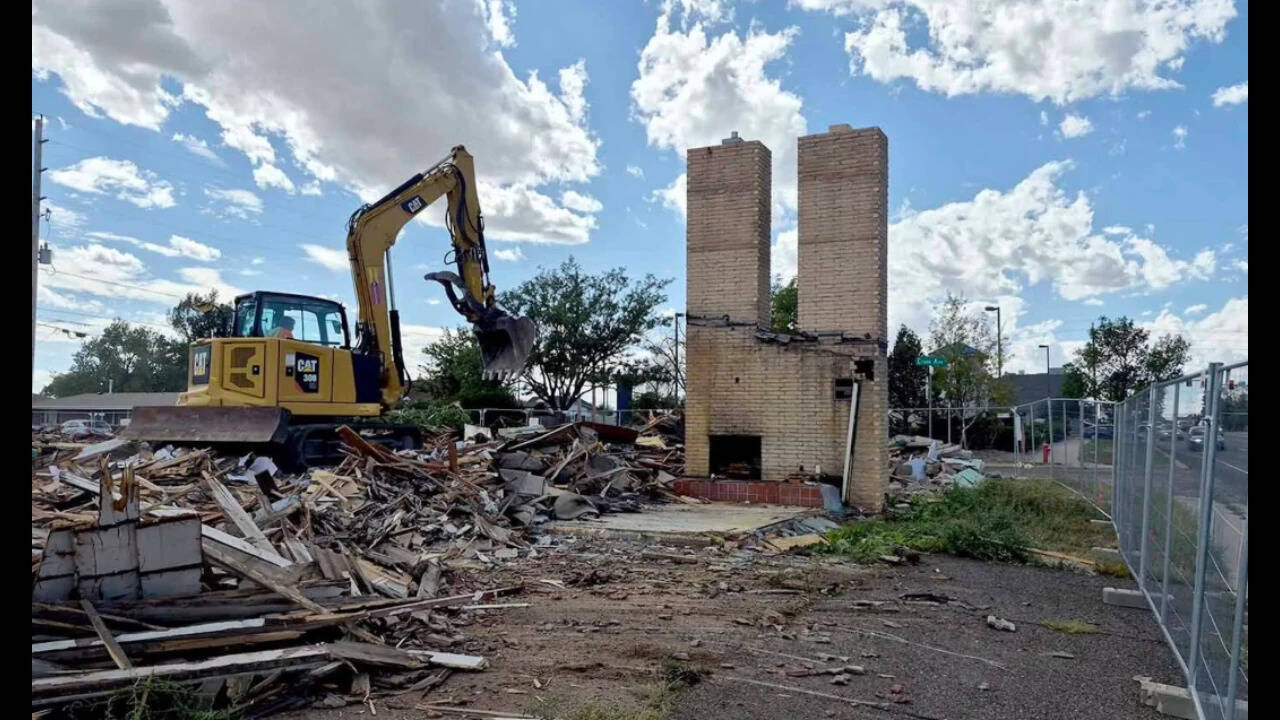
Ninety years of road history can vanish in about three hours. That is how long it took heavy machinery to flatten the Twin Chimneys Motor Court in Cheyenne, Wyoming, turning a storied piece of the historic Lincoln Highway into a pile of rubble. The signature twin stone chimneys, which once welcomed cross-country drivers looking for a bed and a covered spot to park their cars, stood for less than half a minute once the wrecking ball swung at them.
The land at 2405 East Lincolnway won't sit vacant for long. A high-speed 7 Brew Coffee drive-thru stand is taking its place. If you’ve spent any time driving across the American West, you know this script. Progress arrives fast, fueled by private equity and an endless appetite for convenience. But watching another mid-century landmark disappear highlights a harsh reality about how we treat our vanishing roadside heritage.
The End of the Road for Twin Chimneys
Built back in the 1930s, the Twin Chimneys Motor Court was designed to catch the eye of travelers navigating U.S. Route 30 and the historic Lincoln Highway. Long before smartphones or chain hotels dominated travel, motorists relied on distinct visual cues to find a safe place to sleep. The property’s bright red exterior, green roof, knotty pine interiors, and those unmistakable twin stone chimneys made it an unforgettable landmark.
Over the decades, thousands of people passed through its doors. Inside the rooms, travelers left behind fragments of their lives. During the recent demolition, workers pulling apart the debris even uncovered a Desert Storm plaque belonging to Kenneth Joseph Fletcher of the 744th Transportation Company.
Yet, nostalgia doesn't pay property taxes. When the site was sold to make room for a modern beverage stand, preservationists faced an uphill battle that started way too late.
Why Historic Preservation Always Arrives Late
Megan Stanfill, executive director of the Alliance for Historic Wyoming, admits she first noticed the motel while driving past and thinking it was a cool building. By the time she realized its days were numbered, a security fence was already up.
Conversations about adaptive reuse or saving architectural elements usually happen after the permits are signed and the bulldozers are idling outside. Stanfill noted that while the chimneys themselves could have potentially been preserved as an artistic nod to the past, the reality is that property owners hold the keys. Once local channels approve a demolition, heritage advocates are left with few options other than buying vintage postcards on eBay.
It is a tension playing out nationwide. While Route 66 gets a massive wave of centennial-fueled tourism and revitalization, secondary corridors like the Lincoln Highway often lose their historic fabric one lot at a time.
The Drive-Thru Boom vs. Main Street Memory
The company moving onto the East Lincolnway lot is part of a massive commercial expansion. Backed by heavy institutional capital, brands like 7 Brew are scaling up rapidly across multiple states. These operations promise speed, energy, and instant gratification—things that fit neatly into modern commuting habits.
You can't grab a quick iced mocha from a 1930s motor court. Economics favor high-volume retail over weathered timber and historical architecture. When private equity meets local real estate, the coffee cup almost always wins over the chimney.
Still, losing these buildings changes the texture of a city. Corridors like East Lincolnway stop being physical storybooks of American travel and start looking like any other generic stretch of asphalt across the country.
Property owners have every right to maximize their land value. Cities have legal channels that get satisfied. But every time an independent piece of local history gets leveled in three hours, a little more of our collective memory goes with it.
Take a good look at your favorite local landmarks while they're still standing. They might not be there tomorrow.