You can look at a 2,500-acre patch of land and see only rows of crops, or you can watch what happens when humans finally get out of nature's way.
Back in 2021, the Broughton Sanctuary near Skipton in North Yorkshire took a massive gamble. Instead of wringing every last drop of profit from intensively farmed monoculture pasture, estate managers stopped chemical treatments, removed miles of physical barriers, and let the wild take the wheel. Four years later, the results in the December 2025 State of Nature Recovery Report prove that traditional farming models are broken. Today, over 330,000 new trees and more than 1,700 distinct species mark an astonishing ecological turnaround.
Here is what actually went down on the ground, why standard conservation methods usually fail, and how this English estate rewrote the rules on land management.
Stripping Away the Fences That Choked the Land
Modern agriculture loves straight lines, rigid boundaries, and sterile fields. The first thing conservationists did at Broughton wasn't planting seeds—it was tearing things down. Crews hauled out 17 kilometers of fencing.
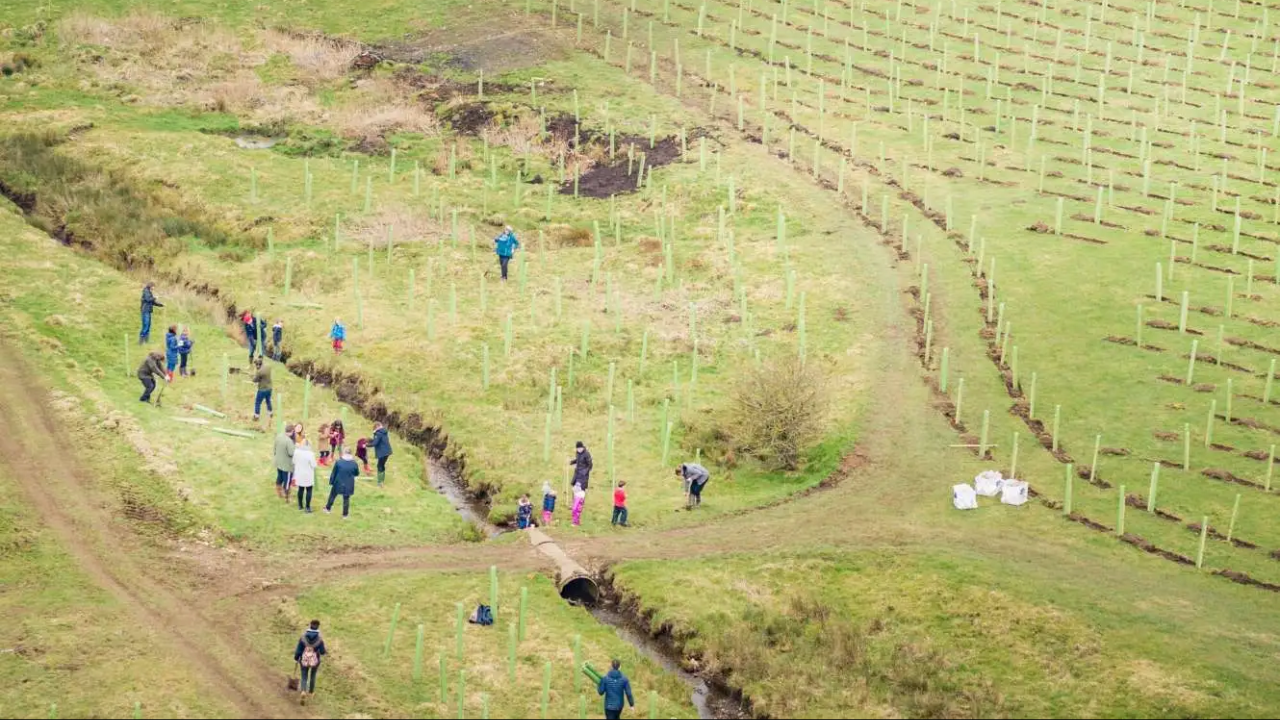
When you remove physical barriers across 1,000 hectares of historic property, animals stop being trapped in fragmented zones. Deer, small mammals, and predatory birds suddenly have continuous pathways across pasture, woodland, and moorland. Tree cover on the estate jumped from a miserable 5 percent in 2020 to more than 35 percent by the end of 2025.
That shift didn't happen by accident. Supported by the White Rose Forest through the UK Government's Trees for Climate initiative, teams planted 19 native broadleaf species across 400 hectares. They also partnered with specialist nurseries to plant 76 specimen oaks grown from acorns harvested from ancient British trees, preserving vital genetic diversity for the future.
Using Livestock As Natural Soil Engineers
Most farmers treat livestock like predictable factory units. Broughton treats them like ecological tools.
Instead of relying on heavy machinery and chemical fertilizers, the estate brought in 57 Riggit Galloway cattle, three Iron Age pigs, three Dales ponies, and 15 roe deer. The cattle graze outdoors year-round without chemical treatments, regular medication, or silage. They keep aggressive plant species from choking out open grassland.
Then there are the pigs. Introduced in August 2024, the three Iron Age pigs act as living bulldozers. Their rooting breaks up heavily compacted soil, exposing forgotten seedbeds and carving out patches of bare dirt. Botanical surveys recorded immediate results. Common eyebright, sneezewort, creeping cinquefoil, bird's-foot trefoil, and mouse-ear hawkweed popped up almost immediately in the disturbed earth. Self-seeded birch, oak, and cherry saplings quickly followed.
The Raptor Return and Beaver Engineering
You cannot fake a functioning ecosystem. When small mammals multiply because tall grasses are finally allowed to grow, predators show up.
All five native British owl species now inhabit the sanctuary. Barn owls, tawny owls, little owls, long-eared owls, and short-eared owls have all made the estate home. Field observations confirm that short-eared owls are breeding on the property for the first time in decades.
Conservationists helped speed up the process by installing 13 barn owl boxes and 13 kestrel boxes built by expert Colin Shawyer. Monitoring alongside raptor specialists recorded dozens of chicks ringed over successive seasons, bouncing back even after severe spring droughts hammered local vole populations.
Meanwhile, down in the wet areas, a small family of beavers—two adults and a kit—are doing what beavers do best. Their dams hold water across the landscape, create sprawling wetland zones, and slow the rush of storm water during heavy rains. Estate teams amplified this natural plumbing by digging seven wetland scrapes and ponds to catch runoff on floodplains.
What Most People Get Wrong About Rewilding
People assume rewilding means locking the gates and abandoning the land to chaos. That is a myth.
Successful nature recovery requires intense planning, continuous monitoring, and strategic human intervention. Broughton's success relied heavily on community labor. During 2025 alone, 200 local volunteers pitched in with habitat management. Educational programs brought over 7,300 children onto the property, turning a private estate into a living laboratory.
The management team didn't just walk away. They expanded their full-time conservation staff from two people to seven, drafting a strict ten-year blueprint running from 2026 to 2036. Their upcoming targets include expanding beaver-managed wetlands, establishing self-sustaining rare-breed livestock herds, and reintroducing missing native species like the harvest mouse. They are also actively ripping out invasive non-native plants like rhododendron and laurel that strangle native forests.
If you own land—whether it is a sprawling rural estate or a suburban backyard—the lesson is simple. Stop micromanaging every square inch. Ditch the chemical inputs, tear down artificial barriers, and let natural processes do the heavy lifting. Nature doesn't need our interference. It just needs us to get out of the way.