Probability suggests that surviving a single nuclear attack is a statistical miracle. Surviving two, separated by just three days and seventy miles, sounds like fiction. Yet, Tsutomu Yamaguchi lived through both the Hiroshima and Nagasaki atomic bombings in August 1945, defying calculations and carrying a burden almost impossible to comprehend.
If you have ever wondered how a single human being could find himself at ground zero of history's darkest moments twice, the answer lies in a mix of unfortunate timing, industrial duty, and a forgotten corporate seal.
The First Flash Over Hiroshima
In the summer of 1945, Tsutomu Yamaguchi was a 29-year-old engineer working for Mitsubishi Heavy Industries. He had spent three grueling months in Hiroshima on a corporate assignment, designing a new oil tanker. August 6 was supposed to be his ticket home to his wife and infant son in Nagasaki.
He was heading to the railway station with two colleagues when he realized he left his personal seal back at the office. He turned back to retrieve it.
That single, mundane detour changed everything.
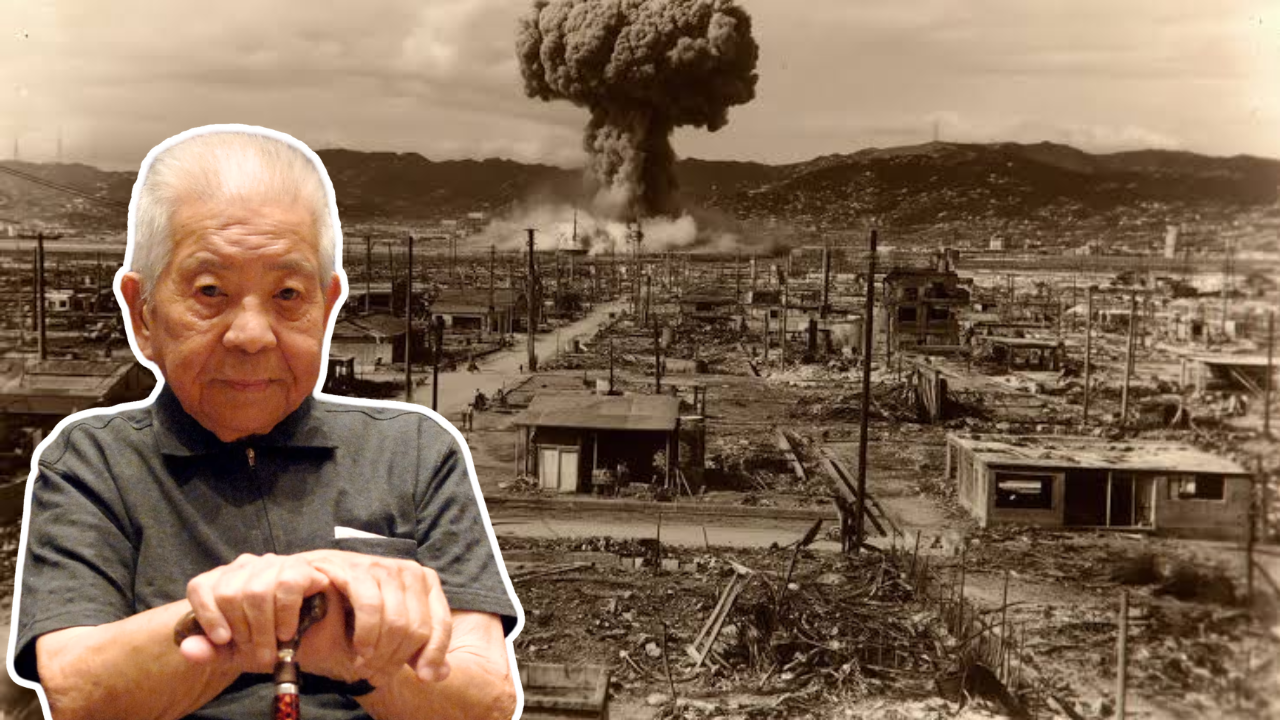
At 8:15 AM, the American B-29 bomber Enola Gay dropped the "Little Boy" atomic bomb. It detonated roughly 580 meters above the city center. Yamaguchi was standing just three kilometers away.
The blinding flash scorched his upper body, ruptured his eardrums, and hurled him into a potato patch. When he regained consciousness, the city he knew had vanished into a monstrous, radioactive black cloud. Entire neighborhoods were burning. Tens of thousands were dead instantly.
Yamaguchi spent a night of terror in a bomb shelter with his coworkers, nursing severe burns and total hearing loss in one ear. The next morning, they navigated streets littered with corpses to reach the train station. They boarded a damaged train and headed south toward home, completely unaware that the nightmare was only halfway done.
Back to Ground Zero in Nagasaki
Yamaguchi arrived in Nagasaki on August 8. He was bandaged, bleeding, and exhausted, but his work ethic refused to let him rest. Despite his injuries, he reported back to the Mitsubishi office on the morning of August 9.
Picture the surreal scene. Sitting across from his supervisor, Yamaguchi tried to explain what he had just witnessed in Hiroshima. He described a weapon so powerful it wiped out an entire city in a single second. His boss looked at him with sheer disbelief, calling him crazy. One bomb could not possibly destroy a metropolis.
At 11:02 AM, while the argument was still hanging in the air, the sky outside turned white.
The US military dropped the "Fat Man" plutonium bomb on Nagasaki. Because Yamaguchi was at work, the office building shielded him from the direct thermal wave, but the blast shattered windows and hurled debris everywhere. He was injured a second time, caught in the radioactive black rain that followed.
Miraculously, his wife and infant son survived as well, though their home was heavily damaged. They spent the next several days hiding in shelters, surrounded by ash, radiation sickness, and unimaginable grief.
The Long Fight for Recognition
For decades, Japanese society rarely talked about the atomic bombings. The survivors, known as hibakusha, faced intense social stigma, discrimination in the job market, and marriage bias out of fear of radiation genetic defects. Yamaguchi kept his head down, worked as an English teacher, returned to Mitsubishi, and tried to build a quiet life.
As he aged, his perspective shifted. He realized that staying silent was a disservice to history.
Yamaguchi began speaking out against nuclear proliferation. In 2006, he published a memoir, wrote poetry about his ordeal, and even traveled to the United Nations to urge world leaders to abolish nuclear weapons.
Official recognition came late. While government records showed that dozens of people experienced both blasts, Yamaguchi was the only person officially certified by the Japanese government as a nijyuu hibakusha—a double atomic bomb survivor—in 2009, just a year before his death at age 93.
What Yamaguchi's Story Teaches Us
People often view historical catastrophes as distant, sterile textbook entries. Yamaguchi’s life reminds us that history is made of individual seconds, missed trains, and broken eardrums.
We live in an era where nuclear stockpiles still pose an existential threat to humanity. Yamaguchi spent his final decades warning that nuclear weapons represent the absolute destruction of human dignity. He didn't view himself as a lucky hero; he saw himself as a reluctant witness to what humanity should never repeat.
Pay attention to the lessons left by those who lived through the worst of human conflict. Study their words, understand the cost of war, and make sure those mistakes stay buried in the past.